
Estimate yearly electricity and dollar savings from replacing a motor, using either one steady load or four yearly load levels.
Table of contents
How to use our Motor Efficiency Savings Calculator
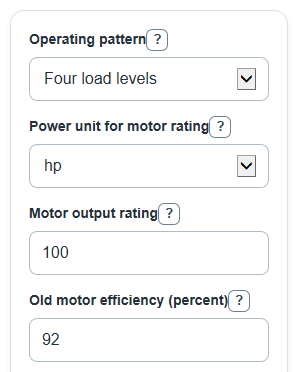
- Choose the Operating pattern: Four load levels for changing loads, or One steady load for a motor that runs at about the same load all year.
- Choose Power unit for motor rating, then enter Motor output rating from the motor nameplate or project spec.
- Enter Old motor efficiency, New motor efficiency, and Electricity price using your expected all-in $ per kWh energy price.
- Enter either Steady load and Annual hours at this load, or the yearly hours in Hours at 25% load, Hours at 50% load, Hours at 75% load, and Hours at 100% load.
- Click Calculate, then sanity-check Average load during entered running hours and the old and new yearly electricity use before using the savings number.
Definitions
Motor output rating: The shaft power the motor is rated to deliver. It is entered in hp or kW based on Power unit for motor rating.
Efficiency: Useful shaft output divided by electrical input power, shown as a percent.
Load: The motor's shaft output at a point in time compared with its rated output. A 75% load means the motor is delivering three-fourths of its rating.
kWh: Kilowatt-hour, a unit of electrical energy used for utility billing [1].
Electricity price: The cost per kWh used to turn energy savings into dollar savings.
Motor loss energy: Electrical energy that does not become useful shaft output. It leaves mostly as heat and other losses.
Average load during entered running hours: The time-weighted average load across the entered hours, so long-running load points count more.
Common mistakes and quick fixes
Mistake: Entering electrical input power in Motor output rating.
Fix: Use the rated shaft output for Motor output rating, and choose the matching Power unit for motor rating.
Mistake: Treating Old motor efficiency or New motor efficiency as a decimal, such as 0.95.
Fix: Enter efficiency as a percent, such as 95 for New motor efficiency.
Mistake: Using Four load levels but leaving Hours at 25% load, Hours at 50% load, Hours at 75% load, and Hours at 100% load all at 0.
Fix: Enter the yearly running hours for at least one load row, or switch Operating pattern to One steady load.
Mistake: Putting weekly or daily runtime into Annual hours at this load.
Fix: Convert runtime to yearly hours before entering Annual hours at this load.
Mistake: Entering a demand-charge or monthly bill amount as Electricity price.
Fix: Enter only the energy price in $ per kWh for Electricity price.
Mistake: Using a Steady load above 100 when the motor is overloaded.
Fix: Keep Steady load between 0 and 100, or use a motor study if overload operation is important.
Limitations & Key Assumptions / Boundary Conditions
- The calculation assumes the old and new motors deliver the same shaft output at each load point.
- Old motor efficiency and New motor efficiency are treated as constant across the entered load points. Real motor efficiency can change with load, voltage, repairs, and drive settings.
- The Four load levels pattern uses fixed load points of 25%, 50%, 75%, and 100%. If your motor often runs near another load, approximate the closest rows or use One steady load.
- Electricity price includes only energy cost in $ per kWh. The calculator does not include demand charges, power factor penalties, taxes, rebates, maintenance savings, purchase cost, or payback time.
- Negative savings are possible. A negative Annual electricity cost saved means the entered new motor efficiency is lower than the old motor efficiency.
- The hp conversion uses mechanical horsepower: 1 hp = 0.745699872 kW.
Methodology
Calculation method
The calculator compares two motors that deliver the same shaft output. Motor efficiency is used to convert shaft output into electrical input power, which is the power the utility meter sees. Electricity use in kWh times Electricity price gives yearly energy cost [1]. The same motor-system energy idea is used in standard motor efficiency work: losses are the input energy that does not become useful output [2].
Formulas
rated_output_kw = motor_power
This line is used when Power unit for motor rating is kW.
rated_output_kw = motor_power * 0.745699872
This line is used when Power unit for motor rating is hp.
shaft_kw_at_point = rated_output_kw * load_percent / 100
input_kw = shaft_kw_at_point / (efficiency_percent / 100)
annual_kwh = sum(input_kw_at_point * hours_at_point)
annual_cost = annual_kwh * electricity_rate
annual_kwh_saved = old_annual_kwh - new_annual_kwh
annual_cost_saved = old_annual_energy_cost - new_annual_energy_cost
annual_loss_heat_reduced_kwh = sum(((old_input_kw - shaft_kw_at_point) - (new_input_kw - shaft_kw_at_point)) * hours_at_point)
average_load_percent = sum(load_percent * hours_at_point) / sum(hours_at_point)
Mini example
For a 100 hp motor, the rated output is 74.5699872 kW. With Four load levels, 1,000 hours at 25%, 1,500 hours at 50%, 2,000 hours at 75%, and 500 hours at 100%, the average load is 60%. If Old motor efficiency is 92%, New motor efficiency is 95%, and Electricity price is $0.12 per kWh, the old motor uses about 243,163.00 kWh per year and the new motor uses about 235,484.17 kWh per year. The Annual electricity use reduced is 7,678.83 kWh per year, and the Annual electricity cost saved is $921.46 per year.
Calculation notes
The calculator validates percent ranges, total hours, negative hours, and malformed comma numbers before doing division. Hidden rows for the other Operating pattern are not read. If New motor efficiency is lower than Old motor efficiency, the savings stay negative so the result shows that the entered new setup costs more to run.