
Enter transformer nameplate values and test losses to estimate efficiency, heat loss, load current, and output power.
Table of contents
How to use our Transformer Loss Calculator
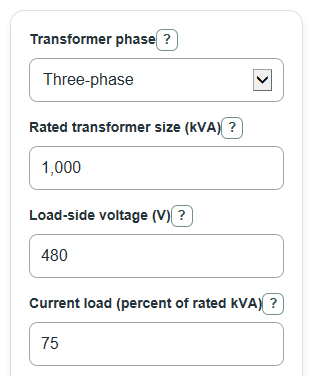
- Choose Transformer phase, then enter Rated transformer size and Load-side voltage from the nameplate or system design.
- Enter Current load as a percent of rated kVA, then enter Load power factor as a decimal from 0 to 1.
- Enter No-load loss and Full-load load loss in watts from a test report, data sheet, or loss table.
- Select Calculate and read Efficiency at this load first, then Total transformer loss at this load and Estimated load-side current.
- Sanity-check the output: load current should rise with Current load, Load loss at this load should rise with the square of Current load, and Real output power at this load should fall if Load power factor is lower.
Definitions
Rated transformer size: The nameplate apparent-power rating in kVA. It is not the same as the current load kW.
Load-side voltage: The voltage on the side feeding the load. For three-phase, this is line-to-line voltage.
Current load: The operating load as a percent of rated kVA. A 75 percent load means the apparent power is 0.75 times the kVA rating.
Load power factor: The fraction of apparent power that becomes real output power. A value of 1.00 means all apparent power is real power.
No-load loss: Core or excitation loss when the transformer is energized with no load connected [2].
Full-load load loss: Winding loss measured or listed at rated current. The calculator scales it by current squared.
Efficiency at this load: Real output power divided by real input power, shown as a percent.
Load where load loss equals no-load loss: The load percent where the simplified model often gives the highest efficiency point.
Common mistakes and quick fixes
Mistake: Entering load kW in Rated transformer size.
Fix: Rated transformer size must be the nameplate kVA rating, such as 1000 for a 1000 kVA transformer.
Mistake: Using phase-to-neutral voltage for Load-side voltage while Transformer phase is three-phase.
Fix: For a three-phase calculation, enter the line-to-line Load-side voltage.
Mistake: Typing 0.75 in Current load when you mean 75 percent.
Fix: Current load uses percent of rated kVA, so enter 75 for 75 percent load.
Mistake: Entering 90 in Load power factor.
Fix: Load power factor must be a decimal from 0 to 1, so enter 0.90 instead of 90.
Mistake: Swapping No-load loss and Full-load load loss.
Fix: No-load loss is the energized transformer loss with no load, while Full-load load loss is the winding loss at rated load.
Mistake: Reading Load where load loss equals no-load loss as a safe overload target.
Fix: Use Load where load loss equals no-load loss only as a simplified efficiency point, not permission to exceed the transformer rating.
Limitations & Key Assumptions / Boundary Conditions
- The loss model treats No-load loss as constant at the entered voltage and treats Full-load load loss as changing with the square of Current load.
- Results depend on the quality of the entered loss values. Test methods, temperature correction, tap position, and voltage can change measured losses.
- Estimated load-side current is based on kVA, voltage, phase, and load percent. It does not include unbalance, harmonics, motor starting current, or protective-device settings.
- Current load may be above 100 percent for what-if checks, but the result is not a recommendation to overload the transformer.
- Load where load loss equals no-load loss is only computed when Full-load load loss is greater than zero.
- Efficiency can be 0 percent at zero load when losses are positive because there is no real output power.
Methodology
How the calculator works
The calculator starts with nameplate-style inputs and test-loss values. Transformer loss testing commonly separates no-load loss from load loss [1]. The entered load percent is treated as apparent-power load, so kVA sets both current and output power before power factor is applied.
load_fraction = Current load / 100
Real output power at this load = Rated transformer size * load_fraction * Load power factor
Load loss at this load = Full-load load loss * load_fraction^2 / 1000
No-load loss used = No-load loss / 1000
Total transformer loss at this load = No-load loss used + Load loss at this load
Real input power needed = Real output power at this load + Total transformer loss at this load
Efficiency at this load = 100 * Real output power at this load / Real input power needed
Load-side current
Current is based on apparent power, not power factor. For single-phase, the calculator divides loaded volt-amperes by voltage. For three-phase, it divides by square root of 3 times the line-to-line voltage.
Single-phase current = Rated transformer size * 1000 * load_fraction / Load-side voltage
Three-phase current = Rated transformer size * 1000 * load_fraction / (sqrt(3) * Load-side voltage)
Best-loss load point
The simplified maximum-efficiency point occurs when scaled load loss equals no-load loss, so the calculator solves that equality as a load percent.
Load where load loss equals no-load loss = 100 * sqrt(No-load loss / Full-load load loss)
Worked mini-example
For a 1000 kVA three-phase transformer at 480 V, 75 percent load, 0.90 power factor, 1500 W no-load loss, and 10000 W full-load load loss, the load fraction is 0.75. Real output power is 1000 * 0.75 * 0.90 = 675 kW. Load loss is 10000 * 0.75^2 / 1000 = 5.625 kW, no-load loss is 1.5 kW, and total loss is 7.125 kW. Input power is 682.125 kW, so efficiency is about 98.96 percent. The three-phase load-side current is about 902.1 A.