
Compare a motor rewind quote with a replacement quote, including energy use, study years, and optional downtime cost.
Table of contents
How to use our Motor Replace vs Rewind Calculator
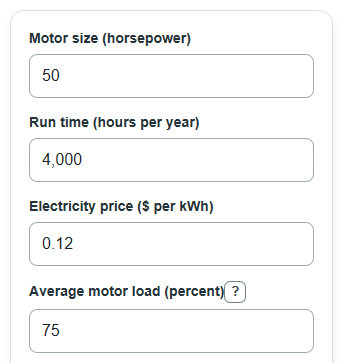
- Enter the motor nameplate value in Motor size, then add Run time, Electricity price, and Average motor load for a normal year.
- Enter Rewind quote, Replacement total cost, Rewound motor efficiency, Replacement motor efficiency, and Compare costs over.
- Open Advanced options only if downtime affects your decision, then enter Downtime cost, Rewind downtime, and Replacement downtime.
- Select Calculate and read Net cost to replace instead of rewind first. Negative favors replacement over the time period; positive favors rewind on cost only.
- Sanity-check the output by comparing Annual energy cost with rewind and Annual energy cost with replacement. If the difference looks too large, recheck load, hours, electricity price, and efficiencies.
Definitions
Motor size: The rated output power on the motor nameplate, entered in horsepower.
Run time: The number of hours the motor is expected to run in one year.
Average motor load: The average share of full motor output used while the motor runs. For example, 75 percent means about three-fourths load.
Efficiency: The percent of electrical input power that becomes useful shaft output power. Higher efficiency means less wasted energy for the same load.
Rewind quote: The quoted cost to repair or rewind the existing motor.
Replacement total cost: The new motor cost plus any install, fit-up, or normal changeout cost you choose to include.
Downtime cost: The estimated cost for each hour the motor is unavailable and that lost time affects production or service.
Payback time: The time needed for yearly energy savings to recover the extra upfront cost of replacement.
Common mistakes and quick fixes
Mistake: Entering Motor size in kilowatts instead of hp.
Fix: Use the horsepower value from the motor nameplate for Motor size.
Mistake: Putting the total monthly bill in Electricity price instead of $ per kWh.
Fix: Use the energy price per kWh from the electric bill for Electricity price.
Mistake: Using 0 or 100 for Average motor load when the motor usually runs partly loaded.
Fix: Enter the best average running load percent in Average motor load, such as 75 for three-fourths loaded.
Mistake: Leaving installation, fit-up, or normal changeout costs out of Replacement total cost.
Fix: Put the full replacement-side cost you want compared in Replacement total cost.
Mistake: Using the old motor nameplate efficiency for Rewound motor efficiency when the repair shop expects a different value after rewind.
Fix: Use the expected post-rewind value for Rewound motor efficiency and the new motor data sheet value for Replacement motor efficiency.
Mistake: Treating Downtime cost as required when production is not affected.
Fix: Leave Downtime cost, Rewind downtime, and Replacement downtime at 0 if downtime is not part of this decision.
Limitations & Key Assumptions / Boundary Conditions
- The calculator assumes the entered Average motor load is steady enough to use one average value for the year.
- Energy cost uses only Electricity price times kWh. It does not include demand charges, time-of-use rates, power factor penalties, or taxes.
- Efficiency values must come from your repair shop, nameplate, or motor data sheet. A poor estimate can change the recommendation.
- Downtime is counted only as Downtime cost times the entered downtime hours. It does not model schedule risk, spare motor availability, or lead-time uncertainty.
- Net cost is a simple study-period comparison. It does not discount future savings, include maintenance differences, or estimate scrap value.
- Study years can be 0. In that case, Net cost to replace instead of rewind equals the upfront cost gap because no yearly operating savings are counted.
Methodology
Calculation steps
The calculator first converts motor horsepower to loaded output power in kilowatts using 0.745699872 kW per hp, then adjusts by Average motor load.
loaded_output_kw = Motor size * 0.745699872 * (Average motor load / 100)
Input power is the electrical power needed to produce that loaded output. The same loaded output is used for the rewound motor and the replacement motor.
input_kw = loaded_output_kw / (efficiency_percent / 100)
Annual energy use and annual energy cost are calculated for both choices.
annual_kwh = input_kw * Run time
annual_energy_cost = annual_kwh * Electricity price
The replacement savings are signed. A positive value means the replacement costs less to run each year. A negative value means it costs more to run each year.
Annual energy cost saved by replacement = Annual energy cost with rewind - Annual energy cost with replacement
Annual energy cut from replacement = annual_rewind_kwh - annual_replacement_kwh
Downtime cost is added to each upfront choice when the advanced downtime fields are used.
rewind_downtime_cost = Downtime cost * Rewind downtime
replace_downtime_cost = Downtime cost * Replacement downtime
The upfront cost gap keeps its sign. Positive means replacement costs more before energy savings. Negative means replacement costs less upfront.
Upfront cost to replace instead of rewind = Replacement total cost + replace_downtime_cost - Rewind quote - rewind_downtime_cost
The main result subtracts study-period energy savings from the upfront gap.
Net cost to replace instead of rewind = Upfront cost to replace instead of rewind - Annual energy cost saved by replacement * Compare costs over
Simple payback is shown only when replacement costs more upfront and saves energy each year.
Payback time for the extra replacement cost = Upfront cost to replace instead of rewind / Annual energy cost saved by replacement * 12
Mini-example
For a 50 hp motor running 4,000 hours per year at 75 percent load, with electricity at $0.12 per kWh, a $3,000 rewind quote, a $6,000 replacement total cost, 91 percent rewound efficiency, 95 percent replacement efficiency, and 5 study years, the upfront replacement gap is $3,000. The replacement saves about 5,175 kWh per year and about $621 per year. Over 5 years, the net cost to replace instead of rewind is about -$105, so replacement is slightly lower cost in this setup.