
Estimate solar street light power, panel size, battery capacity, pole spacing, and light count from your road size and brightness goal.
Advanced options
Table of contents
How to use our Solar Street Light Size Calculator
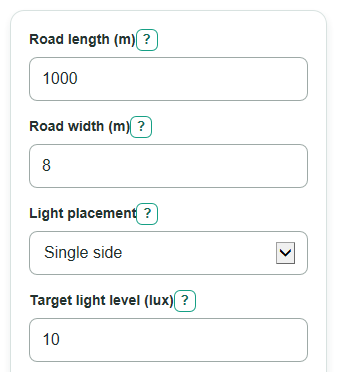
- Enter Road length, Road width, Light placement, Target light level, and Lighting time each night for the section you want to light.
- Open Advanced options only if you want to change Cloudy-day backup, Peak sun hours per day, Solar charging losses, Battery voltage, or light performance assumptions.
- Click Calculate to get the Recommended LED power per light, Recommended solar panel per light, Recommended battery capacity per light, and layout estimates.
- Sanity-check the output by changing Target light level or Peak sun hours per day. Higher lux should raise LED, panel, and battery sizes. Lower sun hours should raise panel size.
- Round the Recommended LED power per light, Recommended solar panel per light, and Recommended battery capacity per light up to real products, then have final road safety and code details checked before building.
Definitions
Target light level: The average brightness goal on the road surface, entered in lux.
Lux: A light level unit. One lux means one lumen reaching one square meter.
Fixture lumens per light: The estimated starting light output each fixture needs before converting lumens to LED watts.
LED output per watt: How many lumens the LED makes for each watt of electric power, shown as lm/W.
Peak sun hours per day: A simplified way to describe daily solar energy as the same energy from a smaller number of full-sun hours.
Solar charging losses: The percent of panel energy not stored usefully because of heat, dirt, wiring, controller losses, and other real-world effects.
Cloudy-day backup: The number of low-sun nights the battery is sized to cover.
Usable battery share: The percent of battery capacity the design allows you to use before recharging.
Common mistakes and quick fixes
Mistake: Entering Road length for only one block when the whole lit road is longer.
Fix: Use the full Road length for the section covered by this calculation, or calculate each section separately.
Mistake: Using Road width for the total property width instead of the paved area to be lit.
Fix: Enter the paved Road width that should receive the Target light level.
Mistake: Choosing Single side under Light placement when poles will be on both sides.
Fix: Select Both sides, opposite each other or Both sides, staggered so Total lights needed and Estimated pole height match the layout.
Mistake: Treating Target light level as fixture lumens.
Fix: Enter Target light level in lux. Fixture lumens per light is calculated from lux, area, losses, and Total lights needed.
Mistake: Leaving Peak sun hours per day at the default for a cloudy or shaded site.
Fix: Change Peak sun hours per day to a local planning value. Lower sun hours increase the Recommended solar panel per light.
Mistake: Setting Usable battery share to 100 percent for a battery that should not be fully drained.
Fix: Enter the planned Usable battery share. A lower share raises the Recommended battery capacity per light.
Limitations & Key Assumptions / Boundary Conditions
- This calculator is for early planning. Final roadway lighting design can require checks for uniformity, glare, intersections, crosswalks, curves, trees, signs, and local rules.
- Estimated pole height uses a simple rule: single-side lighting uses the road width, and both-side lighting uses half the road width. Real pole height depends on the fixture optics and mounting hardware.
- The lux method uses an average-area estimate. It does not model a photometric file, beam pattern, spill light, shadows, pavement reflection, or exact light distribution.
- Recommended solar panel per light depends strongly on Peak sun hours per day and Solar charging losses. Shade, panel angle, dust, high heat, and winter weather can change real output.
- Recommended battery capacity per light is based on Battery voltage, Cloudy-day backup, Usable battery share, and average nightly power. Battery chemistry, temperature, aging, and controller settings can require a larger battery.
- Average brightness used assumes you know the average dimming share across the night. If the light runs at full power all night, leave it at 100 percent.
- Product sizes are sold in steps. Round LED power, panel watts, and battery amp-hours up to available equipment after reviewing manufacturer data.
Methodology
Layout calculation
The calculator first estimates pole height from Road width and Light placement. For Single side, the pole height equals the road width. For both-side layouts, the pole height equals half the road width.
pole_height_m = road_width_m
pole_height_m = road_width_m / 2
Next it estimates a planned spacing from the pole height and Spacing factor. The light count is rounded up so the average spacing is not larger than the planned spacing.
planned_spacing_m = pole_height_m * spacing_factor
lights_per_row = ceil(road_length_m / planned_spacing_m)
total_lights_count = lights_per_row * row_count
actual_spacing_m = road_length_m / lights_per_row
Light and energy sizing
The lumen estimate uses the basic lux relationship: lux is lumens per square meter. The calculator spreads the target road light over the road area, then adjusts for Light reaching the road and Dirt and aging factor.
fixture_lumens_per_light = (target_lux * road_length_m * road_width_m) / (utilization_factor * light_loss_factor * total_lights_count)
LED power is the fixture lumen need divided by LED output per watt.
recommended_led_power_w = fixture_lumens_per_light / led_efficacy_lm_w
Daily energy use is the LED power times Lighting time each night, adjusted by Average brightness used.
daily_energy_wh_per_light = recommended_led_power_w * nightly_hours * (average_brightness_percent / 100)
The solar panel estimate divides daily energy by daily sun input after Solar charging losses.
recommended_solar_panel_w = daily_energy_wh_per_light / (peak_sun_hours * (1 - system_loss_percent / 100))
The battery estimate stores enough watt-hours for Cloudy-day backup, then converts watt-hours to amp-hours using Battery voltage.
recommended_battery_ah = (daily_energy_wh_per_light * autonomy_days / (depth_of_discharge_percent / 100)) / battery_voltage
Total LED load is the per-light LED power times the total light count.
total_project_led_load_w = recommended_led_power_w * total_lights_count
Worked mini-example
For a 1000 m long road, 8 m Road width, Single side placement, 10 lux Target light level, 12 hours Lighting time each night, 2 Cloudy-day backup days, 4.5 Peak sun hours per day, 20 percent Solar charging losses, 12 V Battery voltage, 80 percent Usable battery share, 3.5 Spacing factor, 160 lm/W LED output, 0.40 Light reaching the road, and 0.80 Dirt and aging factor, the estimated pole height is 8 m. Planned spacing is 28 m, so lights per row is ceil(1000 / 28) = 36 and Total lights needed is 36.
The road area is 8000 square meters. Fixture lumens per light is (10 * 1000 * 8) / (0.40 * 0.80 * 36) = 6944.4 lm. Recommended LED power per light is 6944.4 / 160 = 43.4 W. Daily energy use per light is 43.4 * 12 = 520.8 Wh/day. Recommended solar panel per light is 520.8 / (4.5 * 0.80) = 144.7 W. Recommended battery capacity per light is (520.8 * 2 / 0.80) / 12 = 108.5 Ah.
Roadway lighting guidance normally evaluates more than average lux, including context and lighting application needs [1]. This calculator does not replace a photometric plan or permit review.