
Enter a total light loss factor or separate retained-light factors to calculate how much initial light remains and how much is expected to be lost.
This is the share of initial light expected to remain after all entered factors are multiplied.
This is the retained-light share, not the percentage lost.
This is 100 percent minus the retained-light percentage.
This is an estimate under the entered factors, not a final room-lighting result.
This does not check uniformity, glare, or code requirements.
This does not check uniformity, glare, or code requirements.
Table of contents
How to use our Light Loss Factor Calculator
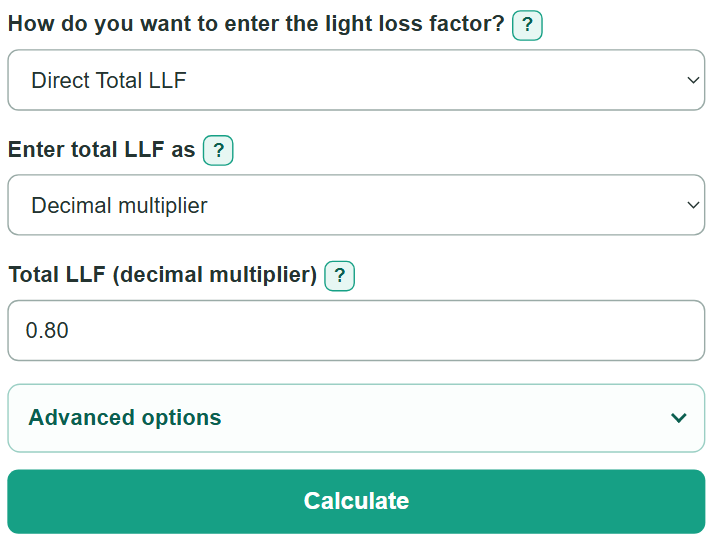
- Choose "Direct Total LLF" when a lighting worksheet, schedule, specification, or earlier calculation already gives an overall LLF.
- In "Enter total LLF as," choose the form used by your source. Enter a decimal such as 0.80, or choose retained-light percent before entering 80.
- Choose "Detailed Component Product" when you have separate factors. Enter the required lamp or LED, fixture dirt, and room-surface factors as decimals from 0 to 1.
- Enter "Lamps still operating" only when failed lamps may stay unreplaced during the maintenance period. Leave it blank when it does not apply.
- Open "Advanced options" to add a documented driver, ballast, or other factor, or to estimate maintained lumens, footcandles, or lux from an initial value.
- Select "Calculate." Read "Total light loss factor" first. Then check that the retained-light and light-loss percentages add to 100%.
- If you chose the wrong entry form before typing a value, select the correct form and re-enter the original value. Changing the form converts an already correct valid value.
Definitions
Light loss factor (LLF): A ratio of light under stated conditions to initial light under rated conditions. Some lighting material calls it a maintenance factor. [1]
Retained-light factor: A decimal multiplier from 0 to 1 that shows the share of initial light expected to remain. For example, 0.90 means 90% remains.
Lumen maintenance factor: The share of a lamp's or LED's initial light output expected to remain after a stated operating time.
Lamp survival factor: The share of lamps expected to still operate when failed lamps are not immediately replaced.
Luminaire maintenance factor: The share of useful light remaining after dirt on a fixture reduces or redirects light.
Room-surface maintenance factor: The share of useful reflected light remaining after dirt affects room surfaces.
Lumens: A measure of total light output.
Footcandles and lux: Measures of illuminance, meaning light arriving on a surface. Do not mix these values with lumens.
Common mistakes and quick fixes
Mistake: Entering 80 while "Enter total LLF as" is set to decimal multiplier.
Fix: Enter 0.80 as a decimal multiplier, or select retained-light percent before entering 80.
Mistake: Reading an LLF of 0.80 as 80% light loss.
Fix: An LLF of 0.80 means 80% of the initial light remains and 20% is expected to be lost.
Mistake: Using a dirt or maintenance factor from a different fixture, room, operating period, or cleaning plan.
Fix: Use values documented for the actual luminaire, environment, maintenance plan, and planned operating time.
Mistake: Treating lumens, footcandles, and lux as interchangeable.
Fix: Keep each value in its matching optional field. Lumens measure light output, while footcandles and lux measure light arriving on a surface.
Mistake: Adding a factor already included in a supplied total LLF or another detailed factor.
Fix: Include each allowance once in detailed mode. In direct mode, do not multiply extra component factors into the supplied total.
Limitations & Key Assumptions / Boundary Conditions
- This is a planning calculation. It does not perform a photometric layout, check glare or uniformity, or confirm code compliance.
- The answer depends on the entered factors. Light-source aging, lamp failures, dirt, cleaning, room surfaces, operating time, and equipment settings can change maintained light.
- Use direct entry only when the supplied total LLF applies to the same fixture, environment, maintenance plan, and operating period.
- Blank optional survival, driver or ballast, and other factors are treated as 1, so they cause no additional reduction.
- Maintained lumens, footcandles, and lux are calculated by applying LLF to the initial value entered. They do not convert units or predict lighting at a different location.
Methodology
Calculation method
The calculator treats LLF as the share of initial light expected to remain. In direct mode, a decimal multiplier is used as entered, while a retained-light percentage is divided by 100.
total LLF = entered retained-light percent / 100
In detailed mode, the required retained-light factors are multiplied. A blank optional lamp-survival, driver or ballast, or other factor uses 1, which does not change the product.
total LLF = lamp or LED factor × lamp survival factor × fixture dirt factor × room-surface factor × driver or ballast factor × other factor
The calculator then converts the LLF into complementary percentages.
retained light (%) = total LLF × 100
light lost (%) = (1 - total LLF) × 100
If an optional initial light value is entered, the calculator applies the same LLF to that value.
maintained light = initial light × total LLF
Worked example
Suppose the factors are 0.90 for lamp or LED light remaining, 0.98 for lamps still operating, 0.85 for fixture dirt, 0.95 for room-surface dirt, 0.96 for the driver, and 0.99 for another documented factor. Their product is 0.676889136. That means 67.6889% of initial light remains and 32.3111% is expected to be lost. With 1,000 initial lumens, the maintained estimate is 676.89 lumens.