
Estimate yearly heating savings and payback for basement walls, rim joists, or slab floors using your area, climate, fuel, and R-values.
Table of contents
How to use our Basement Insulation Savings Calculator
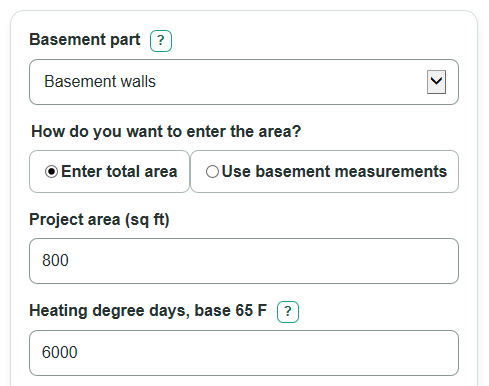
- Choose Basement part, then choose How do you want to enter the area? Use Project area if you already measured it, or use basement measurements for the helper.
- Enter only the active measurement fields, such as Basement perimeter and Basement wall height for walls, Rim joist height for a rim joist, or Slab length and Slab width for a slab floor.
- Enter Heating degree days, base 65 F, Current R-value, New total R-value, Heating fuel, Fuel price, and Heating system efficiency. Use 100 percent efficiency for electric resistance heat.
- Open Advanced options if you want to change Weather exposure, add Project cost for Simple payback time, or include a Yearly fuel price increase in the 10-year total.
- After you calculate, sanity-check Estimated insulation area and Estimated fuel saved per year against your measurements and fuel bills before using the dollar savings for a budget decision.
Definitions
Basement part: The surface being insulated: basement walls, the rim joist or band joist, or the basement slab floor.
Project area: The square footage that will receive new insulation.
Heating degree days, base 65 F: A climate number that counts how much and how often outdoor temperatures are below 65 F during the heating season.
R-value: A measure of how well a material slows heat flow. Higher R-value means less heat passes through for the same temperature difference.
U-value: Heat flow rate through a surface. In this calculator, U-value is 1 divided by R-value.
Heating system efficiency: The percent of fuel heat that becomes useful heat in the home. AFUE is commonly used for furnaces and boilers.
Weather exposure: The percent of the surface treated like it faces outdoor weather in the heat-loss estimate. Lower values make the estimate more cautious for ground-contact surfaces.
MMBtu: One million Btu. It is used here to show the yearly heat loss cut in a readable size.
Common mistakes and quick fixes
Mistake: Using the whole house floor size for Project area when only part of the basement is being insulated.
Fix: Enter only the area that gets new insulation, or use basement measurements and check Estimated insulation area.
Mistake: Entering the added insulation only in New total R-value.
Fix: New total R-value should include the existing surface plus the added insulation, not just the new layer.
Mistake: Using a monthly fuel bill for Fuel price.
Fix: Enter the unit price: $ per therm for natural gas, $ per gallon for oil or propane, or $ per kWh for electric heat.
Mistake: Leaving Heating system efficiency at 90 percent for electric resistance heat.
Fix: Use 100 for Heating system efficiency when Heating fuel is electric resistance.
Mistake: Treating Weather exposure as exact for a slab floor or below-grade wall.
Fix: Try a lower and higher Weather exposure value to see how much Estimated heating cost saved per year changes.
Mistake: Reading Simple payback time when Estimated heating cost saved per year is zero or negative.
Fix: Check Current R-value and New total R-value; payback only makes sense when the upgrade saves money each year.
Limitations & Key Assumptions / Boundary Conditions
- The calculator uses a simple steady-state R-value and heating degree day method. It does not model air leaks, wind, solar heat, thermal bridges, moisture, or thermostat schedules.
- Weather exposure is a user choice. A slab floor or below-grade wall may act less like outdoor air than an exposed wall, so changing Weather exposure can change savings a lot.
- Heating degree days, base 65 F should match your location as closely as possible. A nearby city or old weather data can move the estimate up or down.
- Fuel price should be the marginal unit price you pay for heat, not a whole utility bill with fixed fees unless you want a rougher estimate.
- Heating fuel heat content uses standard conversion values. Real fuel deliveries, gas billing units, and equipment performance can vary.
- Ten-year savings use the Yearly fuel price increase you enter and are not discounted to present value.
- A negative Estimated heating cost saved per year is allowed. It means New total R-value is lower than Current R-value, so the project would increase estimated heating use.
Methodology
Area used
The calculator uses Project area directly when you choose Enter total area. When you choose Use basement measurements, it switches the area math based on Basement part.
area_sqft = project_area_sqft
area_sqft = basement_perimeter_ft * wall_height_ft
area_sqft = basement_perimeter_ft * (rim_joist_height_in / 12)
area_sqft = slab_length_ft * slab_width_ft
Heat saved
The heat-loss cut is based on the change in U-value. Since U-value equals 1 divided by R-value, the savings come from the difference between the old and new U-values. Heating degree days are multiplied by 24 to convert days to degree-hours.
heat_saved_btu = area_sqft * hdd65 * 24 * (1 / current_r_value - 1 / new_r_value) * (weather_exposure_percent / 100)
heat_loss_cut_mmbtu = heat_saved_btu / 1000000
Fuel and cost saved
The calculator converts heat saved into fuel units using the selected Heating fuel and Heating system efficiency. The fuel heat content values are 100000 Btu per therm for natural gas, 138500 Btu per gallon for heating oil, 91500 Btu per gallon for propane, and 3412 Btu per kWh for electric resistance heat [3].
fuel_units_saved = heat_saved_btu / (fuel_btu_per_unit * (heating_efficiency_percent / 100))
annual_cost_saved = fuel_units_saved * fuel_price
10-year savings and payback
Let g be Yearly fuel price increase divided by 100. If g is 0, the calculator multiplies first-year savings by 10. Otherwise, it uses a simple escalating total.
if g = 0: ten_year_cost_saved = annual_cost_saved * 10
if g is not 0: ten_year_cost_saved = annual_cost_saved * (((1 + g) ^ 10 - 1) / g)
simple_payback_years = project_cost / annual_cost_saved
Simple payback time is shown only when Project cost is entered and Estimated heating cost saved per year is positive.
Worked example
For Project area = 800 sq ft, Heating degree days, base 65 F = 6000, Current R-value = 5, New total R-value = 15, Weather exposure = 100 percent, natural gas heat content = 100000 Btu per therm, Heating system efficiency = 90 percent, and Fuel price = $1.50 per therm, the heat saved is 15360000 Btu, or 15.36 MMBtu.
heat_saved_btu = 800 * 6000 * 24 * (1 / 5 - 1 / 15) * 1 = 15360000
Fuel saved is 170.67 therms, so Estimated heating cost saved per year is about $256. With no Yearly fuel price increase, Estimated heating cost saved over 10 years is $2560. If Project cost is $2400, Simple payback time is about 9.4 years.
Sources
- U.S. DOE Building America - Measure Guideline: Basement Insulation Basics (savings examples) - Energy
- U.S. DOE EERE - High-Performance Slab-on-Grade Foundation Insulation Retrofits (alternate host PDF) - Energy
- 7.9: Insulation and Home Heating Fuels (V) - Engineering LibreTexts - Libretexts
- BSD-103: Understanding Basements | buildingscience.com - Buildingscience