
Estimate solar panels, batteries, inverter size, controller current, and weak-month coverage from your off-grid daily energy use.
Table of contents
How to use our Off-Grid Solar System Size Calculator
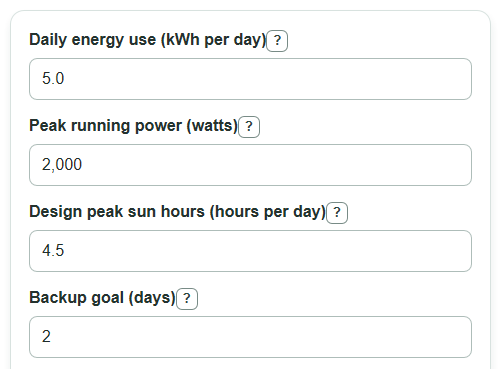
- Enter Daily energy use in kWh/day and Peak running power in watts for the loads that may run at the same time.
- Enter Design peak sun hours, Backup goal, and Battery system voltage for the system you plan to build.
- Open Advanced options if you want to change Solar system losses, Usable battery limit, headroom values, Highest startup surge, or Monthly peak sun hours, Jan to Dec.
- Click Calculate and read Recommended solar array size first, then check Worst-month daily energy margin and Months below daily energy need.
- Sanity-check the output by comparing Lowest monthly energy covered with your Daily energy use; if it is lower, plan for more panels, lower loads, or backup charging in those months.
Definitions
Daily energy use: The energy your loads use in one day, measured in kilowatt-hours per day (kWh/day).
Peak running power: The highest steady watts that may be running at the same time.
Design peak sun hours: The daily sunlight amount expressed as the same energy as full-strength sun for that many hours.
Backup goal: The number of days the battery should cover your Daily energy use without new solar charging.
Solar system losses: The percent of panel energy not delivered as useful stored or used energy after heat, wiring, dust, controller, battery, and inverter effects.
Usable battery limit: The percent of the battery bank you plan to use before recharging.
Battery bank size before usable limit: The rated battery energy needed so the usable part can meet the Backup goal.
Worst-month daily energy margin: The lowest monthly solar energy covered minus Daily energy use, in kWh/day. A negative value means a shortfall.
Charge controller current: The estimated controller amp rating needed for the array at the selected Battery system voltage.
Common mistakes and quick fixes
Mistake: Entering appliance watts as Daily energy use.
Fix: Daily energy use must be kWh/day, so multiply watts by hours used per day and divide by 1000.
Mistake: Using total daily load for Peak running power.
Fix: Peak running power is only the watts that may be on at the same time.
Mistake: Leaving Design peak sun hours at an average value when winter is the real concern.
Fix: Put local Monthly peak sun hours, Jan to Dec in Advanced options and review Worst-month daily energy margin.
Mistake: Setting Solar system losses to 0 percent because the panels are new.
Fix: Use a realistic Solar system losses value for heat, wiring, dust, conversion losses, and charging losses.
Mistake: Setting Usable battery limit to 100 percent without checking the battery guidance.
Fix: Adjust Usable battery limit to the amount of battery capacity you actually plan to use.
Mistake: Ignoring Highest startup surge for pumps, compressors, or tools.
Fix: Enter Highest startup surge and compare it with Startup surge to cover before choosing an inverter.
Limitations & Key Assumptions / Boundary Conditions
- This is a planning estimate for main component sizing. It does not replace a code-compliant electrical design.
- Monthly results depend on the Monthly peak sun hours, Jan to Dec values you enter. Bad sun-hour data gives bad seasonal results.
- The array calculation uses one Solar system losses percent for all months. Real losses vary with temperature, shading, dirt, wire length, and equipment.
- The battery calculation sizes energy storage from Daily energy use, Backup goal, and Usable battery limit. It does not model battery age, cold-weather capacity loss, charge rate limits, or manufacturer warranty rules.
- The inverter check uses Peak running power, Inverter headroom, and Highest startup surge. Real inverter surge ratings depend on the model and the time duration of the surge.
- The Charge controller current estimate assumes the controller is matched to the selected Battery system voltage. String voltage, controller voltage limits, wire sizing, fuses, breakers, grounding, and local code still need separate checks.
- If Backup goal is 0 days, Battery bank size before usable limit can be 0 kWh because the autonomy target asks for no stored backup energy.
Methodology
Panel size
The calculator sizes the solar array from Daily energy use, Design peak sun hours, and Solar system losses. The basic idea follows common PV sizing practice: pick the load goal, choose a solar resource value, and include system losses before selecting equipment [1].
array_w = daily_energy_kwh * 1000 / (peak_sun_hours * (1 - solar_loss_percent / 100))
The 1000 factor converts kWh to Wh. Solar system losses must be less than 100 percent because 100 percent losses would leave no usable solar energy.
Monthly solar check
The calculator uses the same Recommended solar array size and Solar system losses for each value in Monthly peak sun hours, Jan to Dec.
monthly_energy_kwh[i] = array_w * monthly_sun_hours[i] * (1 - solar_loss_percent / 100) / 1000
worst_month_energy_margin_kwh = min(monthly_energy_kwh[i] - daily_energy_kwh)
months_below_daily_need = count(monthly_energy_kwh[i] < daily_energy_kwh)
Worst-month daily energy margin keeps its sign. Positive means the weakest entered month still covers the daily load. Negative means the array falls short by that many kWh/day in the weakest month.
Battery size
Battery bank size before usable limit is based on the desired Backup goal and the usable part of the battery bank.
battery_bank_nominal_kwh = daily_energy_kwh * autonomy_days / (battery_usable_percent / 100)
battery_bank_capacity_ah = battery_bank_nominal_kwh * 1000 / battery_voltage
Amp-hours depend on Battery system voltage, so the same kWh battery bank has fewer Ah at 48 V than at 12 V.
Inverter and controller size
The inverter continuous rating adds headroom to Peak running power. Startup surge to cover is the larger of Highest startup surge and the continuous inverter size.
inverter_continuous_rating_w = peak_running_w * (1 + inverter_headroom_percent / 100)
startup_surge_to_cover_w = max(surge_w, inverter_continuous_rating_w)
The charge controller current uses the power-current relationship for electric systems, where power equals voltage times current [2].
charge_controller_current_a = array_w / battery_voltage * (1 + controller_headroom_percent / 100)
Mini-example
For Daily energy use of 5 kWh/day, Design peak sun hours of 4.5, Solar system losses of 25 percent, Backup goal of 2 days, Usable battery limit of 80 percent, and Battery system voltage of 48 V, the Recommended solar array size is about 1,481 W. With monthly sun hours of 3.2, 3.8, 4.6, 5.4, 5.9, 6.1, 6.0, 5.6, 4.9, 4.0, 3.4, and 3.0, the lowest covered energy is about 3.33 kWh/day. The Worst-month daily energy margin is 3.33 minus 5, or -1.67 kWh/day, and 5 months are below the daily need.
Sources
- U.S. DOE EERE - A Consumer's Guide (PV system sizing & goals) (PDF) - Energy
- How to Size Your Off-Grid Solar System | The Off-Grid Workshop - Theoffgridworkshop
- [2409.05086] Exploring the Optimal Size of Grid-forming Energy Storage in an Off-grid Renewable P2H System under Multi-timescale Energy Management - Arxiv
- [1402.2833] Features of a fully renewable US electricity system: Optimized mixes of wind and solar PV and transmission grid extensions - Arxiv