
Estimate a practical grid-tied solar inverter size from your panel wattage, panel count, and preferred panel-to-inverter ratio.
Table of contents
How to use our Solar Inverter Size Calculator
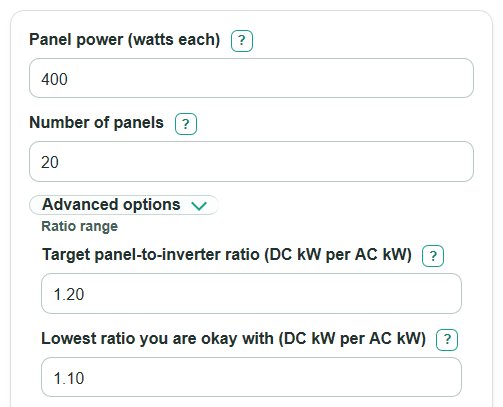
- Enter Panel power (watts each) using the watt rating printed on one solar panel.
- Enter Number of panels for the panels connected to this inverter or inverter group.
- Open Advanced options only if you want to change the Target panel-to-inverter ratio, ratio range, inverter efficiency, or Common inverter sizes (kW AC) list.
- Click Calculate, then use Best common inverter size as the practical shopping-size result and compare it with Exact calculated target.
- Sanity-check the answer by looking at Ratio with the common size and Fit check; if the ratio is outside your selected range, adjust the common-size list or ratio limits.
Definitions
Panel power (watts each): The DC nameplate watt rating for one solar panel, such as 400 W.
Panel array size: The total DC nameplate size of the panels connected to the inverter, shown in kW DC.
kW DC: Kilowatts of direct-current panel capacity before the inverter changes the power to AC.
kW AC: Kilowatts of alternating-current inverter output capacity, which is the side used by home wiring and the grid.
Target panel-to-inverter ratio: Panel array kW DC divided by inverter kW AC. A ratio above 1 means the panel nameplate total is larger than the inverter AC rating.
Common inverter sizes (kW AC): The editable list of inverter sizes the calculator can choose from for the practical recommendation.
Rough clipping-start point: A simple estimate of the DC input level where the selected inverter may start capping AC output.
Common mistakes and quick fixes
Mistake: Using total array watts in Panel power (watts each) instead of one panel's watt rating.
Fix: Put the watt rating for one panel in Panel power (watts each) and put the panel total count in Number of panels .
Mistake: Counting panels connected to a different inverter in Number of panels .
Fix: Count only the panels served by this inverter or inverter group before reading Panel array size .
Mistake: Setting Target panel-to-inverter ratio to 1 because the panel total feels like it must equal the inverter size.
Fix: Use the ratio you actually want to test, then check Fit check and Ratio with the common size .
Mistake: Leaving a needed model size out of Common inverter sizes (kW AC) .
Fix: Add the kW AC size you are considering to Common inverter sizes (kW AC) so Best common inverter size can choose it.
Mistake: Reading Rough clipping-start point as a full energy-loss forecast.
Fix: Treat Rough clipping-start point as a simple cap estimate, then use design software or installer modeling for expected annual clipping.
Limitations & Key Assumptions / Boundary Conditions
- This calculator sizes grid-tied inverter AC capacity from panel nameplate watts. It does not size a battery backup inverter for home loads.
- It does not check string voltage, module current, wire size, breaker size, rapid shutdown, interconnection limits, or electrical code compliance.
- It does not check a manufacturer's maximum allowed DC oversizing, MPPT voltage range, or approved equipment list.
- The clipping-start estimate uses one efficiency percent and does not model hourly weather, shade, panel direction, temperature, soiling, or wiring losses.
- The common-size result can only pick from the sizes you enter in Common inverter sizes (kW AC). Add real model sizes if you want a shopping comparison.
- Panel nameplate ratings are measured under standard test conditions, so live power output can be lower or higher for short periods depending on site conditions.
Methodology
How the calculation works
The calculator first turns one-panel wattage and panel count into a total DC panel array size.
array_size_kw_dc = panel_watts * panel_count / 1000
It then divides that array size by the target panel-to-inverter ratio to get an exact inverter target in kW AC.
recommended_inverter_kw_ac = array_size_kw_dc / target_dc_ac_ratio
Because real inverter models come in set sizes, the calculator checks each positive number in Common inverter sizes (kW AC).
ratio_for_size = array_size_kw_dc / size_kw_ac
eligible size: min_ok_ratio <= ratio_for_size and ratio_for_size <= max_ok_ratio
Among eligible sizes, it chooses the size closest to the exact target. If two sizes are equally close, it chooses the larger size. If no listed size fits the selected range, it still chooses the closest listed size and the fit check explains that the ratio is outside your range.
dc_ac_ratio_with_suggested = array_size_kw_dc / suggested_common_inverter_kw_ac
The rough clipping-start point divides the chosen inverter AC size by the efficiency as a decimal.
clipping_start_dc_kw = suggested_common_inverter_kw_ac / (inverter_efficiency_percent / 100)
Worked example
With 20 panels at 400 W each, the array size is 400 * 20 / 1000 = 8.00 kW DC. With a target ratio of 1.20, the exact inverter target is 8.00 / 1.20 = 6.67 kW AC. From the default common-size list, 6 kW AC gives a ratio of 8.00 / 6.00 = 1.33, which lands inside the default 1.10 to 1.35 range. With 96 percent efficiency, the rough clipping-start point is 6.00 / 0.96 = 6.25 kW DC.
How the fit check is chosen
If Ratio with the common size is below Lowest ratio you are okay with, the calculator says the inverter is larger than your selected range. If it is above Highest ratio you are okay with, it says the inverter is smaller than your selected range and may clip more often. Otherwise, it says the inverter lands inside your selected range.