
Estimate how long your battery bank can run an AC load through an inverter before you need to recharge.
Table of contents
How to use our Inverter Battery Runtime Calculator
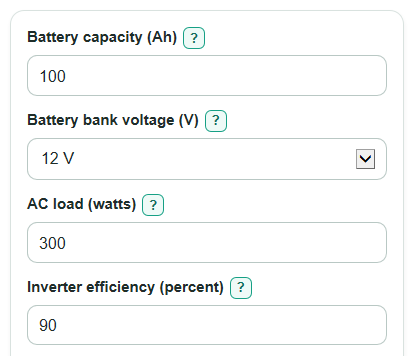
- Enter Battery capacity (Ah) from the battery label. If batteries are in parallel, add the Ah ratings; if they are in series, keep Ah the same and choose the higher Battery bank voltage (V).
- Choose Battery bank voltage (V), then enter AC load (watts) using the running watts of the devices, not the short startup surge.
- Enter Inverter efficiency (percent) and Battery you plan to use (percent). Use the inverter manual and battery maker limits when you have them.
- Open Advanced options if the load cycles on and off, the inverter has idle draw, or you want Shorten result for a safety margin (percent).
- Check Average outlet load and Average battery power draw. If they look too low or too high, recheck duty cycle, watts, and whether the load is really always on.
Definitions
Battery capacity (Ah): Amp-hours on the battery label. It says how much electric charge the battery can deliver under its rating conditions.
Battery bank voltage (V): The nominal voltage feeding the inverter, such as 12 V, 24 V, or 48 V.
AC load (watts): The running outlet power used by the devices plugged into the inverter.
Watt-hour (Wh): A unit of energy. One watt-hour means using 1 watt for 1 hour.
Inverter efficiency (percent): The share of battery power that becomes usable AC outlet power. Losses turn into heat.
Device runs this much of the time (percent): The duty cycle, or the percent of time a device is on. A 40% setting means about 24 minutes per hour.
Inverter idle power (watts): Battery-side power the inverter uses just to stay on, even when the outlet load is small or off.
Estimated battery current: The average amps drawn from the battery bank at the selected voltage.
Common mistakes and quick fixes
Mistake: Entering startup surge in AC load (watts) instead of running watts.
Fix: Use the normal running watts for AC load (watts), then separately make sure the inverter can handle surge.
Mistake: Adding Battery capacity (Ah) for batteries wired in series.
Fix: For series batteries, keep Battery capacity (Ah) the same and choose the higher Battery bank voltage (V).
Mistake: Leaving Device runs this much of the time (percent) at 100 for a fridge, pump, or other cycling load.
Fix: Estimate the percent of each hour the device is actually on so Average outlet load is not overstated.
Mistake: Ignoring Inverter idle power (watts) for a small load like a router or CPAP.
Fix: Enter the no-load watts from the inverter manual so Average battery power draw includes idle use.
Mistake: Setting Battery you plan to use (percent) to 100 because the label shows the full rating.
Fix: Use the share you are willing to discharge before recharging, based on battery type and maker guidance.
Mistake: Treating Planning runtime as a guarantee.
Fix: Add Shorten result for a safety margin (percent) if the battery is old, cold, heavily loaded, or the appliance watts are uncertain.
Limitations & Key Assumptions / Boundary Conditions
- The result uses nominal Battery bank voltage (V). Real battery voltage changes with charge level, load, temperature, and battery chemistry.
- Battery capacity (Ah) is treated as available at the label rating. Lead-acid batteries can deliver less usable energy at high current than their label suggests.
- Inverter efficiency (percent) is treated as one constant value. Real efficiency changes with load level and inverter design.
- Inverter idle power (watts) is added as battery-side power and is treated as constant while the inverter is on.
- AC load (watts) should be running watts. This calculator does not test whether the inverter can handle startup surge.
- Estimated battery current is an average planning number. It is not a cable, fuse, or safety-code sizing tool.
- Very long runtimes from tiny loads are less reliable because self-discharge, standby behavior, and battery management cutoffs start to matter more.
Methodology
Core calculation
The calculator first converts the battery label rating into usable energy. Amp-hours times volts gives watt-hours, then the usable battery percent keeps only the share you plan to use.
usable_battery_energy_wh = battery_capacity_ah * battery_voltage_v * (usable_battery_percent / 100)
Next it adjusts the outlet load for devices that cycle on and off.
average_ac_load_watts = ac_load_watts * (duty_cycle_percent / 100)
Then it estimates the average power drawn from the battery. The outlet load is divided by inverter efficiency, and inverter idle power is added after that because idle power is already on the battery side.
battery_power_draw_watts = (average_ac_load_watts / (inverter_efficiency_percent / 100)) + inverter_idle_watts
The math-only runtime is usable battery energy divided by average battery power draw. Simple battery Ah times voltage divided by load watts can overestimate runtime because it skips factors like inverter efficiency and discharge limits [2].
raw_runtime_hours = usable_battery_energy_wh / battery_power_draw_watts
The planning runtime shortens the math-only runtime by the selected safety margin.
planning_runtime_hours = raw_runtime_hours * (1 - safety_margin_percent / 100)
The estimated battery current divides average battery-side watts by the selected battery bank voltage.
battery_current_amps = battery_power_draw_watts / battery_voltage_v
Mini-example
For a 100 Ah battery bank at 12 V, using 50% of the battery gives 600 Wh of usable energy. A 300 W always-on load at 90% inverter efficiency draws about 333.33 W from the battery. Runtime is 600 Wh / 333.33 W = 1.8 hours. With a 0% safety margin, Planning runtime is also 1.8 hours.
Validation choices
Battery capacity must be greater than 0 Ah. Inverter efficiency, usable battery percent, and duty cycle must be inside their allowed percent ranges. If Average outlet load and Inverter idle power are both 0, runtime is not finite, so the calculator asks you to add a load or idle power.