
Estimate lithium battery runtime from capacity and either device watts or measured battery-side current. Conversion efficiency applies to the watts estimate.
Table of contents
How to use our Lithium Battery Runtime Calculator
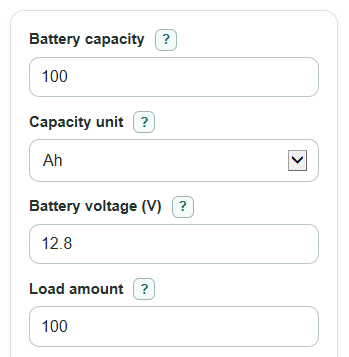
- Enter Battery capacity and choose the matching Capacity unit: Ah, mAh, or Wh.
- Enter Battery voltage from the battery label, then enter Load amount and pick the correct Load unit.
- Open Advanced options to adjust the battery count, usable charge, or health. Power path and Power conversion efficiency (%) apply when Load unit is Watts; battery-side current already includes those losses.
- Click Calculate and read Estimated runtime, then check Power pulled from battery and Current pulled from battery. Energy delivered to the load is shown for Watts only.
- Sanity-check the answer: if Battery load rate is high or the Check note appears, verify the load watts, voltage, wiring limit, and battery discharge rating.
Definitions
Amp-hour (Ah): A charge rating. A 100 Ah battery can supply 100 amps for about 1 hour in a simple ideal case, or a smaller current for longer.
Milliamp-hour (mAh): A smaller charge unit. 1000 mAh equals 1 Ah.
Watt-hour (Wh): An energy rating. It is usually the best unit for comparing runtime because it combines voltage and capacity.
Battery voltage: The nominal voltage used to turn charge into energy and to estimate current. Use the battery label voltage, not the charger voltage.
Load amount: Enter device output power for Watts, or the total measured battery-side current for either current unit. Use an average running value that includes standby demand.
Power conversion efficiency: The percent of battery energy that reaches the load after losses in an inverter or DC converter.
C-rate: The battery current divided by the battery amp-hour capacity. A 1C load would drain the rated Ah in about 1 hour before losses.
Common mistakes and quick fixes
Mistake: Picking mAh for Capacity unit and entering a power-bank mAh number with the wrong Battery voltage.
Fix: Use the voltage tied to that mAh rating, often the internal cell voltage printed on the label, or enter Wh if the label gives Wh.
Mistake: Entering wall-outlet amps in Load amount while Load unit is set to Amps at battery voltage.
Fix: For AC appliances, enter watts for Load amount and choose Inverter to AC outlet for Power path.
Mistake: Leaving Power conversion efficiency (%) at 100 for a device-watts estimate that uses an inverter or converter.
Fix: Enter a realistic efficiency for Watts. For battery-side current, conversion losses are already included in the measured current, so the efficiency input is hidden and ignored.
Mistake: Treating Battery health as the same thing as Battery you plan to use.
Fix: Use Battery health for lost capacity from age or conditions, and use Battery you plan to use for the percent of the remaining battery you plan to drain.
Mistake: Ignoring Battery load rate when Estimated runtime looks possible on paper.
Fix: If Battery load rate is high, check the battery management system, fuse, wiring, and manufacturer discharge limit before using the estimate.
Limitations & Key Assumptions / Boundary Conditions
- The result assumes the load stays constant. Motors, refrigerators, radios, laptops, and heaters can change power use while running.
- The result uses the entered nominal voltage. Real lithium battery voltage changes during discharge, so real current and runtime can differ.
- Very high current can reduce real usable capacity and can trigger a battery management system, fuse, inverter, or wiring limit.
- Cold temperatures, battery age, cell imbalance, and manufacturer cutoff settings can lower usable energy beyond the entered Battery health value.
- If a battery label lists mAh at internal cell voltage, using output voltage with that mAh number will overstate or understate energy.
- Very long runtime estimates ignore self-discharge and standby power unless you include those watts in Load amount.
Methodology
Calculation steps
The calculator first converts the entered capacity to amp-hours for one battery.
capacity_ah_single = capacity_value when Capacity unit = Ah
capacity_ah_single = capacity_value / 1000 when Capacity unit = mAh
capacity_ah_single = capacity_value / battery_voltage when Capacity unit = Wh
It then finds the battery label energy for the full bank.
nameplate_energy_wh = capacity_ah_single * battery_voltage * battery_count
Next it applies the planned battery use and battery health.
usable_energy_wh = nameplate_energy_wh * (usable_percent / 100) * (battery_health_percent / 100)
For Watts, effective efficiency is Power conversion efficiency (%) divided by 100. For Amps at battery voltage or mA at battery voltage, effective efficiency is 1 because the entered current already includes conversion losses.
energy_at_entered_load_boundary_wh = usable_energy_wh * effective_efficiency
The load is converted to watts. Current entries are treated as current at the battery voltage.
load_watts = load_value when Load unit = Watts
load_watts = load_value * battery_voltage when Load unit = Amps at battery voltage
load_watts = (load_value / 1000) * battery_voltage when Load unit = mA at battery voltage
Runtime is usable energy at the entered load boundary divided by power at that same boundary [1]. Battery-side current therefore gives usable amp-hours divided by battery amps.
runtime_hours = energy_at_entered_load_boundary_wh / load_watts
runtime_minutes = runtime_hours * 60
The calculator also shows battery-side stress checks.
battery_power_needed_w = load_watts / effective_efficiency
battery_current_a = battery_power_needed_w / battery_voltage
c_rate = battery_current_a / (capacity_ah_single * battery_count)
Mini-example
For a 100 Ah battery at 12.8 V, one battery has 1280 Wh of label energy. If you plan to use 90 percent, battery health is 100 percent, and efficiency is 95 percent, delivered energy is 1094.4 Wh. With a 100 W load, runtime is 1094.4 / 100 = 10.944 hours, or about 656.64 minutes. Battery-side power is 100 / 0.95 = 105.26 W, battery current is 105.26 / 12.8 = 8.22 A, and battery load rate is 8.22 / 100 = 0.082 C.