
Estimate your home solar panel count, system size, roof fit, monthly production, and rough before-incentives cost.
Advanced options
Table of contents
How to use our How Many Solar Panels Do I Need Calculator
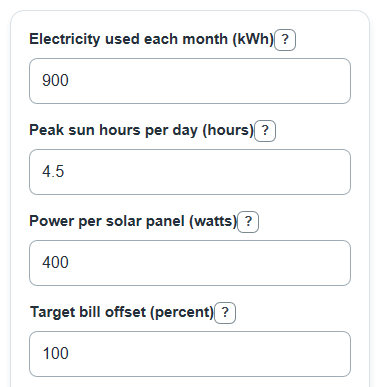
- Enter Electricity used each month from your bill in kWh, then enter Peak sun hours per day for your area.
- Enter Power per solar panel, choose your Target bill offset, and enter your Usable roof area after shade, vents, chimneys, and setbacks.
- Open Advanced options only if you want to change Real-world system efficiency, Roof space used per panel, or Installed cost.
- Click Calculate, then read Solar panels needed, Roof fit check, and Roof fit space left first.
- Sanity-check the result: if Estimated monthly solar production is far above the target or the panel count looks extreme, recheck kWh, sun hours, panel watts, and roof area.
Definitions
Electricity used each month: The energy your home uses in an average month, measured in kilowatt-hours (kWh), not dollars.
Peak sun hours per day: The average daily sunlight counted as full-strength sun for solar production estimates.
Power per solar panel: The DC watt rating of one solar panel under standard test conditions.
Target bill offset: The percent of your monthly electricity use you want the solar system to make on average.
Real-world system efficiency: The share of ideal solar output kept after losses from heat, inverter conversion, wiring, dirt, and similar factors.
Usable roof area: The roof area that can realistically hold panels after blocked, shaded, or restricted space is removed.
Installed solar system size: The rounded-up DC size in kilowatts, found from the whole-panel count and the panel watt rating.
Roof fit space left: Usable roof area minus roof space needed. Positive means extra space remains. Negative means the planned panels need more space.
Ceiling: A rounding method that always moves up to the next whole number, used because a solar array cannot use part of a panel.
Common mistakes and quick fixes
Mistake: Typing the dollar amount from the power bill into Electricity used each month .
Fix: Use the kWh per month printed on the bill, not the bill price.
Mistake: Using total roof size for Usable roof area .
Fix: Enter only the area that can actually hold panels after shade, vents, chimneys, walkways, and setback rules.
Mistake: Entering the full system size into Power per solar panel .
Fix: Enter the watt rating for one panel, such as 400 W, not the total kW size of the array.
Mistake: Treating Peak sun hours per day as the number of daylight hours.
Fix: Use average full-strength sun hours, which are usually lower than total daylight hours.
Mistake: Setting Real-world system efficiency above 100 or leaving it as an unrealistically low value by accident.
Fix: Keep it above 0 and no more than 100, and use the default if you do not have a better loss estimate.
Mistake: Reading a negative Roof fit space left as extra space.
Fix: Negative means the layout is short on roof space by that many square feet.
Limitations & Key Assumptions / Boundary Conditions
- This is a planning estimate, not a permit-ready solar design or installer quote.
- Peak sun hours are user-entered, so the estimate can be off if the local solar resource number is too high or too low.
- The energy estimate uses an average month of 30.4375 days and does not model hourly weather, seasons, shade movement, roof direction, roof tilt, snow, or panel aging.
- The roof-fit check uses one average Roof space used per panel. It does not test exact panel dimensions, fire setbacks, roof face shapes, rafters, or electrical code rules.
- The cost estimate uses Installed cost before incentives. It excludes tax credits, rebates, batteries, financing, utility fees, main-panel upgrades, and roof repairs.
- The calculator allows Target bill offset up to 200 percent for oversizing checks, but utilities may limit system size or credits for extra production.
Methodology
Energy target
The calculator first turns your monthly electricity use into the average monthly solar energy target. A 100 percent target sizes solar to make about the same energy you use over an average month. A smaller target sizes a smaller system.
target_monthly_solar_kwh = monthly_kwh * target_offset_percent / 100
target_daily_solar_kwh = target_monthly_solar_kwh / 30.4375
System size and panel count
Next, the calculator estimates the DC solar system size needed before panel rounding. It divides the daily energy target by peak sun hours and by real-world system efficiency.
required_system_kw = (target_monthly_solar_kwh / 30.4375) / (peak_sun_hours * system_efficiency_percent / 100)
The panel count is rounded up because the system must use whole panels.
panels_needed = ceil(required_system_kw * 1000 / panel_watts)
installed_system_kw = panels_needed * panel_watts / 1000
Production, roof fit, and cost
After rounding up the panel count, the calculator estimates the monthly production from the installed system size. It also checks whether the panels fit in the usable roof area you entered.
estimated_monthly_solar_kwh = installed_system_kw * peak_sun_hours * 30.4375 * system_efficiency_percent / 100
roof_space_needed_sqft = panels_needed * panel_roof_area_sqft
roof_fit_space_left_sqft = usable_roof_area_sqft - roof_space_needed_sqft
estimated_system_cost_before_incentives = installed_system_kw * 1000 * installed_cost_per_watt
Mini-example
Suppose a home uses 900 kWh per month, has 4.5 peak sun hours per day, uses 400 W panels, targets 100 percent offset, has 500 sq ft of usable roof area, uses 85 percent efficiency, uses 22 sq ft per panel, and uses $3.00 per W installed cost. The target is 900 kWh per month. The required system size before rounding is about 7.73 kW. The calculator rounds up to 20 panels, giving an installed size of 8.00 kW. Estimated monthly solar production is about 931.4 kWh. Roof space needed is 440 sq ft, so roof fit space left is 60 sq ft. Estimated system cost before incentives is $24,000.