
Estimate month-by-month energy from a horizontal solar array using historical sunlight data for your location.
How to use our Monthly Solar Energy Calculator by Location
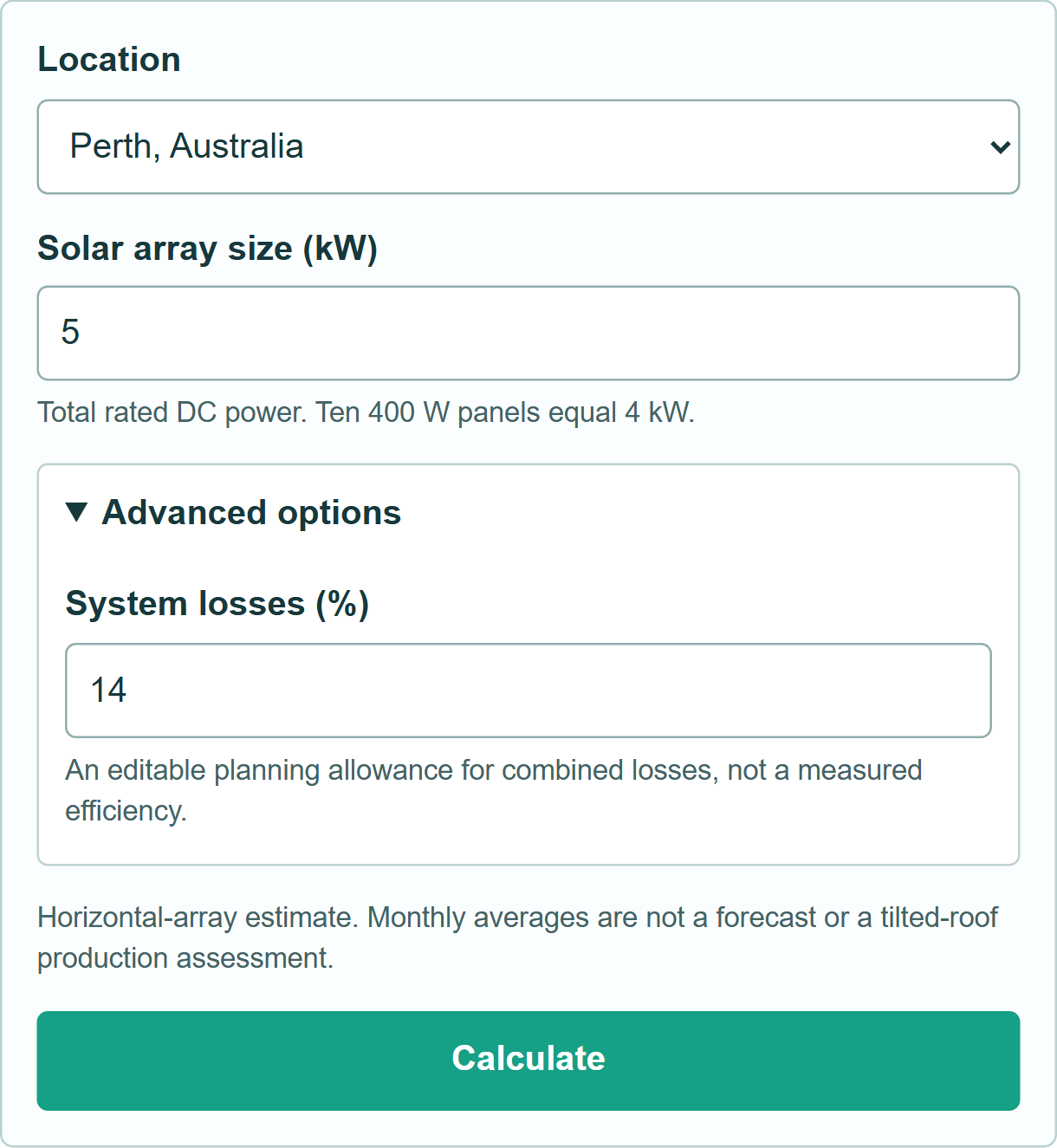
- Choose a city or enter your location's latitude and longitude. City choices use the listed city center, not your exact address.
- Enter total panel capacity in kW. Adjust the assumed combined losses if you have a better estimate.
- Calculate to load NASA POWER monthly sunlight averages and see the energy table.
- Compare the low-sun months with your needs. Use a site-specific model for a tilted roof, shading or battery sizing.
Definitions
Peak sun hours: Daily solar energy expressed as equivalent hours at 1 kW/m²; these are not daylight hours. kW: Rated panel power. kWh: Electrical energy. Climatology: A long-term historical average rather than a forecast.
Common mistakes and quick fixes
Do not enter panel watts as kW: 400 W equals 0.4 kW. Do not substitute daylight duration for peak sun hours, or treat a historical monthly average as a promise for tomorrow. Confirm the latitude and longitude signs.
Limitations & Key Assumptions / Boundary Conditions
This simple horizontal-array model does not calculate the benefit of tilt or tracking, roof direction, local shade, snow cover, hourly temperature, inverter clipping or battery losses. NASA values represent a regional grid, not a rooftop measurement. Monthly averages cannot size backup storage for cloudy spells. Network access to NASA POWER is required; coordinates are sent to NASA only when Calculate is selected.
Methodology
NASA POWER supplies monthly average daily global horizontal solar irradiation in kWh/m²/day. Dividing that by the reference irradiance of 1 kW/m² gives equivalent peak sun hours. This calculator estimates daily energy as array kW × peak sun hours × (1 – losses/100), then multiplies by the days in each month. Annual energy is the sum of those twelve month totals [1, 2].
Example: 5 kW, 4 peak sun hours per day and 14% losses give 17.2 kWh/day. A 30-day month gives 516 kWh. A non-leap calendar is used for the annual total. The initial 14% loss allowance is a planning assumption and can be changed.
The response's data period is shown with each result. No city-specific example is substituted if the lookup fails. A zero-sun month is valid, but missing or negative data is rejected.