
Compare your current roof with a planned roof to estimate yearly bill savings, cooling electricity saved, and possible heating cost changes.
Advanced options
Table of contents
How to use our Cool Roof Energy Savings Calculator
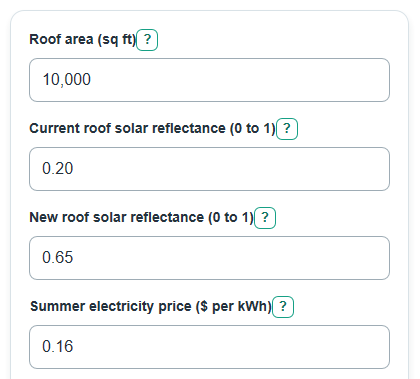
- Enter Roof area for the sunny roof area that affects the cooled or heated space below it.
- Enter Current roof solar reflectance and New roof solar reflectance as numbers from 0 to 1, where a higher number reflects more sunlight.
- Enter Summer electricity price and Cooling-season sun hours for the time when sun hits the roof and air conditioning is needed.
- Open Advanced options if you want to change sun strength, Air conditioner efficiency, heat flow, or heating-season inputs.
- Click Calculate, then sanity-check the signs: a more reflective new roof should usually show positive Cooling electricity saved, while a less reflective new roof can show negative savings.
Definitions
Solar reflectance: The fraction of sunlight a roof reflects. A value of 0.65 means 65 percent of sunlight is reflected. Cool roof ratings commonly use this idea [2].
Cooling-season sun hours: The yearly hours when strong sun hits the roof during times the building needs air conditioning.
Air conditioner efficiency (COP): Coefficient of performance. It means cooling delivered divided by electricity used, so a higher COP needs less electricity for the same cooling.
Share of roof heat that reaches indoors: A simple factor for insulation and roof construction. Lower values mean less roof heat reaches the rooms below.
Heating energy input: Purchased heating energy before system losses. For example, fuel or electricity bought by the heating system.
Net yearly bill savings: Cooling bill savings minus added heating cost. A negative number means the new roof is estimated to cost more per year in this simple model.
Common mistakes and quick fixes
Mistake: Entering Roof area for the whole lot or building footprint instead of the roof area that gets sun.
Fix: Use the sunny Roof area in square feet that affects the conditioned space below it.
Mistake: Typing Current roof solar reflectance or New roof solar reflectance as 65 instead of 0.65.
Fix: Enter reflectance as a ratio from 0 to 1, so 65 percent is 0.65.
Mistake: Leaving Summer electricity price blank or using a monthly bill total.
Fix: Enter the price per kWh, such as 0.16, for Summer electricity price.
Mistake: Setting Air conditioner efficiency to 0 or using a percent value for COP.
Fix: Enter Air conditioner efficiency as COP, such as 3.0, and keep it greater than 0.
Mistake: Ignoring Added heating cost from less winter sun in a cold climate.
Fix: Check Heating-season sun hours, Heating energy price, and Heating system efficiency so Net yearly bill savings includes the winter effect.
Mistake: Treating Net savings per roof square foot as the whole building savings.
Fix: Use Net yearly bill savings for the total yearly dollar change, and use Net savings per roof square foot only for comparing roof options by area.
Limitations & Key Assumptions / Boundary Conditions
- This is a first-pass estimate, not a full building energy simulation. Actual bills can change because of weather, roof slope, attic ventilation, insulation, air leaks, thermostat settings, shade, and HVAC controls.
- The model uses the sun strength and sun hours you enter. Local climate data is not looked up automatically.
- Solar reflectance is treated as one yearly value for each roof. Dirt, aging, coatings, repairs, and product ratings can change real reflectance over time.
- The Share of roof heat that reaches indoors is a simplified insulation and roof-construction factor. It does not replace a heat-transfer model.
- Heating effects are counted only through reduced winter solar heat gain on the roof. The calculator does not model snow cover, passive solar through windows, or humidity effects.
- Negative savings are allowed. They mean the new roof is estimated to increase the bill compared with the current roof under the entered assumptions.
Methodology
Calculation steps
The calculator compares the current roof reflectance with the new roof reflectance in one run. A higher solar reflectance means the new roof absorbs less sunlight, which can reduce cooling load [1].
sr_change = new_solar_reflectance - current_solar_reflectance
cooling_heat_reduction_kwh = roof_area_ft2 * summer_solar_input_w_ft2 * sr_change * roof_heat_flow_factor * cooling_sun_hours / 1000
cooling_electricity_saved_kwh = cooling_heat_reduction_kwh / ac_cop
cooling_bill_savings = cooling_electricity_saved_kwh * summer_electricity_rate
The winter side uses the same reflectance change, but it treats lost winter roof heat as heat the heating system may need to replace.
heating_energy_added_kwh = (roof_area_ft2 * winter_solar_input_w_ft2 * sr_change * roof_heat_flow_factor * heating_sun_hours / 1000) / (heating_system_efficiency_percent / 100)
added_heating_cost = heating_energy_added_kwh * heating_energy_cost
net_yearly_bill_savings = cooling_bill_savings - added_heating_cost
savings_per_square_foot = net_yearly_bill_savings / roof_area_ft2
peak_heat_gain_reduction_w = roof_area_ft2 * summer_solar_input_w_ft2 * sr_change * roof_heat_flow_factor
Mini-example
For a 10,000 sq ft roof changing from 0.20 to 0.65 reflectance, the reflectance change is 0.45. With 70 W per sq ft summer sun strength, 0.15 heat flow factor, 1,000 cooling-season sun hours, COP 3.0, and $0.16 per kWh electricity, the cooling electricity saved is 15,750 kWh per year and the cooling bill savings is $2,520 per year. With 20 W per sq ft winter sun strength, 500 heating-season sun hours, $0.05 per kWh heat input, and 90 percent heating efficiency, added heating energy input is 7,500 kWh per year and added heating cost is $375 per year. Net yearly bill savings is $2,145 per year, or $0.2145 per sq ft per year.
Calculation choices
Watts are converted to kilowatts by dividing by 1000. Heating system efficiency is converted from percent to a ratio by dividing by 100. The calculator keeps signed results, so a less reflective new roof can show negative Cooling electricity saved, negative Cooling bill savings before heating effect, and negative Net yearly bill savings.