
Estimate storm window energy savings, cooling savings, simple payback, and long-term net savings from your window area, climate, utility rates, and project cost.
Advanced options
Table of contents
How to use our Storm Window Savings Calculator
- Enter the U-factor drop, which is the old window heat leak rate minus the new heat leak rate after adding storm windows.
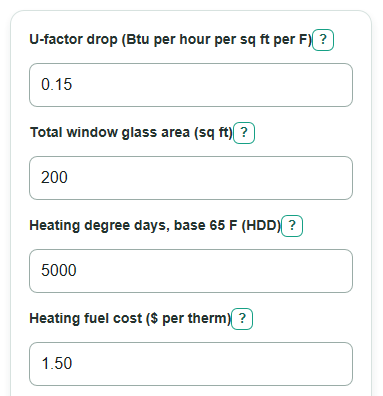
- Enter Total window glass area, Heating degree days, Heating fuel cost, and Storm window project cost using the same units shown in each label.
- Open Advanced options if you want to change Heating system efficiency, Heat in one fuel unit, Cooling degree days, Electricity price, Cooling system SEER, or Years to compare.
- Select Calculate and read Estimated yearly energy savings first, then check Simple payback time and Net savings after chosen years.
- Sanity-check the output: if savings look too high or too low, recheck U-factor drop, Total window glass area, degree days, fuel price, and whether your fuel unit matches Heat in one fuel unit.
Definitions
U-factor drop: The reduction in window heat leak rate after adding storm windows. A bigger drop means less heat moves through the glass area.
Total window glass area: The combined square feet of glass that will get storm windows, not the floor area of the home.
Heating degree days, base 65 F: A weather score for how much heating a place needs. More heating degree days usually means a colder heating season [1].
Cooling degree days, base 65 F: A weather score for how much cooling a place needs. More cooling degree days usually means a hotter cooling season [1].
Heating system efficiency: The percent of fuel heat that becomes useful heat in the home.
Cooling system SEER: Seasonal cooling output in Btu per watt-hour of electricity. A higher SEER uses less electricity for the same cooling load.
Simple payback time: Storm window project cost divided by Estimated yearly energy savings.
Net savings after chosen years: Estimated energy savings over the chosen time span minus the project cost. A negative value means energy savings have not covered the project cost yet.
Common mistakes and quick fixes
Mistake: Entering the new window U-factor in U-factor drop instead of the drop between old and new.
Fix: Use old U-factor minus new U-factor for U-factor drop.
Mistake: Using the wall opening size or the whole house size for Total window glass area.
Fix: Add only the glass area getting storm windows for Total window glass area.
Mistake: Mixing up Heating degree days, base 65 F with Cooling degree days, base 65 F.
Fix: Put cold-season HDD in Heating degree days, base 65 F and hot-season CDD in Cooling degree days, base 65 F.
Mistake: Entering Heating fuel cost per gallon or per kWh while Heat in one fuel unit still uses the therm default.
Fix: Make Heating fuel cost and Heat in one fuel unit describe the same fuel unit.
Mistake: Leaving Heating system efficiency as 100 percent for an older furnace that is not 100 percent efficient.
Fix: Enter the best estimate you have for Heating system efficiency, such as the AFUE percent on the equipment label if available.
Mistake: Reading Net savings after chosen years as guaranteed profit.
Fix: Treat Net savings after chosen years as energy savings minus Storm window project cost under the entered assumptions.
Limitations & Key Assumptions / Boundary Conditions
- This is a conduction-only estimate. It does not include air leakage, solar heat through glass, shading, wind, curtains, thermostat settings, or room-by-room comfort changes.
- The calculator depends on the U-factor drop you enter. Product ratings, installation quality, and existing window condition can change the real drop.
- Heating degree days, base 65 F and Cooling degree days, base 65 F are annual climate summaries. A single unusual winter or summer can make actual bills different.
- Heating fuel cost, Electricity price, Heating system efficiency, and Cooling system SEER are treated as fixed values for the whole comparison period.
- Simple payback time ignores maintenance, tax credits, rebates, financing, resale value, and energy price changes.
- Cooling savings are a low-detail estimate. It uses Cooling system SEER as a seasonal average and does not model humidity removal or part-load performance.
- Net savings after chosen years is signed. A negative value is allowed and means the energy savings estimate has not paid back the Storm window project cost in that time.
Methodology
Calculation steps
The calculator uses degree days to estimate how much heat flow is avoided through the window glass area. Heating degree days and cooling degree days are weather measures based on how far daily temperatures are from 65 F [1]. U-factor is a window heat transfer rating used for energy performance comparisons [2].
annual_heating_savings = (u_factor_drop * window_area_sqft * heating_degree_days * 24 / (heating_efficiency_percent / 100) / fuel_btu_per_unit) * heating_fuel_cost
annual_cooling_savings = (u_factor_drop * window_area_sqft * cooling_degree_days * 24 / (cooling_seer * 1000)) * electricity_price
annual_total_savings = annual_heating_savings + annual_cooling_savings
simple_payback_years = project_cost / annual_total_savings
net_savings_over_years = annual_total_savings * comparison_years - project_cost
monthly_average_savings = annual_total_savings / 12
Mini-example
With a U-factor drop of 0.15, 200 sq ft of glass, 5000 heating degree days, $1.50 per therm, 80 percent heating efficiency, 100000 Btu per fuel unit, 1000 cooling degree days, $0.16 per kWh, SEER 14, a $2000 project cost, and 20 years to compare, the heating savings are $67.50 per year and the cooling savings are about $8.23 per year. Estimated yearly energy savings are about $75.73. Simple payback time is about 26.41 years. Net savings after 20 years are about -$485.43.
Calculation choices
The heating side divides avoided window heat flow by Heating system efficiency because a less efficient heating system must burn more fuel to deliver the same heat indoors. The cooling side divides avoided heat gain by Cooling system SEER and by 1000 to convert watt-hours to kWh. If Estimated yearly energy savings are zero or less, Simple payback time is shown as N/A instead of dividing by zero. Net savings after chosen years keeps the negative sign when the project has not paid back from energy savings alone.