
Compare portable and window AC costs using power, daily use, season length, electricity price, and optional purchase prices.
Advanced options
Table of contents
How to use our Portable AC vs Window AC Cost Calculator
- Enter Portable AC power and Window AC power in watts, not BTU.
- Enter Use per day, Cooling season, and Electricity price from your bill in $ per kWh.
- Open Advanced options if you want Total cost saved with window AC over chosen years and payback results based on purchase prices.
- Click Calculate and read Seasonal running cost saved with window AC first; a positive dollar amount means the window AC costs less to run.
- Sanity-check the result by comparing the two watt numbers: if hours, days, and price are the same, the higher-watt AC should usually show higher energy use.
Definitions
Portable AC power: The electric power used by the portable air conditioner, measured in watts.
Window AC power: The electric power used by the window air conditioner, measured in watts.
Watt: A unit of electric power. For this calculator, watts show how fast the AC uses electricity.
kWh: Kilowatt-hour, a unit of electricity use. A 1,000-watt appliance running for 1 hour uses 1 kWh [1].
Electricity price: The cost you pay for each kWh, shown as $ per kWh on many electric bills.
Seasonal running cost saved with window AC: Portable AC seasonal electricity cost minus Window AC seasonal electricity cost. Positive means the window AC is cheaper to run.
Payback seasons: The number of cooling seasons needed for lower window AC electricity cost to make up for a higher Window AC purchase price.
Common mistakes and quick fixes
Mistake: Typing BTU into Portable AC power or Window AC power.
Fix: Use watts from the label or manual; BTU is cooling size, not electric power.
Mistake: Entering a monthly electric bill total in Electricity price.
Fix: Enter the per-kWh rate, such as 0.17, in Electricity price.
Mistake: Putting total summer hours into Use per day.
Fix: Enter the average hours used on one cooling day in Use per day, then enter the number of days in Cooling season.
Mistake: Leaving Portable AC purchase price and Window AC purchase price at 0 and then reading Total cost saved with window AC over chosen years as a full ownership comparison.
Fix: Enter both purchase prices if you want the total cost result to include upfront cost.
Mistake: Treating a negative Seasonal running cost saved with window AC as an error.
Fix: A negative value means the portable AC is cheaper to run under the numbers you entered.
Limitations & Key Assumptions / Boundary Conditions
- The calculator compares electricity use from entered watts. It does not estimate watts from BTU, CEER, EER, room size, or thermostat behavior.
- Use per day is an average. Real AC run time changes with weather, insulation, shade, thermostat setting, and how well the window or hose is sealed.
- Monthly running cost saved with window AC uses a 30-day estimating month. It is not a calendar-month bill forecast.
- Electricity price is treated as one flat $ per kWh rate. Tiered rates, time-of-use prices, demand charges, taxes, and fixed fees can change real bills.
- Purchase prices do not include installation supplies, brackets, maintenance, repairs, resale value, or replacement timing.
- Payback is shown only when the window AC costs more upfront and saves electricity each season. If it does not save electricity, there is no electricity-cost payback.
Methodology
Energy use
The calculator first converts each AC power value from watts to kilowatts by dividing by 1,000. The EIA defines the relationship between watts, kilowatts, and kilowatt-hours used for electric energy calculations [1].
daily_kwh = (watts / 1000) * hours_per_day
seasonal_kwh = daily_kwh * season_days
Running cost
For each AC, seasonal cost equals seasonal energy use times the electricity price. The monthly estimate uses 30 days at the same daily use.
monthly_cost = daily_kwh * 30 * electricity_rate
seasonal_cost = seasonal_kwh * electricity_rate
The running-cost savings are signed. Positive means the window AC costs less to run. Negative means the portable AC costs less to run.
savings_with_window = portable_cost - window_cost
Total cost and payback
Total cost adds purchase price to the seasonal electricity cost multiplied by Years to compare.
total_cost = purchase_price + seasonal_cost * years_to_compare
total_saved_with_window = portable_total_cost - window_total_cost
Payback seasons apply only when the window AC costs more upfront and the window AC saves money on seasonal electricity. If the window AC is cheaper upfront and cheaper to run, payback is 0 seasons.
payback_seasons = (window_purchase_price - portable_purchase_price) / seasonal_running_cost_saved_with_window
Mini-example
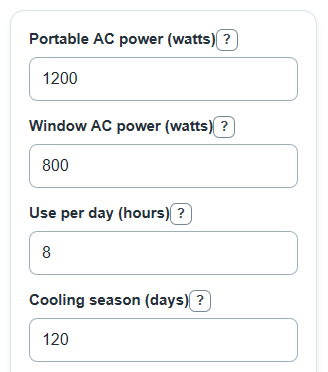
With Portable AC power of 1,200 watts, Window AC power of 800 watts, Use per day of 8 hours, Cooling season of 120 days, and Electricity price of $0.17 per kWh, the portable AC uses 1,152 kWh for the season and costs $195.84. The window AC uses 768 kWh and costs $130.56. Seasonal running cost saved with window AC is $65.28. If the portable AC purchase price is $450, the window AC purchase price is $350, and Years to compare is 5, Total cost saved with window AC over chosen years is $426.40.