
Estimate portable AC electricity cost from label watts or BTU, then adjust for cycling and standby time.
Advanced options
Table of contents
How to use our Portable AC Running Cost Calculator
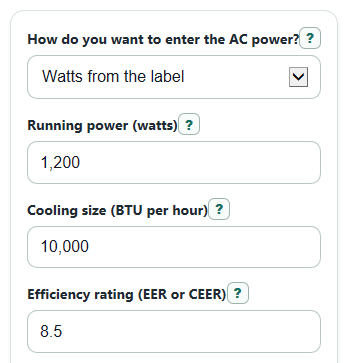
- Choose How do you want to enter the AC power? Use Running power (watts) if the label or manual lists input watts.
- If you do not have watts, choose BTU and efficiency rating, then enter Cooling size (BTU per hour) and Efficiency rating (EER or CEER).
- Enter Cooling time (hours per day), Days used, and Electricity price ($ per kWh) from your electric bill if possible.
- Open Advanced options only if you want to adjust Compressor working time (percent), Standby power (watts), or Extra standby time (hours per day).
- Sanity-check the results: Estimated running power used should be close to the label input watts, and Electricity used per day should feel reasonable for the number of cooling hours.
Definitions
Running power (watts): The electrical input power the portable AC uses while cooling. This is different from BTU cooling size.
Cooling size (BTU per hour): The amount of heat the AC can move in one hour. Bigger BTU numbers usually mean a larger cooling capacity.
Efficiency rating (EER or CEER): Cooling output divided by electrical input. A higher EER or CEER means less power for the same BTU per hour.
Electricity price ($ per kWh): The amount your utility charges for one kilowatt-hour of electricity.
Compressor working time (percent): The share of scheduled cooling time when the compressor is actually running instead of cycled off.
Standby power (watts): Power used while the unit is plugged in but not cooling, such as for a display, timer, or Wi-Fi feature.
kWh: Kilowatt-hour, the billing unit for electricity. One kWh equals 1,000 watts used for 1 hour.
Common mistakes and quick fixes
Mistake: Typing the cooling BTU number into Running power (watts).
Fix: Use the product label input watts for Running power (watts), or switch How do you want to enter the AC power? to BTU and efficiency rating.
Mistake: Leaving Electricity price ($ per kWh) at the default when your local bill is very different.
Fix: Enter the total $ per kWh from your electric bill, including delivery charges if your bill shows them.
Mistake: Using 24 for Cooling time (hours per day) when the AC is only turned on at night.
Fix: Count only the hours the unit is scheduled to cool, such as 8 for overnight use.
Mistake: Setting Compressor working time (percent) to 100 when the compressor cycles off after the room cools.
Fix: Use 100 for a high estimate, or enter a lower percent if the compressor is not working the whole scheduled time.
Mistake: Adding Extra standby time (hours per day) on top of Cooling time (hours per day) so the total is more than 24.
Fix: Keep Cooling time (hours per day) plus Extra standby time (hours per day) at 24 or less.
Mistake: Entering Standby power (watts) when the unit is unplugged outside cooling hours.
Fix: Set Standby power (watts) or Extra standby time (hours per day) to 0 if the AC is not plugged in during that time.
Limitations & Key Assumptions / Boundary Conditions
- The estimate depends on the Electricity price ($ per kWh) you enter. Local rates can change by utility, season, time of day, and bill fees.
- Running power from BTU and efficiency is an estimate. If you have a label value for Running power (watts), use it.
- Compressor working time (percent) is a user estimate. Hot rooms, sun, open doors, dirty filters, and hose setup can change real compressor time.
- Standby power (watts) is counted only during Extra standby time (hours per day), not during Cooling time (hours per day).
- The calculator treats each day as the same usage pattern. It does not model weather changes, thermostat changes, demand charges, or tiered electric rates.
- Cooling time (hours per day) plus Extra standby time (hours per day) must be 24 or less because both are treated as parts of the same day.
Methodology
Core calculation
The calculator first finds the portable AC running power. If you choose label watts, it uses Running power (watts) directly. If you choose BTU and efficiency, it divides Cooling size (BTU per hour) by Efficiency rating (EER or CEER). EIA electricity data shows that electricity prices vary by place and customer type, so your own bill rate is the best input for Electricity price ($ per kWh) [1].
running_power_w = running_watts
running_power_w = cooling_btu_per_hour / efficiency_rating
Next, the calculator converts watts and hours into kWh. Compressor working time (percent) reduces cooling electricity when the compressor is not running during every scheduled cooling minute.
cooling_kwh_per_day = (running_power_w / 1000) * cooling_hours_per_day * (run_share_percent / 100)
Optional standby use is added only when Standby power (watts) and Extra standby time (hours per day) are entered.
standby_kwh_per_day = (standby_watts / 1000) * standby_hours_per_day
The daily and period totals come from adding cooling and standby electricity, then multiplying by Days used and Electricity price ($ per kWh).
daily_energy_kwh = cooling_kwh_per_day + standby_kwh_per_day
period_energy_kwh = daily_energy_kwh * days_used
daily_cost = daily_energy_kwh * electricity_rate
period_cost = period_energy_kwh * electricity_rate
Estimated cost per cooling hour excludes extra standby time so it answers a simple question: how much one more scheduled cooling hour costs under the same compressor working time.
scheduled_hour_cost = (running_power_w / 1000) * (run_share_percent / 100) * electricity_rate
Mini example
For a 1,200 watt portable AC used 8 hours per day for 30 days at $0.18 per kWh, with Compressor working time (percent) set to 100 and no standby use, daily energy is 1,200 / 1,000 * 8 * 1 = 9.60 kWh. Period energy is 9.60 * 30 = 288.00 kWh. Estimated cost for the days used is 288.00 * $0.18 = $51.84, and Estimated cost per cooling hour is 1.2 * $0.18 = $0.22 per hour.