
Estimate cooling-season savings from running a ceiling fan while raising your AC thermostat.
Table of contents
How to use our Ceiling Fan vs AC Savings Calculator
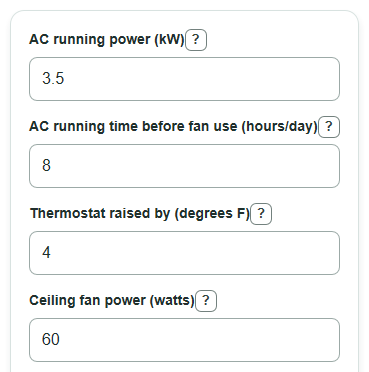
- Enter AC running power, AC running time before fan use, Thermostat raised by, Ceiling fan power, and Electricity price.
- Open Advanced options if you want to change Cooling days to total, add Extra fan-only time, or adjust AC energy cut per 1 degree F.
- Click Calculate to see Cooling-season net savings first, followed by daily savings, AC energy avoided, and fan energy used.
- Sanity-check the result: if Fan time used in the estimate is near 24 hours/day or the thermostat change is very large, check whether those inputs match how you will actually use the fan.
Definitions
AC running power: The electric power your air conditioner uses while it is actively cooling, measured in kilowatts.
AC running time before fan use: The number of hours per day the AC would run before you raise the thermostat and use the fan.
Thermostat raised by: How many degrees F warmer you set the AC while the ceiling fan is on.
Ceiling fan power: The fan's electric power in watts. Include light kit watts only if the lights run too.
Electricity price: The cost you pay for each kilowatt-hour, shown as $ per kWh on many electric bills.
AC energy cut per 1 degree F: The estimated percent drop in AC energy for each 1 degree F thermostat increase.
Cooling-season net savings: The estimated AC cost avoided minus fan running cost over the Cooling days to total.
Fan time used in the estimate: AC running time before fan use plus Extra fan-only time.
Common mistakes and quick fixes
Mistake: Using whole-day average electricity use for AC running power.
Fix: For AC running power, enter the power while the AC is running, not the 24-hour average.
Mistake: Entering wall-clock cooling time for AC running time before fan use when the compressor cycles on and off.
Fix: For AC running time before fan use, estimate only the hours the AC would actually run.
Mistake: Including fan lights in Ceiling fan power when the lights will stay off.
Fix: For Ceiling fan power, use fan-only watts unless the light kit will be on too.
Mistake: Leaving Electricity price at a guess that does not match your bill.
Fix: For Electricity price, use your $ per kWh energy rate for the hours when cooling happens.
Mistake: Putting all fan use into AC running time before fan use.
Fix: Put the normal AC run time in AC running time before fan use, then add fan-only use in Extra fan-only time.
Mistake: Treating Cooling-season net savings as guaranteed bill savings.
Fix: Read Main assumption used and adjust AC energy cut per 1 degree F if your home, climate, or comfort setting makes the default too high or too low.
Limitations & Key Assumptions / Boundary Conditions
- The calculator estimates energy from power and time. It does not read your actual AC cycling, utility meter, or thermostat data.
- The default AC energy cut per 1 degree F is a simple modeling assumption. Real savings can differ by climate, humidity, shade, insulation, duct condition, and AC efficiency.
- Ceiling fans move air and help people feel cooler; they do not lower the room air temperature by themselves [1]. Savings usually depend on raising the thermostat while people are in the room.
- The calculator assumes the fan runs for AC running time before fan use plus Extra fan-only time. If the fan runs in an empty room, the added fan cost can reduce or reverse savings.
- Dollar results use the entered Electricity price only. Demand charges, tiered rates, time-of-use rates, taxes, and fixed bill fees are not modeled.
- Negative Cooling-season net savings is allowed. It means the estimated fan electricity costs more than the AC energy avoided.
Methodology
Calculation method
The calculator compares two cases: AC alone at the old thermostat setting, and AC at a warmer setting while the ceiling fan runs. The thermostat effect is entered as AC energy cut per 1 degree F.
baseline_ac_kwh_day = ac_power_kw * ac_hours_per_day
ac_kwh_saved_day = baseline_ac_kwh_day * (thermostat_raise_f * savings_per_degree_pct / 100)
fan_hours_day = ac_hours_per_day + extra_fan_hours_per_day
fan_kwh_day = (fan_power_watts / 1000) * fan_hours_day
day_net_savings = (ac_kwh_saved_day - fan_kwh_day) * electricity_rate
season_net_savings = day_net_savings * cooling_days
season_ac_energy_saved = ac_kwh_saved_day * cooling_days
season_fan_energy_used = fan_kwh_day * cooling_days
season_ac_cost_avoided = season_ac_energy_saved * electricity_rate
season_fan_cost = season_fan_energy_used * electricity_rate
Worked mini-example
With AC running power of 3.5 kW, AC running time before fan use of 8 hours/day, Thermostat raised by 4 degrees F, Ceiling fan power of 60 watts, Electricity price of $0.16 per kWh, Cooling days to total of 120 days, Extra fan-only time of 0 hours/day, and AC energy cut per 1 degree F of 3 percent, baseline AC energy is 28 kWh per day. The estimated AC energy avoided is 3.36 kWh per day because 4 * 3 percent = 12 percent. Fan energy is 0.48 kWh per day. Net savings per cooling day is (3.36 - 0.48) * $0.16 = $0.4608. Over 120 cooling days, Cooling-season net savings is $55.30, with 403.2 kWh of AC energy avoided and 57.6 kWh of fan energy used.
Validation and sign handling
The calculator blocks blank, nonnumeric, infinite, or out-of-range entries. AC running time before fan use and Fan time used in the estimate must stay within 0 to 24 hours/day. Cooling days to total must be at least 1. Power, price, thermostat increase, extra fan time, and percent savings cannot be negative. The combined thermostat savings percent must be less than 100 percent, so estimated AC energy avoided cannot exceed the baseline AC energy. Net savings is not clamped to zero; a negative value means the fan plan is estimated to cost more.