
Estimate your residential panel load in amps and see how much room may remain for one added electrical load.
Table of contents
How to use our Panel Load Calculator
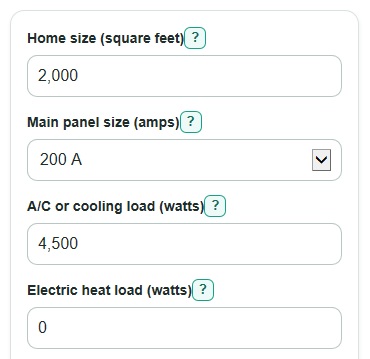
- Enter Home size (square feet), then choose Main panel size (amps) from the main breaker or service rating.
- Enter A/C or cooling load (watts) and Electric heat load (watts); the calculator uses the larger one instead of adding both.
- Enter Added load running amps (amps) for the new load you want to test, such as an EV charger setting or hot tub running load.
- Open Advanced options if you need to change Panel voltage (volts), appliance loads, circuit counts, or Added load runs for 3 hours or more.
- After calculating, sanity-check the result: Panel used near or above 100% or a negative Room left after added load means you should stop and get a licensed electrician to verify the project.
Definitions
Volt-ampere (VA): A load unit used in electrical load calculations. In this planning estimate, entered watts are treated as VA when no power factor is entered.
Calculated panel load: The estimated total demand converted to amps at the selected Panel voltage (volts).
Base home demand: The demand load from Home size (square feet), small-appliance circuits, laundry circuits, cooking, dryer, water heater, and other fixed loads before HVAC and the added load.
Heating or cooling load used: The larger value from A/C or cooling load (watts) and Electric heat load (watts).
Continuous load: A load expected to run at full load for 3 hours or more. When Added load runs for 3 hours or more is yes, the added load is counted at 125 percent.
Room left after added load: Main panel size (amps) minus Calculated panel load. A negative value means the estimate is over the selected panel size.
Largest added running load that fits: The estimated running amps for one added load that would bring the panel up to, but not over, the selected panel size using the same continuous-load choice.
Common mistakes and quick fixes
Mistake: Using the sum of branch breakers for Main panel size (amps).
Fix: Use the main breaker or service rating for Main panel size (amps), not the total of all small breakers.
Mistake: Entering the EV breaker size in Added load running amps (amps).
Fix: Enter the actual running amps or charger setting in Added load running amps (amps).
Mistake: Adding A/C or cooling load (watts) and Electric heat load (watts) by hand before entering them.
Fix: Enter each one separately; Heating or cooling load used will be the larger of the two.
Mistake: Leaving Electric dryer load (watts), Electric water heater load (watts), or Other fixed loads (watts) at defaults when your home has different nameplate loads.
Fix: Change those fields to the real nameplate watts, or use 0 for gas equipment with no electric heating load.
Mistake: Setting Added load runs for 3 hours or more to no for a load that can run continuously, such as many EV charging sessions.
Fix: Choose yes when the added load is expected to run at full load for 3 hours or more.
Mistake: Treating Smallest common panel size that fits as approval to install a larger service.
Fix: Use Smallest common panel size that fits only as a planning clue, then have a licensed electrician check local code, conductors, grounding, and equipment.
Limitations & Key Assumptions / Boundary Conditions
- This is a planning estimate for a dwelling panel. It is not a permit-ready load calculation or permission to install wiring.
- The method uses a simplified NEC-style dwelling worksheet pattern. Local amendments, utility rules, existing service conductors, equipment ratings, and permit office forms can change the required answer.
- Watts are treated as volt-amperes. Real motors, heat pumps, welders, generators, battery systems, solar equipment, and power-factor effects may need a more detailed calculation.
- The calculator uses the larger of A/C or cooling load (watts) and Electric heat load (watts). Special HVAC setups, backup heat controls, or loads that can run together may require different handling.
- Smallest common panel size that fits only checks a fixed list: 60, 100, 125, 150, 175, 200, 225, 250, 300, and 400 amps. It does not size service conductors, feeders, breakers, grounding, or utility equipment.
- A positive Room left after added load does not prove the panel is safe. A licensed electrician should inspect the actual panel condition, bus rating, breaker spaces, load balance, and local code requirements.
- A negative Largest added running load that fits means the base estimate is already above the selected panel size before adding the new load.
Methodology
How the estimate is calculated
The calculator follows a plain residential dwelling-load worksheet pattern. It starts with 3 VA per square foot, adds 1500 VA for each kitchen small-appliance circuit, adds 1500 VA for each laundry circuit, and includes the entered fixed appliance loads [1][2].
base_connected_va = home_area_sqft * 3 + small_appliance_circuits * 1500 + laundry_circuits * 1500 + range_load_kw * 1000 + dryer_load_w + water_heater_load_w + other_fixed_loads_w
The base connected load is then reduced with the dwelling demand step: the first 10000 VA is counted at 100 percent, and the amount above 10000 VA is counted at 40 percent.
base_demand_va = base_connected_va if base_connected_va <= 10000 else 10000 + 0.40 * (base_connected_va - 10000)
Heating and cooling are treated as noncoincident loads in this estimate, so the larger entered value is used.
hvac_used_va = max(cooling_load_w, heating_load_w)
The added load is converted from running amps to VA. If Added load runs for 3 hours or more is yes, the calculator multiplies the added load by 1.25.
added_multiplier = 1.25 if added_load_continuous == yes else 1.00
added_load_used_va = added_load_a * system_voltage_v * added_multiplier
Total demand is the base home demand plus the HVAC value plus the added load value. The amp result is total VA divided by Panel voltage (volts).
total_demand_va = base_demand_va + hvac_used_va + added_load_used_va
demand_amps = total_demand_va / system_voltage_v
Panel comparison uses the selected Main panel size (amps). Room left after added load is signed on purpose, so negative values show how far the estimate is over the panel size.
panel_used_percent = demand_amps / panel_rating_a * 100
room_left_amps = panel_rating_a - demand_amps
The reverse capacity answer solves for the largest added running load that would fit with the same continuous-load setting.
max_added_running_amps = (panel_rating_a * system_voltage_v - base_demand_va - hvac_used_va) / (system_voltage_v * added_multiplier)
Smallest common panel size that fits is the first size in this list that is at least the calculated amps: 60, 100, 125, 150, 175, 200, 225, 250, 300, and 400 A. If the estimate is above 400 A, the calculator shows that it is above the supported common residential list.
Mini example
For a 2000 square foot home with a 200 A panel, 4500 W cooling, no electric heat, 12 kW range, 5000 W dryer, 4500 W water heater, two kitchen small-appliance circuits, one laundry circuit, and no added load, the base connected load is 32000 VA. The base demand is 18800 VA, the HVAC value is 4500 VA, and the total is 23300 VA. At 240 V, the calculated panel load is 97.08 A. That uses 48.54% of a 200 A panel and leaves about 102.92 A before applying the same method to an added load.