
Estimate a subpanel feeder breaker size and minimum panel rating from the loads you plan to run together.
Table of contents
How to use our Subpanel Size Calculator
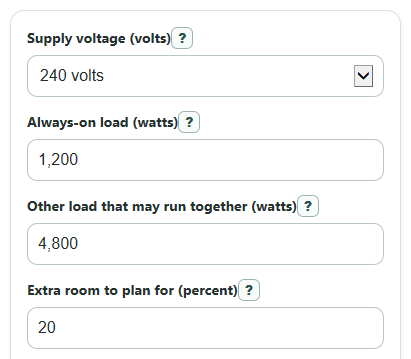
- Choose Supply voltage (volts), usually 240 volts for a typical US 120/240-volt subpanel.
- Enter Always-on load (watts) for loads that may run for 3 hours or more, then enter Other load that may run together (watts) using real expected watts, not breaker handle totals.
- Set Extra room to plan for (percent) if you want spare planning space above the calculated load.
- Use Advanced options only when they apply: add Largest motor already counted above (amps), or fill both Main service size (amps) and Existing calculated load on main service (amps) for the headroom check.
- Sanity-check the result: Recommended feeder breaker size should be above Calculated load before extra room, and Buy a subpanel rated at least does not mean the main service has more power available.
Definitions
Supply voltage (volts): The feeder voltage used to turn watts into amps. Most US home subpanels are based on 120/240-volt service, so 240 volts is common for mixed 120-volt and 240-volt loads.
Always-on load (watts): Load expected to run at full load for 3 hours or more. The calculator counts this at 125 percent.
Other load that may run together (watts): The real expected watt load that could be on at the same time. This is not the total of breaker labels.
Extra room to plan for (percent): A user-chosen spare margin added after the calculated load. It helps with planning but is not a code demand factor.
Largest motor already counted above (amps): The largest motor current that is already included in the watt load. The calculator adds only the extra 25 percent for that one motor.
Recommended feeder breaker size: The first standard amp size at or above the planning load. Standard breaker amp ratings are set in standard size lists [1].
Buy a subpanel rated at least: The minimum panel bus rating suggested by the calculator. A higher-rated panel can still be protected by a smaller feeder breaker when the equipment and code allow it.
Main service room after this subpanel: A simple headroom check: positive means amps appear left; negative means the simplified check shows a shortage.
Common mistakes and quick fixes
Mistake: Using breaker handle totals in Other load that may run together (watts).
Fix: Enter the real watts expected to run together in Other load that may run together (watts).
Mistake: Putting a short-use tool or appliance in Always-on load (watts).
Fix: Put only loads expected to run for 3 hours or more in Always-on load (watts); put short-use loads in Other load that may run together (watts).
Mistake: Setting Extra room to plan for (percent) and then treating it like a code demand factor.
Fix: Use Extra room to plan for (percent) as a planning margin only, and compare Calculated load before extra room to Planning load with extra room.
Mistake: Entering Largest motor already counted above (amps) when the motor was not included in Other load that may run together (watts).
Fix: Only enter Largest motor already counted above (amps) if that motor load is already part of Other load that may run together (watts).
Mistake: Filling Main service size (amps) but leaving Existing calculated load on main service (amps) blank.
Fix: Fill both Main service size (amps) and Existing calculated load on main service (amps), or clear both if you do not want Main service room after this subpanel.
Mistake: Reading Buy a subpanel rated at least as extra power created by the subpanel.
Fix: Treat Buy a subpanel rated at least as the minimum equipment rating; the real limit is still the feeder breaker, feeder wires, and main service.
Limitations & Key Assumptions / Boundary Conditions
- This is a planning calculator, not a permit-ready NEC dwelling load calculation.
- It treats watts as volt-amps for a simplified single-phase estimate. Power factor, appliance demand rules, heating and cooling demand rules, and dwelling-specific load rules can change the final answer.
- It estimates load amps, a feeder breaker target, and a minimum panel rating only. It does not choose wire gauge, conductor material, conduit fill, voltage drop, grounding, bonding, neutral separation, or grounding electrodes.
- A subpanel adds breaker spaces near the loads. It does not create more available power than the main service and feeder can safely supply.
- The main-service check uses Main service size (amps) minus Existing calculated load on main service (amps) minus the new subpanel load. Use a real calculated load, not the sum of breaker handle numbers.
- The supported standard breaker list stops at 400 amps. If the planning load is higher, the job needs a qualified electrician or engineer.
- Final approval depends on equipment listings, local code amendments, utility requirements, permits, and the inspector.
Methodology
Load calculation
The calculator first adjusts the always-on load, adds the other load, and adds an optional largest-motor extra amount if you entered one. It then divides by the selected voltage to get amps.
continuous_adjusted_va = continuous_load_watts * 1.25
motor_extra_va = largest_motor_amps * supply_voltage * 0.25
base_load_amps = (continuous_adjusted_va + other_load_watts + motor_extra_va) / supply_voltage
The 0.25 motor step is an extra adder because the motor is assumed to already be counted at 100 percent in Other load that may run together (watts).
Planning room and breaker size
Next, the calculator adds your planning margin and rounds up to the first supported standard breaker amp size.
planned_load_amps = base_load_amps * (1 + future_room_percent / 100)
recommended_breaker_amps = first standard breaker amp value >= planned_load_amps
The standard breaker list used is 15, 20, 25, 30, 35, 40, 45, 50, 60, 70, 80, 90, 100, 110, 125, 150, 175, 200, 225, 250, 300, 350, and 400 amps [1].
Panel rating and spare room
The suggested subpanel rating is the first common panel bus rating at or above the recommended feeder breaker size. The spare capacity shown is the breaker target minus the calculated load before extra room.
suggested_panel_rating_amps = first common panel bus amp value >= recommended_breaker_amps
spare_capacity_amps = recommended_breaker_amps - base_load_amps
A larger panel rating is an equipment rating. It does not raise the usable amps above the feeder breaker and feeder wiring limits; overcurrent devices are rated by voltage, amperage, and interrupting rating [2].
Main service check
If both optional main-service fields are filled, the calculator subtracts the existing calculated load and the new subpanel calculated load from the main service size.
main_remaining_after_load_amps = main_service_rating_amps - existing_calculated_load_amps - base_load_amps
A negative value is kept visible because it means the simplified check shows a shortage instead of unused room.
Mini example
With 240 volts, 1200 watts always on, 4800 watts other load, 20 percent extra room, and 0 motor amps, the adjusted always-on load is 1500 volt-amps. The base load is (1500 + 4800 + 0) / 240 = 26.25 amps. The planning load is 26.25 * 1.20 = 31.5 amps, so the calculator rounds up to a 35-amp recommended feeder breaker and suggests a subpanel rated at least 60 amps.