
Enter a motor's rated horsepower, voltage, efficiency, and power type to estimate its running current in amps.
Estimated at the entered rated load. Starting current can be much higher.
This is the estimated real power supplied after accounting for efficiency.
This is shaft output power, not electrical input power.
Table of contents
How to use our Motor Horsepower to Amps Calculator
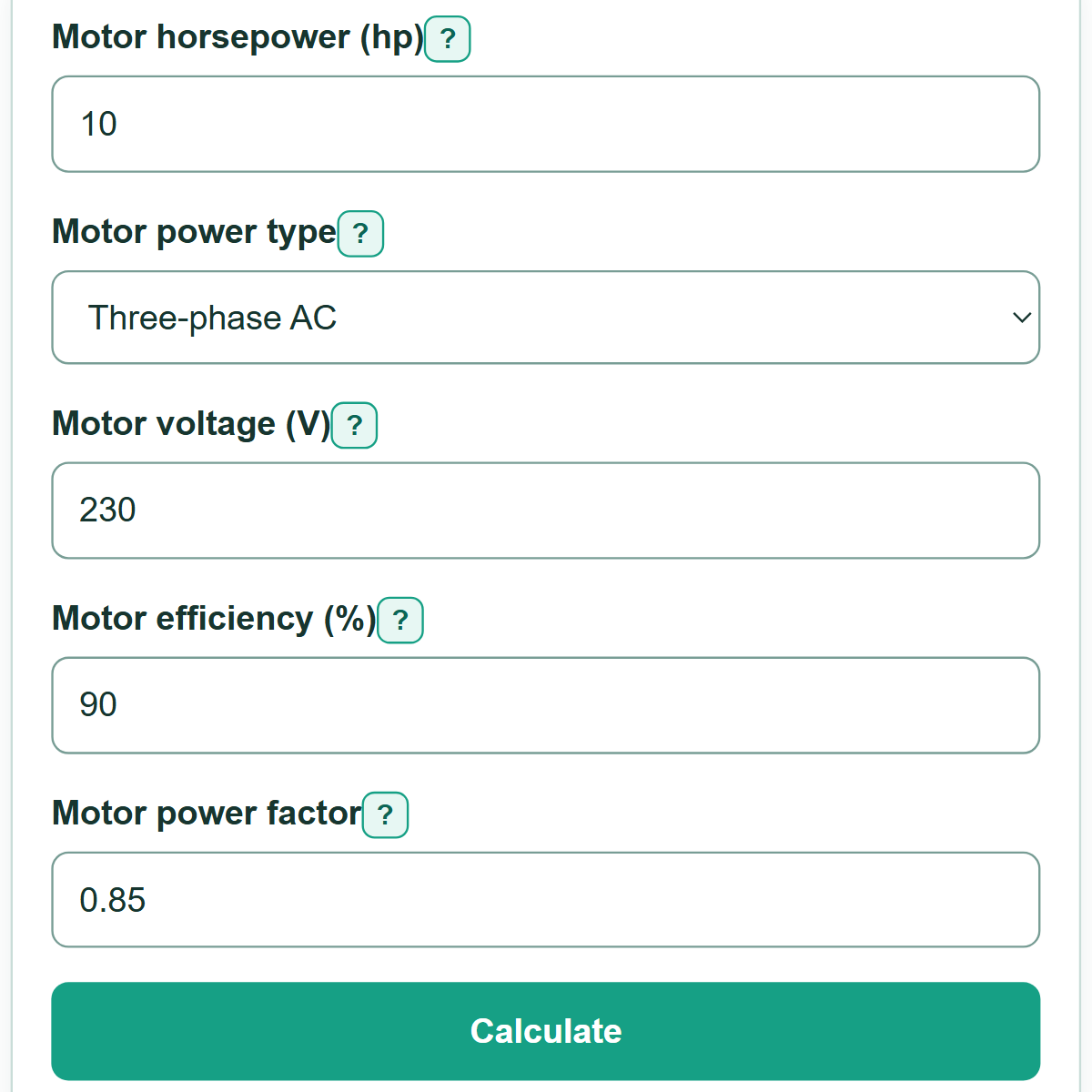
- Find the motor's rated horsepower, voltage, efficiency, and, for AC motors, power factor on its nameplate, data sheet, or manual.
- Enter the rated shaft output in "Motor horsepower (hp)". Do not enter electrical input power or kilowatts in this field.
- Choose the matching "Motor power type": "Three-phase AC", "Single-phase AC", or "DC".
- Enter "Motor voltage (V)" for the connection being used. For three-phase AC, enter the line-to-line voltage.
- Enter "Motor efficiency (%)" as the manufacturer's percent value, such as 90 for 90%.
- For an AC motor, enter "Motor power factor" as a decimal greater than 0 through 1, such as 0.85. The field is hidden for DC because power factor is not used in the DC formula.
- Select "Calculate". Read "Estimated motor current" first, then use the power results to check that electrical input power is greater than mechanical output power when efficiency is below 100%.
- Compare the estimate with the motor nameplate before making an equipment decision. Do not use this result alone to select a breaker, wire, overload, or starter.
Definitions
Mechanical horsepower (hp): Shaft output power. This calculator uses 1 mechanical hp = 745.69987158227022 W. [1]
Efficiency: Mechanical output power divided by electrical input power. A motor below 100% efficiency draws more electrical power than it delivers at its shaft.
Power factor (PF): For an AC motor, a decimal greater than 0 through 1 that relates real power to apparent power. It affects the AC current estimate and is not used for DC.
Line-to-line voltage: Voltage measured between two supply lines in a three-phase system. This is the voltage used in the three-phase formula.
Rated load: The operating condition connected to the motor's stated rating. Actual current can change when load or supply conditions change.
Common mistakes and quick fixes
Mistake: Entering electrical input kilowatts as "Motor horsepower (hp)".
Fix: Enter rated mechanical shaft horsepower from the nameplate. The calculator estimates electrical input power separately after applying efficiency.
Mistake: Using phase-to-neutral voltage for a three-phase motor.
Fix: Enter the line-to-line voltage for the motor connection in use, such as 230 V or 460 V.
Mistake: Typing 85 for "Motor power factor" when the nameplate says 0.85.
Fix: Enter power factor as a decimal greater than 0 through 1. Enter efficiency as a percent in "Motor efficiency (%)".
Mistake: Treating estimated running current as starting current or a breaker size.
Fix: Use this only as a rated-load estimate. Starting current and protection sizing need motor-specific data and applicable electrical rules.
Limitations & Key Assumptions / Boundary Conditions
- This is an estimated rated-load current from the entered horsepower, voltage, efficiency, and, for AC, power factor. It is not a nameplate-current lookup.
- The three-phase calculation assumes a balanced AC system and uses the entered line-to-line voltage.
- Actual current can differ with motor load, supply voltage, temperature, speed, motor design, and rating conditions.
- Starting current can be much higher than the estimated running current.
- Do not use this estimate alone to select conductors, breakers, fuses, overload protection, starters, or other electrical equipment. Check the motor nameplate and applicable electrical rules.
Methodology
Power conversion
The calculator converts rated mechanical horsepower to shaft output power using the mechanical-horsepower conversion factor published by NIST. [1]
Output power (kW) = horsepower x 745.69987158227022 / 1000
Efficiency adjustment
Horsepower is shaft output, not electrical input. The calculator divides shaft output by efficiency written as a decimal to estimate the electrical real power required.
Input power (kW) = output power (kW) / (efficiency (%) / 100)
Current calculation
Three-phase AC uses line-to-line voltage, power factor, and the square root of 3. Single-phase AC uses voltage and power factor. DC uses voltage without a power-factor adjustment.
Three-phase current (A) = input power (kW) x 1000 / (sqrt(3) x voltage (V) x power factor)
Single-phase current (A) = input power (kW) x 1000 / (voltage (V) x power factor)
DC current (A) = input power (kW) x 1000 / voltage (V)
Worked example
For a 10 hp three-phase motor at 230 V with 90% efficiency and 0.85 power factor, the calculator finds 7.456999 kW of mechanical output, 8.285554 kW of estimated electrical input, and 24.468884 A of estimated current.