
Estimate how many soccer field lights you need, the average brightness, and the weekly or yearly energy cost.
Table of contents
How to use our Soccer Field Lighting Calculator
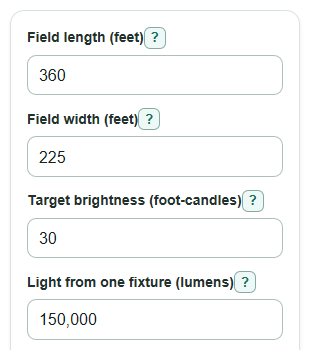
- Enter Field length (feet) and Field width (feet) for only the playing area you want to light.
- Enter Target brightness (foot-candles) and Light from one fixture (lumens) from your lighting goal and fixture spec sheet.
- Choose Round fixture count to so the install count matches your rough layout idea, such as pairs or groups of four.
- Open Advanced options if you want to adjust Light kept on the field (%), Future light level to plan for (%), Power per fixture (watts), Hours used each week, Electric price ($ per kWh), or Number display.
- Check whether Estimated average field brightness is close to the target and whether the planning note says the rough count needs extra review.
Definitions
Foot-candle: A brightness unit equal to 1 lumen landing on 1 square foot.
Lumen: A measure of how much visible light a fixture gives off.
Lux: A metric brightness unit. One foot-candle is about 10.76391 lux.
Light kept on the field (%): The share of fixture light assumed to land on the playing area after aiming and spill losses.
Future light level to plan for (%): A planning factor for light loss from aging, dirt, and normal wear.
kWh: Kilowatt-hour, the energy unit used for electric cost. A 1 kW load running for 1 hour uses 1 kWh.
Uniformity: How evenly light is spread across the field. This calculator estimates average brightness, not bright and dark spots.
Common mistakes and quick fixes
Mistake: Using the whole property for Field length (feet) and Field width (feet).
Fix: Enter only the lit playing area, unless you truly plan to light extra space too.
Mistake: Entering a lux value in Target brightness (foot-candles).
Fix: Convert lux to foot-candles first, or use a foot-candle target directly.
Mistake: Using fixture watts instead of Light from one fixture (lumens).
Fix: Put the lumen output in Light from one fixture (lumens) and the wattage in Power per fixture (watts).
Mistake: Setting Light kept on the field (%) to 100 when the fixture lumens are raw spec-sheet lumens.
Fix: Use a lower planning percent unless your lumen value already means light delivered to the field.
Mistake: Ignoring Future light level to plan for (%) and assuming lights stay as bright as new.
Fix: Keep the default or enter a realistic lower percent so the plan allows for aging and dirt.
Mistake: Reading Fixtures to install as a final pole layout.
Fix: Treat Fixtures to install as an early fixture count, then have a photometric layout check uniformity, glare, aiming, and spill light.
Limitations & Key Assumptions / Boundary Conditions
- The calculator estimates average horizontal brightness only. It does not calculate uniformity, glare, spill light, vertical illuminance, pole height, aiming angles, shadows, or broadcast needs.
- Fixture lumens are treated as one average output value. Real fixtures have beam patterns, mounting heights, optics, tilt angles, and aiming losses that change the field result.
- Light kept on the field (%) and Future light level to plan for (%) are planning assumptions. Small changes in these percents can change the fixture count a lot.
- Fixtures to install is rounded up using the selected rule, so Estimated average field brightness can be higher than Target brightness (foot-candles).
- Energy cost uses Power per fixture (watts), Hours used each week, and Electric price ($ per kWh). It does not include demand charges, controls, installation, maintenance, taxes, or utility rate tiers.
- The result should not be used as proof that a field meets a league, school, city, IES, FIFA, UEFA, or broadcast requirement. A final project needs a photometric lighting design.
Methodology
Core brightness math
The calculator first finds the playing area, then finds how many lumens must land on that area to reach the target average foot-candles.
area_ft2 = field_length_ft * field_width_ft
delivered_lumens_target = area_ft2 * target_fc
It then adjusts for light that misses the field and for the future light level plan.
required_fixture_lumens = delivered_lumens_target / ((field_keep_percent / 100) * (maintenance_factor_percent / 100))
exact_fixture_count = required_fixture_lumens / fixture_lumens
The fixture count is always rounded up. The selected rule rounds to any whole number, the next even number, or the next multiple of 4.
fixtures_to_install = rounded_up_fixture_count
Brightness after rounding
After rounding, the calculator estimates the average field brightness from the actual fixture count.
estimated_fc = (fixtures_to_install * fixture_lumens * (field_keep_percent / 100) * (maintenance_factor_percent / 100)) / area_ft2
estimated_lux = estimated_fc * 10.76391
Power and cost
Running cost uses the rounded fixture count, not the unrounded count.
total_power_kw = fixtures_to_install * fixture_watts / 1000
energy_per_week_kwh = total_power_kw * hours_per_week
estimated_cost_per_week = energy_per_week_kwh * electric_price
estimated_cost_per_year = estimated_cost_per_week * 365 / 7
Mini-example
For a 360 ft by 225 ft field, the area is 81,000 square feet. At 30 foot-candles, the delivered target is 2,430,000 lumens. With 70% light kept on the field and an 80% future light level plan, the needed fixture lumens before rounding are 4,339,285.71 lumens. With 150,000 lumens per fixture, the exact count is 28.93 fixtures. If you round to an even number, the calculator shows 30 fixtures. The estimated average brightness after rounding is 31.11 foot-candles, or about 334.88 lux. If each fixture uses 1,000 watts and the lights run 20 hours per week at $0.16 per kWh, the weekly energy cost is $96.00.