
Estimate basketball court brightness, fixture count, total lumens, lux, and power using court size, light output, and loss factors.
Advanced options
Table of contents
How to use our Basketball Court Lighting Calculator
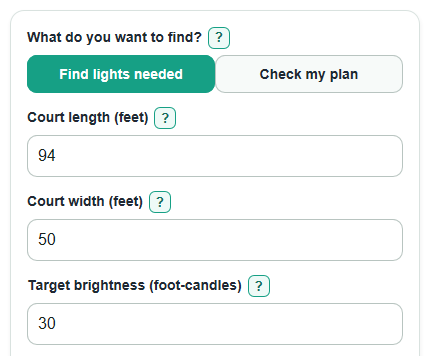
- Choose What do you want to find?: Find lights needed estimates a fixture count, while Check my plan tests your Number of fixtures planned.
- Enter Court length (feet), Court width (feet), Target brightness (foot-candles), and Light from one fixture (lumens) for the area you want lit.
- Open Advanced options if you want to change Usable light on the court (percent), Light left after aging and dirt (percent), Power for one fixture (watts), or Number format.
- Select Calculate, then read Fixtures needed or Does the plan meet the target? first, followed by Estimated average brightness in foot-candles and lux.
- Sanity-check Court area used and Fixture lumens before losses; if either looks far from your real court or fixture sheet, fix the inputs before using the estimate.
Definitions
Foot-candle: A unit for light landing on a surface. One foot-candle means one lumen spread over one square foot.
Lumen: A measure of visible light output. In this calculator, Light from one fixture (lumens) is the listed light from one fixture before the court loss factors are applied.
Usable light on the court: The percent of fixture lumens that actually lands on the court after beam spread, aiming, fixture position, and spill are considered.
Light left after aging and dirt: The percent of light still available after lamps, lenses, and dirt reduce output over time.
Lux: The metric version of light on a surface. The calculator converts foot-candles to lux using 1 foot-candle = 10.76391 lux.
Power per square foot: Estimated total power divided by Court area used. It helps compare fixture choices for the same court size.
Common mistakes and quick fixes
Mistake: Using the whole gym or yard for Court length (feet) and Court width (feet) when only the playing area needs light.
Fix: Enter the lit court rectangle so Court area used matches the space you are planning.
Mistake: Entering a league or broadcast requirement into Target brightness (foot-candles) without checking whether it is average, minimum, horizontal, or vertical light.
Fix: Use a target that matches the same type of Estimated average brightness the calculator reports.
Mistake: Putting raw LED chip lumens into Light from one fixture (lumens) when the fixture sheet also lists delivered lumens.
Fix: Use delivered fixture lumens when available so Fixture lumens before losses is less optimistic.
Mistake: Leaving Usable light on the court (percent) at 100 because the lights point toward the court.
Fix: Use a lower planning percent if beams spill outside the court or mounting positions are far from ideal.
Mistake: Treating Does the plan meet the target? as proof that the court has no dark spots.
Fix: Use Estimated average brightness as an early check, then get a photometric layout when evenness, glare, poles, or spill light matter.
Mistake: Reading Estimated total power as energy use.
Fix: Remember Power for one fixture (watts) gives connected load; energy also depends on how many hours the lights run.
Limitations & Key Assumptions / Boundary Conditions
- This is a planning estimate. A final basketball lighting design should use fixture photometric data, mounting height, aiming, pole or ceiling locations, glare control, and spill-light checks.
- Estimated average brightness does not show uniformity. A plan can meet the average target and still have dark corners or bright hot spots.
- Usable light on the court (percent) and Light left after aging and dirt (percent) are simplified factors. Real values depend on fixture optics, cleaning, aiming, and fixture age.
- Light from one fixture (lumens) should be the delivered fixture output when possible. Raw LED package lumens can make the plan look brighter than it will be.
- Target brightness (foot-candles) varies by use. Recreational play, school play, competition, video, and local rules can need different targets.
- Estimated total power is connected load only. It is not an electric bill estimate because runtime and electric rate are not included.
- The court area is treated as a flat rectangle. The calculator does not model walls, ceilings, reflectance, shadows, vertical light, or neighbor spill light.
Methodology
How the estimate is calculated
The calculator first finds the court area, then finds how much light must land on that area to reach the target average foot-candles.
area_sqft = court_length_ft * court_width_ft
delivered_lumens_needed = target_fc * area_sqft
Next, it estimates how much useful light one fixture contributes after the usable-light and light-loss percentages are applied.
effective_lumens_per_fixture = fixture_lumens * (usable_light_factor / 100) * (light_loss_factor / 100)
In Find lights needed mode, the fixture count is rounded up because you cannot install part of a fixture.
fixtures_needed = ceil(delivered_lumens_needed / effective_lumens_per_fixture)
In Check my plan mode, the calculator uses Number of fixtures planned as the fixture count, then compares the achieved brightness with the target.
achieved_fc = fixture_count * effective_lumens_per_fixture / area_sqft
achieved_lux = achieved_fc * 10.76391
It also reports total listed fixture lumens needed before losses, estimated connected power, and power per square foot.
raw_fixture_lumens_needed = delivered_lumens_needed / ((usable_light_factor / 100) * (light_loss_factor / 100))
total_watts = fixture_count * watts_per_fixture
watts_per_sqft = total_watts / area_sqft
Worked example
For a 94 ft by 50 ft court, the area is 4,700 sq ft. With a 30 fc target, the court needs 141,000 lumens landing on the playing surface.
If each fixture is 45,000 lumens, usable light is 70%, and light left after aging and dirt is 80%, one fixture contributes 45,000 * 0.70 * 0.80 = 25,200 estimated useful lumens.
141,000 / 25,200 = 5.595, so the calculator rounds up to 6 fixtures. Those 6 fixtures produce an estimated average brightness of 32.17 fc, or about 346.26 lux. If each fixture is 300 W, the estimated total power is 1,800 W and the power per square foot is about 0.383 W/sq ft.
How to read the result
Fixtures needed is the smallest whole fixture count that meets or beats the target average using the entered loss factors. Does the plan meet the target? passes only when Estimated average brightness is at least Target brightness (foot-candles). Passing the average target is useful for early budgeting, but organized competition may also have venue-specific lighting and equipment requirements [1].