
Estimate parking lot fixtures, installed lumens, maintained brightness, and a rough spacing check before ordering lights.
Table of contents
How to use our Parking Lot Lighting Calculator
- Enter Lot length (ft) and Lot width (ft) for only the area you want to light.
- Enter Target brightness (foot-candles), Lumens per fixture, and Mounting height (ft) from the pavement to the fixture.
- Open Advanced options if you want to change Light that reaches the lot (percent), Kept light after dirt and aging (percent), Target spacing as height times, or Number format.
- Click Calculate, then read Recommended fixtures first and compare Estimated maintained brightness with your Target brightness (foot-candles).
- Sanity-check Average square spacing per fixture against Target spacing from mounting height; a wide spacing note means the average light may still leave dark areas.
Definitions
Foot-candle: A light level equal to 1 lumen reaching 1 square foot of surface [1].
Lumens per fixture: The rated light output of one fixture before site losses are applied.
Light that reaches the lot (percent): The estimated share of fixture lumens that lands on the parking area instead of spilling elsewhere.
Kept light after dirt and aging (percent): The share of light expected to remain after dirt, age, and other losses.
Maintained brightness: The estimated average foot-candles on the pavement after utilization and light loss are included.
Average square spacing per fixture: A quick square-grid spacing estimate found from each fixture's share of the lot area.
Common mistakes and quick fixes
Mistake: Using the whole property for Lot length (ft) and Lot width (ft) when only the parking area needs lights.
Fix: Measure or estimate the actual paved area you want lit, or calculate separate sections.
Mistake: Entering fixture watts in Lumens per fixture.
Fix: Use the rated lumen output from the fixture spec sheet or product label.
Mistake: Treating Target brightness (foot-candles) as a code requirement for every site.
Fix: Use the target required by your local rule, owner standard, or lighting professional when one applies.
Mistake: Entering pole length for Mounting height (ft) instead of the height from pavement to fixture.
Fix: Use the installed fixture height above the pavement, not the part of the pole below grade.
Mistake: Leaving Light that reaches the lot (percent) or Kept light after dirt and aging (percent) unrealistically high.
Fix: Use manufacturer photometric data or maintenance data when you have it; otherwise keep the planning defaults conservative.
Mistake: Looking only at Recommended fixtures and ignoring Spacing check.
Fix: Review Average square spacing per fixture and Target spacing from mounting height before assuming the lot will be evenly lit.
Limitations & Key Assumptions / Boundary Conditions
- This is a quick planning estimate, not a stamped photometric lighting plan.
- The lot is treated like a rectangle. Odd shapes, islands, trees, buildings, slopes, and parked vehicles can change real light levels.
- The method estimates average horizontal light. It does not calculate dark spots, glare, uniformity ratios, light trespass, or security camera needs.
- Fixture optics matter. Two fixtures with the same Lumens per fixture can spread light very differently.
- The default Light that reaches the lot (percent), Kept light after dirt and aging (percent), and Target spacing as height times are rough planning values, not code values.
- Local codes, owner standards, permits, and utility requirements may require different Target brightness (foot-candles), shielding, controls, or pole locations.
- If Recommended fixtures is high or the Spacing check warns about wide spacing, get a photometric layout before buying fixtures or submitting for permits.
Methodology
How the fixture count is estimated
The calculator uses a lumen method. It first estimates the lot area, then finds the maintained lumens needed on the pavement, then adjusts upward for light that does not reach the lot and light lost over time.
area_sqft = lot_length_ft * lot_width_ft
maintained_lumens_needed = area_sqft * target_fc
initial_lumens_needed = maintained_lumens_needed / ((coefficient_utilization / 100) * (light_loss_factor / 100))
recommended_fixtures = ceil(initial_lumens_needed / fixture_lumens)
Rounding uses the ceiling function, which means the count is rounded up to the next whole fixture. This keeps the estimate from recommending part of a fixture.
How the result details are calculated
After the fixture count is rounded up, the calculator recalculates the installed lumens and estimated maintained brightness from the whole number of fixtures.
total_initial_lumens = recommended_fixtures * fixture_lumens
maintained_average_fc = (recommended_fixtures * fixture_lumens * (coefficient_utilization / 100) * (light_loss_factor / 100)) / area_sqft
average_fixture_spacing = sqrt(area_sqft / recommended_fixtures)
target_spacing = mounting_height_ft * spacing_multiplier
The spacing check compares average_fixture_spacing with mounting_height_ft. If the spacing is much larger than the height-based target, the lot may meet the average brightness estimate but still have dark areas between fixtures.
Worked example
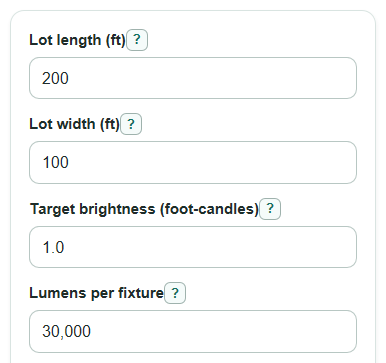
For a 200 ft by 100 ft lot, the area is 20,000 square feet. With a 1.0 foot-candle target, 30,000 lumens per fixture, 60 percent light reaching the lot, and 80 percent kept light, the initial lumens needed are 20,000 / (0.60 * 0.80) = 41,666.67 lumens. Dividing by 30,000 lumens per fixture gives 1.39, so the calculator rounds up to 2 fixtures. Installed fixture lumens are 60,000, and estimated maintained brightness is (2 * 30,000 * 0.60 * 0.80) / 20,000 = 1.44 foot-candles.