
Check transformer size, wire voltage loss, and farthest-light voltage for one low-voltage landscape lighting run.
Table of contents
How to use our Landscape Lighting Calculator
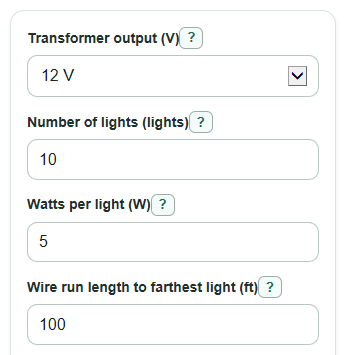
- Choose Transformer output (V), then enter Number of lights, Watts per light, Wire run length to farthest light, and Wire size.
- Open Advanced options if you need to change Where the lights sit on the run, Light rating override, Maximum transformer use, Minimum voltage at farthest light, or Number format.
- Click Calculate and read Minimum transformer size with your limit first, then check Voltage at farthest light and Run check.
- Use Thinnest common wire that passes to see whether a thicker wire could meet your voltage target without changing the lights.
- Sanity-check the result: longer runs, more watts, thinner Wire size, or lights Mostly near the end should increase Voltage lost in the wire.
Definitions
Transformer output (V): The voltage, or electrical push, sent from the transformer to this wire run.
Watts per light: The power used by one fixture. More watts means more current and more voltage lost in the wire.
AWG: American Wire Gauge. A smaller AWG number means thicker wire, lower resistance, and usually less voltage drop.
Voltage lost in the wire: The volts used up pushing current through the copper wire resistance before power reaches the farthest light.
Current in the run: The flow of electricity through the wire, measured in amps (A). Higher current causes more voltage loss in the same wire.
Minimum transformer size with your limit: The transformer watt rating needed before rounding up to a real product size, based on your Maximum transformer use setting.
Thinnest common wire that passes: The highest AWG number in the calculator list that still keeps Voltage at farthest light at or above your target.
Common mistakes and quick fixes
Mistake: Entering the total cable loop in Wire run length to farthest light.
Fix: Enter the one-way cable path from the transformer to the farthest light.
Mistake: Using total watts in Watts per light.
Fix: Enter the watt rating for one light, or the average watts for one light if fixtures differ.
Mistake: Counting lights from several branches in Number of lights.
Fix: Count only the lights on this one wire run, then calculate other branches separately.
Mistake: Choosing Spread along the run in Where the lights sit on the run when most fixtures are near the far end.
Fix: Choose Mostly near the end for a more conservative voltage loss estimate.
Mistake: Setting Minimum voltage at farthest light higher than Transformer output (V).
Fix: Lower the target or choose a transformer tap that is high enough for that target and allowed by your equipment.
Mistake: Leaving Maximum transformer use at 80 percent when your transformer manual requires a different limit.
Fix: Change Maximum transformer use to match the equipment instructions before sizing the transformer.
Limitations & Key Assumptions / Boundary Conditions
- This is a planning estimate for one low-voltage landscape lighting run, not a final electrical design.
- The voltage loss math assumes copper wire using the listed AWG resistance values at about 20 C. Aluminum wire, different cable, or hot wire can change the result.
- Spread along the run estimates evenly spaced lights by using half the run length for voltage loss. Mostly near the end uses the full one-way distance.
- The calculator does not model bad connectors, corroded splices, loose terminals, fixture driver behavior, daisy-chain tap points, hub layouts, loop layouts, or local code rules.
- Higher transformer taps can raise voltage, but you should verify the real voltage with a meter and follow the light and transformer manufacturer limits.
- If no listed Wire size passes, common fixes are to split the run, shorten the run, reduce watts on the run, use thicker wire than listed, or use equipment designed for a higher voltage.
Methodology
Core calculations
The calculator first finds Total light power from the number of fixtures on the run and the watt rating for one fixture.
total_light_watts = light_count * watts_per_light
For current, the rated light voltage is the Light rating override if you entered one. If it is blank, the calculator uses 24 V when Transformer output (V) is 24 V, and 12 V otherwise.
run_current_a = total_light_watts / rated_voltage
Voltage loss uses the selected copper AWG resistance in ohms per 1000 ft. The factor 2 counts the outgoing and return conductors.
effective_length_ft = run_length_ft / 2 when lights are spread along the run
effective_length_ft = run_length_ft when lights are mostly near the end
voltage_lost_v = 2 * run_current_a * (awg_ohms_per_1000_ft / 1000) * effective_length_ft
The farthest-light voltage is transformer output minus wire loss. If the loss is equal to or greater than the output, the run is treated as not workable with those inputs instead of showing a useful negative fixture voltage.
far_voltage_v = supply_voltage_v - voltage_lost_v
voltage_lost_pct = (voltage_lost_v / supply_voltage_v) * 100
Transformer and wire checks
The transformer size result divides the connected lighting watts by your Maximum transformer use setting.
min_transformer_w = total_light_watts / (max_transformer_use_pct / 100)
The wire suggestion checks common copper sizes in this order: 18, 16, 14, 12, 10, and 8 AWG. It returns the first size that keeps Voltage at farthest light at or above Minimum voltage at farthest light.
suggested_wire_awg = first AWG where far_voltage_v >= min_fixture_voltage_v
Mini example
For 10 lights at 5 W each, Total light power is 50 W. With a 12 V light rating, Current in the run is 50 / 12 = 4.1667 A. If the 100 ft run uses 12 AWG copper and the lights are spread along the run, the effective length is 50 ft. Using 1.588 ohms per 1000 ft, Voltage lost in the wire is about 0.6617 V, so Voltage at farthest light is about 11.3383 V. With Maximum transformer use set to 80 percent, Minimum transformer size with your limit is 50 / 0.80 = 62.5 W before rounding up to an available transformer size.