
Enter any two known circuit values to find voltage, current, resistance, and power, with an optional resistor wattage safety check.
Advanced options
How to use our Ohms Law Calculator
- Choose Find this value for the main answer you want, then choose Known values to match the two values you already know.
- Enter Known value 1 and Known value 2, and pick the correct Unit for known value 1 and Unit for known value 2 such as mA, kOhms, or mW.
- If you want a heating check, open Advanced options and enter Resistor power rating (W). You can also set Target safety margin (percent) to compare against a more cautious limit.
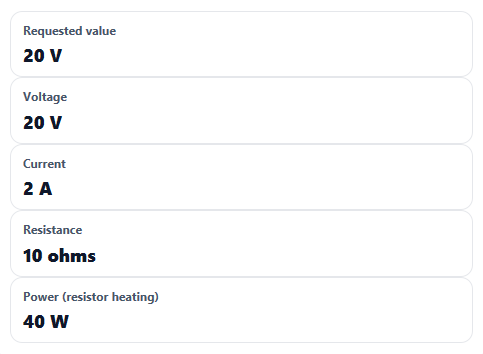
- Click Calculate to see the Requested value first, then the solved Voltage, Current, Resistance, and Power.
- Sanity-check the result: if Power looks too high for your resistor size, or the Notes card says a sign or zero value makes the pair invalid, recheck the selected pair, units, and decimal places.
Definitions
Find this value: The main result you want the calculator to highlight first.
Known values: The two circuit values you already know and want to use for the calculation.
Voltage: Electrical push across the resistor, measured in volts (V).
Current: Flow of electric charge through the resistor, measured in amperes (A).
Resistance: How much the resistor opposes current, measured in ohms.
Power: How fast electrical energy turns into heat in the resistor, measured in watts (W).
Resistor power rating (W): The maximum power a resistor is designed to handle under its rated conditions before overheating becomes a concern [1].
Target safety margin (percent): Extra room below the resistor's rating. A 50% margin means using only half of the rated power.
Requested value: The solved or confirmed value for the target you selected.
Power rating check: A comparison between calculated Power and the optional resistor rating to show headroom or overload.
Notes: Short messages that explain invalid inputs, sign limits, or why a certain pair cannot be solved.
Common mistakes and quick fixes
Mistake: Choosing the wrong Known values pair, such as entering voltage and resistance while the menu is still set to current and resistance.
Fix: Make sure Known values matches the two numbers you actually know before filling in Known value 1 and Known value 2 .
Mistake: Entering 4 in Known value 2 but leaving Unit for known value 2 as ohms when you really mean 4 kOhms.
Fix: Set the matching unit selector correctly. A unit mistake can change Resistance , Current , and Power by 1,000 times or more.
Mistake: Using 0 for a value that will be in the denominator, like zero resistance in a voltage-resistance setup.
Fix: If the calculator shows an error in Notes , change the zero input to a physically valid value for the selected formula pair.
Mistake: Entering a negative or zero Resistor power rating (W) and expecting a valid Power rating check .
Fix: Use a rating greater than 0 W, such as 0.25 W or 0.5 W, or leave the rating blank if you only want the Ohm's law results.
Mistake: Typing 150 into Target safety margin (percent) .
Fix: Keep Target safety margin (percent) at 0 to less than 100. For example, 50 means you want Power to stay at or below half the resistor rating.
Mistake: Assuming the sign of Voltage or Current can always be recovered from a power-based square-root pair.
Fix: When the pair is based on power and resistance, treat the solved Requested value as magnitude unless Notes tells you the sign is known from the chosen inputs.
Limitations & Key Assumptions / Boundary Conditions
- This calculator is for a simple DC resistive circuit that follows Ohm's law. It does not model batteries sagging, nonlinear parts, temperature effects, or AC behavior.
- Some input pairs need division, so zero values can block the calculation. For example, current cannot be found from voltage and resistance when resistance is 0.
- Power-and-resistance pairs that use a square root give magnitude only. They do not determine the sign of voltage or current by themselves.
- Negative voltage or current can be valid as signed reference values in direct formulas, but negative power with a square-root pair is not valid for this simple resistor model.
- The optional resistor check compares calculated Power with the entered Resistor power rating (W). Real resistor temperature also depends on airflow, mounting, ambient heat, and part type.
- Target safety margin (percent) is an interpretation aid, not a universal design rule. Different projects may use different safety targets.
- Scaled display units such as mA or kOhms are for easier reading only. The math is done in base units of V, A, ohms, and W.
Methodology
How the calculator solves the circuit
This calculator uses the two selected known values, converts them into base units, solves the full set of circuit values, and then displays the answer in easy-to-read units. For a simple resistor, voltage, current, resistance, and power are linked by standard Ohm's law and resistor power formulas [1][2].
V = I * R
I = V / R
R = V / I
P = V * I
P = I^2 * R
P = V^2 / R
Pair-specific solving
If you choose current and resistance, the calculator finds voltage with V = I * R and then power with P = I^2 * R. If you choose voltage and current, it finds resistance with R = V / I and power with P = V * I. If you choose voltage and resistance, it finds current with I = V / R and power with P = V^2 / R.
V = P / I
I = P / V
R = P / I^2
R = V^2 / P
V = sqrt(P * R)
I = sqrt(P / R)
For power-based pairs, the calculator checks for invalid cases first. It blocks division by zero and rejects negative values inside square roots for the simple resistor model. When a square root is used, the result is shown as the principal positive magnitude, so sign is not determined by that pair alone.
Unit conversion
The calculator converts all entered units to base units before solving: mV to V, kV to V, mA to A, uA to A, kOhms to ohms, MOhms to ohms, mW to W, and kW to W. After solving, it may show a friendlier scaled value, such as 2 mA instead of 0.002 A.
Power rating check
If you enter Resistor power rating (W), the calculator compares the solved resistor power with that rating. Positive headroom means the resistor is below its rating. Negative headroom means the resistor is overloaded.
headroom_pct = ((rated_power - P) / rated_power) * 100
If you also enter Target safety margin (percent), the calculator computes a lower recommended limit and compares actual power against that limit too.
allowed_power = rated_power * (1 - safety_margin / 100)
Example: if the resistor rating is 0.25 W and the safety margin is 50%, the allowed power for that target is 0.125 W. If the solved circuit power is 0.20 W, the resistor is still below its absolute rating but above the safer target.
Worked mini-example
Suppose Known values is voltage and resistance, with 12 V and 6 ohms. The calculator first finds current, then power.
I = 12 / 6 = 2 A
P = 12 * 2 = 24 W
So the Requested value is 2 A if you asked for current, and the full solved set is 12 V, 2 A, 6 ohms, and 24 W.
Assumptions behind the results
The method assumes one simple ohmic resistor in a DC setting, steady values, and no extra series or parallel parts. Real circuits can differ because of resistor tolerance, heating, changing supply voltage, or non-ohmic components, so use the result as a clean ideal-circuit calculation first.