
Estimate outdoor light count, brightness after rounding, installed watts, yearly cost, and low-voltage transformer size from basic fixture specs.
Advanced options
Table of contents
How to use our Outdoor Lighting Calculator
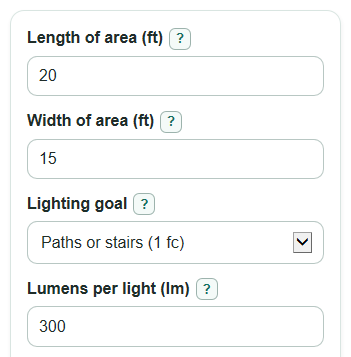
- Enter Length of area (ft) and Width of area (ft) for the space you want to light.
- Pick a Lighting goal, or choose Custom light level and enter Custom light level (fc).
- Enter Lumens per light (lm) and Watts per light (W) from the fixture label or product sheet.
- Open Advanced options only if you want to change Light reaching the area (factor), Age and dirt factor, Hours on per night, Electricity price ($ per kWh), Extra transformer capacity (%), or Number display.
- Select Calculate, then sanity-check Lights needed and compare Actual maintained light level with your target before buying fixtures.
Definitions
Foot-candle (fc): A light level equal to 1 lumen spread over 1 square foot.
Lux (lx): The metric unit for light level on a surface. The calculator uses 1 fc = 10.76391 lx.
Lumen (lm): A measure of visible light output from a lamp or fixture.
Light reaching the area (factor): The estimated share of fixture lumens that lands on the target area instead of spilling away.
Age and dirt factor: A multiplier that lowers the estimate for light lost over time from dirt, weather, and normal fixture aging.
Low-voltage transformer size before rounding: Total installed watts plus your chosen extra capacity, shown before picking a standard transformer size.
Kilowatt-hour (kWh): A unit of electricity use. One kWh equals 1000 watt-hours.
Common mistakes and quick fixes
Mistake: Using only the brightest corner for Length of area (ft) and Width of area (ft).
Fix: Measure the full zone you want covered, or split an odd shape into smaller rectangles and run the calculator more than once.
Mistake: Entering LED replacement watts in Watts per light (W).
Fix: Use the fixture input watts from the label or product sheet, because Total installed power and yearly cost depend on real watts.
Mistake: Picking Custom light level without filling Custom light level (fc).
Fix: Enter a maintained foot-candle target greater than 0, or choose a preset Lighting goal.
Mistake: Putting a percent like 60 in Light reaching the area (factor).
Fix: Enter factors as decimals from more than 0 to 1, such as 0.60 for 60%.
Mistake: Leaving Hours on per night or Electricity price ($ per kWh) unrealistic.
Fix: Use your timer schedule and electric bill rate so Estimated electricity use per year and Estimated electricity cost per year match your setup better.
Mistake: Treating Low-voltage transformer size before rounding as the exact transformer to buy.
Fix: Use Extra transformer capacity (%) to add headroom, then choose the next standard transformer size allowed by the maker.
Limitations & Key Assumptions / Boundary Conditions
- The area is treated like a rectangle. For L-shaped spaces, curved paths, or separate zones, split the space and run the calculator more than once.
- The method estimates average maintained brightness. It does not model beam angle, mounting height, glare, shadows, trees, walls, or fixture photometric files.
- Light reaching the area (factor) and Age and dirt factor are planning inputs. Real values depend on the fixture, aim, surface colors, weather, and cleaning schedule.
- Local outdoor lighting rules may limit brightness, spill light, shielding, fixture height, or hours of operation. This calculator does not check zoning or electrical code rules.
- Low-voltage transformer size before rounding is not a full wiring design. Long wire runs, voltage drop, wire size, connectors, and transformer maker limits still matter.
- Estimated electricity use per year assumes the same Hours on per night for 365 nights and no dimming, motion sensors, outages, or seasonal schedule changes.
Methodology
Core method
The calculator uses a simple lumen method: estimate the maintained lumens needed on the ground, adjust for light loss, divide by fixture lumens, then round up to a whole number of lights.
area_ft2 = area_length_ft * area_width_ft
target_maintained_lumens = target_fc * area_ft2
initial_lumens_needed = target_maintained_lumens / (utilization_factor * maintenance_factor)
fixture_count = ceil(initial_lumens_needed / lumens_per_light)
Rounding up matters because a plan with 2.1 ideal fixtures still needs 3 real fixtures.
Results after rounding
After the whole-number light count is found, the calculator checks what that real count does to brightness, power, transformer sizing, and energy cost.
actual_light_level_fc = (fixture_count * lumens_per_light * utilization_factor * maintenance_factor) / area_ft2
total_initial_lumens = fixture_count * lumens_per_light
total_watts = fixture_count * watts_per_light
min_transformer_watts = total_watts * (1 + transformer_headroom_pct / 100)
yearly_energy_use = total_watts * hours_per_night * 365 / 1000
yearly_energy_cost = yearly_energy_use * electricity_price
Annual cost is based on energy use and an entered electricity price, which is a common way to compare exterior lighting operating cost [1].
Unit conversion and spacing
The target light level in lux is included for guides and product data that use metric lighting units.
target_light_level_lux = target_fc * 10.76391
The simple spacing hint uses the area size and rounded light count to suggest a rough grid. With one light, it gives a center-placement note instead of fake spacing numbers.
Worked example
For a 20 ft by 15 ft path area, the area is 300 square feet. With a 1 fc target, 300 lm lights, a 0.60 light-reaching factor, and a 0.80 age and dirt factor, the initial lumens needed are 300 / (0.60 * 0.80) = 625 lm. Dividing by 300 lm per light gives 2.08, so Lights needed rounds up to 3. The actual maintained light level is (3 * 300 * 0.60 * 0.80) / 300 = 1.44 fc. At 4 W per light, total power is 12 W, yearly use at 6 hours per night is 26.28 kWh, and cost at $0.17 per kWh is about $4.47 per year.