
Estimate the ground area a floodlight can cover while still meeting your target brightness.
Advanced options
Table of contents
How to use our Floodlight Coverage Calculator
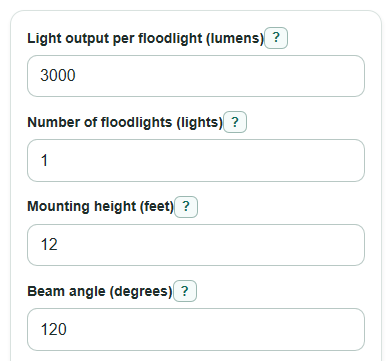
- Enter the Light output per floodlight from the product label or spec sheet.
- Enter the Number of floodlights, Mounting height, Beam angle, and Target brightness for the area you want to light.
- Open Advanced options if you want to adjust Light that still reaches the area, Estimated overlap between lights, or Number format.
- Select Calculate and read Usable coverage area first, then check What limits the coverage to see whether beam width or available light is the tighter limit.
- Sanity-check the result: if Average brightness inside the beam is below your Target brightness, the full Beam footprint area will look dimmer than your goal.
Definitions
Lumens: The total visible light output from one floodlight. More lumens can support more area or higher brightness.
Foot-candle (fc): A brightness unit equal to 1 lumen spread over 1 square foot [1].
Beam angle: The full angle of the main light cone from the fixture. A wider beam makes a larger spot but spreads the same lumens thinner.
Mounting height: The vertical height from the target surface to the floodlight. In this calculator, height is in feet.
Light that still reaches the area: The percent of rated lumens assumed to reach the target after losses from dirt, age, fixture design, or obstruction.
Estimated overlap between lights: The percent of beam area that is counted as shared when multiple floodlights cover some of the same ground.
Usable coverage area: The smaller of the beam footprint area and the brightness-supported area, so the result must be both inside the beam and bright enough.
Common mistakes and quick fixes
Mistake: Using watts instead of Light output per floodlight.
Fix: Enter lumens, not watts; watts show power use, while lumens show light output.
Mistake: Measuring Mounting height from the bottom of the wall or fixture box instead of the ground.
Fix: Use the vertical distance from the ground or target surface up to the light.
Mistake: Leaving Beam angle at 120 degrees when the fixture spec says a different angle.
Fix: Enter the listed full beam angle in degrees; do not enter half the angle.
Mistake: Setting Target brightness too low just to get a bigger Usable coverage area.
Fix: Use the foot-candle target required by your plan, class, or code, then size the lights from that result.
Mistake: Ignoring Estimated overlap between lights when several beams hit the same ground.
Fix: Raise Estimated overlap between lights when the spots overlap, because shared light does not create new covered area.
Mistake: Setting Light that still reaches the area to 100 percent for an old, dirty, or partly blocked fixture.
Fix: Use a lower percent for a more cautious estimate of delivered light.
Limitations & Key Assumptions / Boundary Conditions
- The beam footprint assumes each floodlight is aimed straight down at flat ground with a round, even beam.
- Real floodlights can have rectangular, oval, tilted, or uneven beam patterns, so measured light levels can differ from this estimate.
- The Average brightness inside the beam is an area average. The center may be brighter than the edge.
- Light that still reaches the area is a planning factor, not a measured fixture efficiency value.
- Estimated overlap between lights is a simple area reduction. It does not model how overlapping beams add brightness in shared spots.
- The calculator does not check glare, shadows, pole spacing rules, spill light, property lines, or safety-code compliance.
- Use manufacturer photometric files or a lighting professional for code-required, public-safety, sports, roadway, or glare-sensitive projects.
Methodology
How the calculator estimates coverage
The calculator first estimates the circular ground spot made by one floodlight from Mounting height and Beam angle. Then it checks whether the delivered lumens can meet the Target brightness over that much area.
radius_ft = mounting_height_ft * tan((beam_angle_deg / 2) * pi / 180)
one_beam_area_sqft = pi * radius_ft^2
Because a foot-candle is lumens per square foot, average brightness is delivered lumens divided by beam area.
light_loss_factor_decimal = light_loss_factor / 100
average_brightness_fc = (lumens_per_light * light_loss_factor_decimal) / one_beam_area_sqft
For more than one light, the beam footprint is multiplied by Number of floodlights and then reduced by Estimated overlap between lights.
geometric_beam_area_sqft = fixture_count * one_beam_area_sqft * (1 - overlap_percent / 100)
The brightness-supported area is the largest area the delivered lumens could light at the selected Target brightness, if spread evenly.
brightness_limited_area_sqft = (fixture_count * lumens_per_light * light_loss_factor_decimal) / target_fc
The final Usable coverage area is the smaller of those two limits.
usable_coverage_area_sqft = min(geometric_beam_area_sqft, brightness_limited_area_sqft)
Worked example
For one 3000 lumen floodlight mounted 12 ft high with a 120 degree Beam angle, 80 percent Light that still reaches the area, 0 percent overlap, and a 1 fc Target brightness: the radius is about 20.78 ft, the beam width is about 41.57 ft, and the beam footprint is about 1357.17 sq ft. Delivered light is 2400 lumens, so the brightness-supported area is 2400 sq ft. The calculator uses the smaller value, so Usable coverage area is about 1357.17 sq ft and the coverage is limited by the beam footprint.