
Estimate kitchen lumens, new light count, and power use while subtracting pendants or under-cabinet lights you already have.
Table of contents
How to use our Kitchen Lighting Calculator
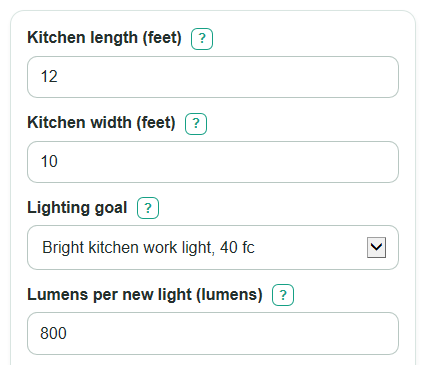
- Enter Kitchen length (feet) and Kitchen width (feet) for the main kitchen area lit by these fixtures.
- Choose Lighting goal, or pick Use my own target and enter Your target brightness (foot-candles).
- Enter Lumens per new light (lumens) from the bulb or fixture label, then add Light you already have (lumens) for lights you will keep.
- Open Advanced options only if you want to change Light that reaches the room, Dimming and dirt factor, LED efficiency (lumens per watt), or Number format.
- Click Calculate, then sanity-check Extra lumens to add and Suggested number of new lights against your room layout, fixture spacing, and whether existing task lights are included.
Definitions
Lumens: The amount of light a bulb or fixture gives off. Use lumens for brightness, not watts.
Watts: The power a light uses. Two lights can use different watts but give off similar lumens.
Foot-candles: Lumens landing on each square foot. A higher foot-candle target means a brighter work area.
Lux: Lumens landing on each square meter. It is the metric version of foot-candles.
Light that reaches the room: A factor for how much rated fixture light reaches the useful area after room shape, surfaces, and fixture direction reduce it.
Dimming and dirt factor: A factor for lower light over time from dimming, age, dirt, or lens buildup.
Extra lumens to add: The signed difference between the target installed lumens and Light you already have (lumens). A negative value means the entered existing lights are already above the target under the same settings.
Common mistakes and quick fixes
Mistake: Using old watt-equivalent numbers for Lumens per new light (lumens).
Fix: Enter the actual rated lumen number from the bulb or fixture label, such as 800 lumens.
Mistake: Including a dining room or hallway in Kitchen length (feet) and Kitchen width (feet) when those lights do not cover it.
Fix: Measure only the kitchen area served by the lights in this estimate.
Mistake: Leaving Light you already have (lumens) at 0 when you plan to keep pendants, a range hood light, or under-cabinet lights.
Fix: Add the rated lumens for lights you will keep so Extra lumens to add does not overstate the purchase.
Mistake: Choosing Countertop prep light, 50 fc as the Lighting goal for the whole kitchen when only the counters need that level.
Fix: Use Bright kitchen work light, 40 fc for a whole-room estimate, or enter a custom target only for the area you are planning.
Mistake: Treating Suggested number of new lights as the final layout plan.
Fix: Use it as a starting count, then check fixture beam spread, cabinet shadows, ceiling height, and electrical placement.
Limitations & Key Assumptions / Boundary Conditions
- This is a planning estimate, not a professional photometric lighting layout.
- The calculation treats the kitchen as one rectangle using Kitchen length (feet) times Kitchen width (feet). L-shaped kitchens, islands, tall cabinets, dark finishes, and shadows can need separate checks.
- It assumes rated lumens are accurate and that Light you already have (lumens) includes only lights you will actually keep and use.
- The Light that reaches the room and Dimming and dirt factor settings are simplified multipliers. Real rooms vary by ceiling height, fixture beam angle, wall color, lens type, and fixture placement.
- Suggested number of new lights is rounded up to whole lights and floored at 0. It does not choose fixture spacing, circuit loading, dimmer compatibility, color temperature, or electrical code compliance.
- Estimated power for new lights depends on LED efficiency (lumens per watt). Replace the default with the fixture label value when you know it.
Methodology
Core calculation
The calculator uses a simplified lumen method. It first finds the kitchen floor area, then estimates how many installed fixture lumens are needed to meet the selected foot-candle target after adjustment factors.
area_sqft = length_ft * width_ft
target_installed_lumens = area_sqft * target_fc / (utilization_factor * light_loss_factor)
extra_lumens_needed = target_installed_lumens - existing_lumens
Extra lumens to add is not clamped to zero. If it is negative, the entered existing lights already exceed the selected target under the current settings.
New light count and after-rounding brightness
The new-light count rounds up because you cannot install part of a fixture. The count is floored at 0 because adding a negative number of lights is not useful.
suggested_new_lights = max(0, ceil(extra_lumens_needed / lumens_per_light))
maintained_footcandles_after_rounding = (existing_lumens + suggested_new_lights * lumens_per_light) * utilization_factor * light_loss_factor / area_sqft
Unit and power outputs
The selected target is also converted to lux, and estimated new LED watts are based on the new lights only.
target_lux = target_fc * 10.76391
estimated_new_led_watts = suggested_new_lights * lumens_per_light / led_efficacy_lm_w
Worked example
For a 12 ft by 10 ft kitchen, area is 120 square feet. With a 40 fc target, 0.70 light that reaches the room, 0.80 dimming and dirt factor, 800 lumens per new light, and 0 existing lumens, the target installed lumens are 120 * 40 / (0.70 * 0.80) = 8,571.4 lumens. The extra lumens to add are 8,571.4 lumens, so the suggested count is ceil(8,571.4 / 800) = 11 lights. After rounding, brightness is (0 + 11 * 800) * 0.70 * 0.80 / 120 = 41.1 fc, and estimated new LED power at 100 lumens per watt is 88 W.