
Enter kVA, voltage, and phase type to calculate line current in amps using the matching voltage basis.
Table of contents
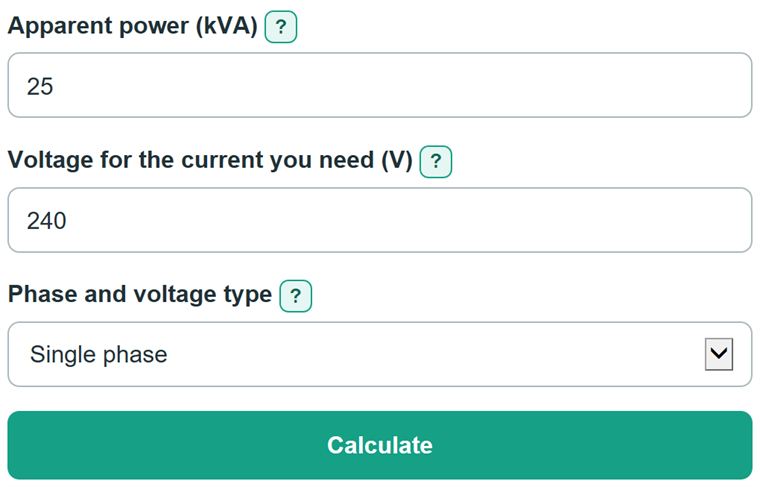
How to use our kVA to Amps Calculator
- Find the apparent-power rating in kVA on the equipment nameplate, load schedule, transformer label, or electrical drawing.
- Enter the voltage on the circuit or winding side where you need the current.
- Choose single phase, 3-phase line-to-line, or 3-phase line-to-neutral for a balanced Wye system.
- Click Calculate, then compare the displayed voltage basis with the nameplate or drawing. For example, a 480Y/277 V system can use either 480 V line-to-line or 277 V line-to-neutral, but the choice must match the number entered.
- Use the amps value as a conversion check, not as a final breaker or wire size. Apply the rules for the actual equipment and installation before selecting protection or conductors.
Definitions
kVA: Kilovolt-amperes, a unit of apparent power. One kVA equals 1,000 volt-amperes (VA).
Apparent power: AC power capacity based on voltage and current, measured in VA or kVA. It differs from real power, measured in kW.
Line current: Current flowing in a supply line conductor, measured in amperes (A).
Line-to-line voltage (L-L): Voltage measured between two phase lines in a three-phase system.
Line-to-neutral voltage (L-N): Voltage measured from one phase line to neutral. This calculator uses it only for a balanced Wye system.
Balanced Wye: A three-phase arrangement with equal phase loads and a neutral connection. Its line-to-line voltage is the square root of 3 times its line-to-neutral voltage. [2]
Power factor: The relationship between real power and apparent power. It is not needed when converting a known kVA rating directly to amps.
Common mistakes and quick fixes
Mistake: Entering kW instead of apparent power in kVA.
Fix: Use the kVA value from the nameplate. Do not add power factor when the known rating is already in kVA.
Mistake: Using voltage from the wrong transformer winding or circuit side.
Fix: Enter the voltage for the exact side where you need to know current.
Mistake: Choosing 3-phase line-to-line while entering a line-to-neutral voltage, such as 277 V on a 480Y/277 V system.
Fix: Choose 3-phase line-to-neutral (balanced Wye) when the voltage is measured from one phase line to neutral.
Mistake: Using the line-to-neutral calculation for an unbalanced load or a system that is not Wye.
Fix: Use that calculation only for a balanced Wye system. An unbalanced system needs circuit-specific analysis.
Mistake: Treating calculated current as a finished wire or breaker size.
Fix: Check the load type, continuous-load requirements, conductor conditions, overcurrent protection, and applicable electrical code.
Limitations & Key Assumptions / Boundary Conditions
- The entered kVA must be the applicable apparent-power rating, and the entered voltage must be from the point where current is being checked.
- The 3-phase line-to-line calculation assumes balanced three-phase apparent power and voltage measured between phase lines.
- The 3-phase line-to-neutral calculation applies only to a balanced Wye system with voltage measured from a phase line to neutral.
- The result is line current, not a breaker size, conductor ampacity, fault-current value, or code-compliant installation design.
- Actual operating current can differ because load, voltage, duty cycle, harmonics, and phase balance can change.
- Voltage must be greater than 0 V. A rating of 0 kVA is allowed and produces 0 A.
Methodology
Calculation method
The calculator converts kVA to VA by multiplying by 1,000, then divides by the voltage relationship for the selected circuit type. The balanced three-phase line-to-line relationship includes the square root of 3. [1]
I = kVA x 1,000 / V
For single phase, I is line current in amps and V is circuit voltage in volts.
I = kVA x 1,000 / (√3 x V L-L)
For balanced three phase using line-to-line voltage, V L-L is the voltage between phase lines.
I = kVA x 1,000 / (3 x V L-N)
For a balanced Wye system using line-to-neutral voltage, V L-N is the voltage from a phase line to neutral.
Worked example
For a 75 kVA balanced three-phase load at 480 V line-to-line, current is 75 x 1,000 / (1.7320508 x 480) = 90.2 A, rounded to one decimal place. For the same 75 kVA load at 277 V line-to-neutral in a balanced Wye system, current is 75 x 1,000 / (3 x 277) = 90.3 A. The small difference comes from 480 V being approximately the square root of 3 times 277 V.
Assumptions and limits
Power factor is not included because the input is apparent power in kVA. If you start with real power in kW, a different calculation needs power factor. Negative kVA and zero or negative voltage are outside the supported equipment-rating domain; division by zero voltage is undefined.