
Enter AC amps, volts, and your electrical setup to calculate apparent power in kVA with the correct single-phase or balanced three-phase method.
Table of contents
How to use our Amps to kVA Calculator
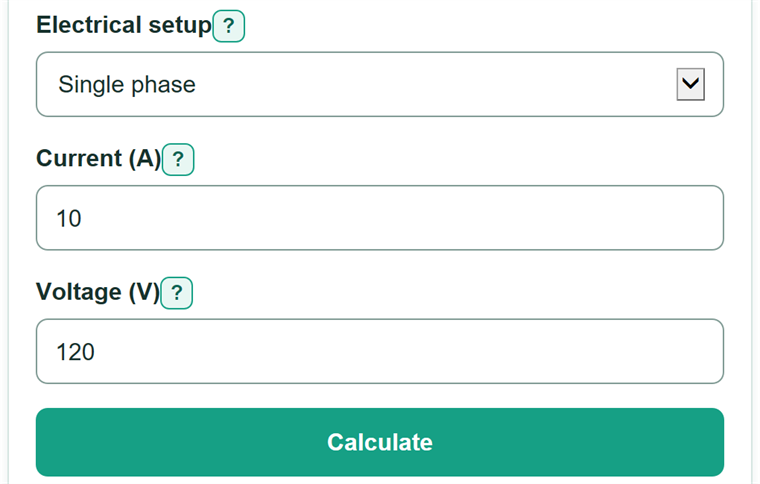
- Choose the electrical setup: single phase, three phase with line-to-line voltage, or three phase with line-to-neutral voltage.
- Enter RMS current in amps from the equipment nameplate, panel information, or an RMS meter reading.
- Enter RMS voltage in volts, making sure its reference matches the three-phase choice.
- Click Calculate to get apparent power in kVA and review the substituted calculation shown below it.
- Sanity-check that the setup, voltage reference, and one-line current match the nameplate or electrical drawing before using the result for planning.
Definitions
Apparent power (kVA): The AC load found from voltage and current, measured in kilovolt-amperes. One kVA equals 1,000 volt-amperes (VA).
RMS: A way of reporting AC voltage or current by its effective heating value. Equipment nameplates and standard AC meter readings normally use RMS values.
Single phase: An AC setup where apparent power is voltage multiplied by current.
Line-to-line voltage: Voltage measured between two phase lines in a three-phase system.
Line-to-neutral voltage: Voltage measured from one phase line to neutral in a three-phase system.
Balanced three-phase load: A load with equal current and similar electrical behavior on all three phases. The calculator's three-phase formulas use this condition.
Common mistakes and quick fixes
Mistake: Selecting single phase for a three-phase load.
Fix: Select the matching three-phase choice, then confirm whether the voltage is line-to-line or line-to-neutral.
Mistake: Entering line-to-neutral voltage while line-to-line voltage is selected.
Fix: Match the selected setup to the voltage reference on the nameplate, drawing, or meter reading.
Mistake: Adding current from all three lines before entering it.
Fix: For a balanced three-phase system, enter the current from one line.
Mistake: Typing kA or kV in fields labeled A and V.
Fix: Convert first. For example, enter 10,000 A instead of 10 kA.
Mistake: Using calculated kVA as the final breaker, conductor, generator, or transformer size.
Fix: Treat kVA as an initial load value, then apply the rules and load conditions for the installation.
Limitations & Key Assumptions / Boundary Conditions
- Use RMS voltage and RMS current. Peak AC values must be converted to RMS values first.
- Three-phase results assume a balanced load. An unbalanced load needs phase-by-phase analysis.
- Power factor is not used because kVA is apparent power. Converting kVA to kW requires power factor.
- The result is an electrical load value, not a final equipment-size recommendation. Motor starting, harmonics, continuous-load requirements, temperature, conductor rules, and local code can change the required size.
- The calculator cannot identify a three-phase voltage reference from the voltage number alone. Enter line-to-line or line-to-neutral voltage only with the matching setup.
Methodology
Calculation method
The calculator chooses the formula from the electrical setup and divides by 1,000 because 1 kVA equals 1,000 VA. The single-phase and balanced three-phase equations use RMS voltage and RMS current. [1]
apparent power (kVA) = voltage (V) x current (A) / 1000
Use this equation for single phase.
apparent power (kVA) = sqrt(3) x line-to-line voltage (V) x line current (A) / 1000
Use this equation for balanced three phase when voltage is measured between two lines. sqrt(3) is about 1.7320508.
apparent power (kVA) = 3 x line-to-neutral voltage (V) x line current (A) / 1000
Use this equation for balanced three phase when voltage is measured from a line to neutral.
Worked example
A balanced three-phase load has 208 V line-to-line and 10 A line current. Its apparent power is 1.7320508 x 208 x 10 / 1000 = 3.603 kVA after rounding.
Calculation scope
Current and voltage are nonnegative RMS magnitudes, so zero current or zero voltage gives 0 kVA. The calculation reports apparent power only. It does not apply power factor or determine a final equipment size.