
Enter your daily use, utility bill, or appliance loads to estimate the nominal battery-bank capacity needed for planned days without charging.
Advanced options
Nominal stored energy after backup days, usable capacity, losses, and extra margin.
Check this daily total before relying on the battery target.
Whole-battery layout details
Capacity plan only. Follow the battery and inverter wiring limits.
Table of contents
How to use our Solar Battery Bank Calculator
- Choose "Enter an energy total" if you have a utility bill, energy-monitor reading, or known daily total. Choose "Build from appliances" if you need to estimate daily energy from individual loads.
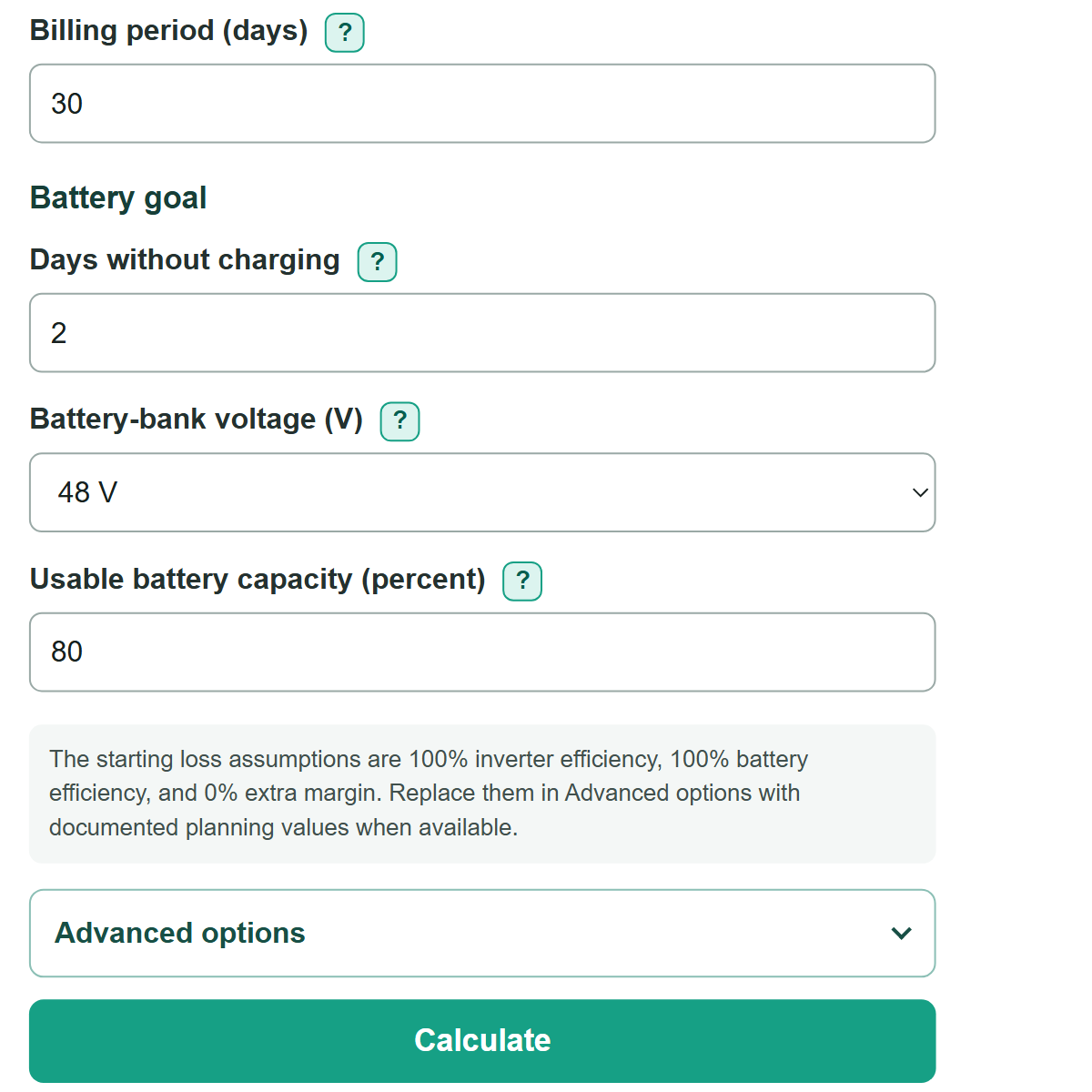
- For a utility bill, select "kWh per billing period" and enter both the bill's kWh use and the actual "Billing period (days)" shown on that bill.
- Enter "Days without charging", choose the planned "Battery-bank voltage (V)", and enter the battery maker's "Usable battery capacity (percent)".
- Open "Advanced options" to enter documented inverter and battery efficiency values, add an extra capacity margin, or enter matching battery-module ratings for a whole-module layout.
- Select "Calculate", then check that "Calculated daily electricity use" matches a realistic day before using the nominal kWh and Ah targets for planning.
Definitions
kWh (kilowatt-hour): A unit of electrical energy equal to 1,000 watt-hours. Utility bills commonly report electricity use in kWh. [1]
Wh (watt-hour): A smaller energy unit. A 100-watt device running for 2 hours uses 200 Wh.
Ah (amp-hour): A battery capacity rating that must be read with a stated voltage. Ah alone does not show stored energy.
Nominal battery capacity: The labeled or planned stored-energy capacity before applying the usable-capacity limit.
Usable battery capacity: The share of nominal battery energy the plan allows you to use. At 80 percent, the plan uses 80 percent of nominal stored energy.
Days without charging: The number of days the battery should run planned loads without useful solar, grid, or generator charging.
Inverter efficiency: The share of battery DC energy delivered to AC loads after conversion by an inverter.
Common mistakes and quick fixes
Mistake: Entering a monthly bill total as daily energy use.
Fix: Select "kWh per billing period" and enter the actual number of days covered by that bill.
Mistake: Treating amp-hours as a complete battery-size answer without checking voltage.
Fix: Read the Ah result with the selected "Battery-bank voltage (V)". The same kWh target needs different Ah at 12 V, 24 V, and 48 V.
Mistake: Using appliance watts without quantity or daily runtime.
Fix: For every appliance row, enter running watts, the number of matching appliances, and realistic hours used per day.
Mistake: Using 100 percent usable capacity when the battery documentation allows less.
Fix: Copy the allowed usable capacity or depth-of-discharge limit from the battery maker's documentation.
Mistake: Treating the optional module layout as wiring approval.
Fix: Use voltage and Ah from one matching battery model, then confirm series-parallel limits with the battery and inverter manuals.
Limitations & Key Assumptions / Boundary Conditions
- This is an energy-capacity estimate. It does not verify inverter continuous power, motor startup surge, battery current limits, wire size, fuses, breakers, or overcurrent protection.
- Daily electricity use can change with weather, occupancy, standby loads, appliance settings, and seasonal heating or cooling.
- The result depends on the usable-capacity and efficiency values entered. The default 100 percent efficiency values do not include real system losses.
- The optional module layout rounds up to complete parallel strings and assumes matching modules. It does not approve a series-parallel connection or override manufacturer limits.
- Battery-bank voltage is nominal and changes during charging and discharging. The Ah result is a capacity conversion, not a voltage-drop calculation.
Methodology
Daily energy
The calculator first finds daily electricity use. A direct daily kWh value stays in kWh. Daily Wh is divided by 1,000. Bill-period kWh is divided by the entered billing days, so it does not assume every bill covers the same number of days. In the appliance path, each row's running watts, quantity, and hours per day are multiplied, then all rows are added.
appliance daily Wh = sum of (watts * quantity * hours per day)
daily energy kWh = daily Wh / 1000
daily energy kWh = bill-period kWh / billing days
Battery capacity
Daily energy is multiplied by the requested days without charging and any extra capacity margin. The result is divided by usable battery capacity, inverter efficiency, and battery energy efficiency. Each percent value is converted to a decimal before it is used.
required nominal kWh = daily kWh * days without charging * (1 + margin / 100) / ((usable capacity / 100) * (inverter efficiency / 100) * (battery efficiency / 100))
The calculator then converts the nominal energy target to amp-hours at the selected nominal bank voltage.
required Ah = required nominal kWh * 1000 / bank voltage
Whole-module layout
If both optional module ratings are entered, the calculator divides bank voltage by module voltage to find modules in each series string. It rounds the number of parallel strings up to a whole number so the planned module bank meets or exceeds the calculated Ah target.
series modules = bank voltage / module voltage
parallel strings = ceiling(required Ah / module Ah)
total modules = series modules * parallel strings
Worked example
A bill showing 300 kWh over 30 days equals 10 kWh per day. With 2 days without charging, 80 percent usable capacity, 100 percent inverter efficiency, 100 percent battery efficiency, and no extra margin, the required nominal capacity is 25 kWh. At 48 V, that converts to about 520.8 Ah.