
Use this solar panel angle calculator to pick a simple fixed tilt and compare it with your roof or current setup.
Advanced options
Table of contents
How to use our Solar Panel Angle Calculator
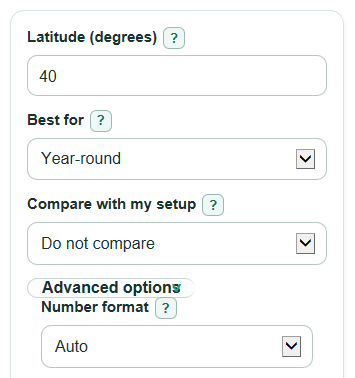
- Enter Latitude (degrees), using a positive number north of the equator and a negative number south of it.
- Choose Best for: Year-round, Summer, Winter, or Spring and fall.
- Use Compare with my setup if you want to enter Current panel angle (degrees) or Roof rise (inches per 12 inches).
- Open Advanced options only if you need a different Mount angle step (degrees), Number format, or Summer or winter offset (degrees), then select Calculate.
- Sanity-check the results: Recommended tilt angle and Nearest mount setting should be between 0 and 90 degrees, and a small Simple tilt-only loss means your current angle is close in this simple check.
Definitions
Tilt: The panel angle above flat ground. A flat panel is 0 degrees, and a panel straight up is 90 degrees.
Latitude: How far a place is north or south of the equator, measured in degrees.
Azimuth: Compass direction. In solar tools, azimuth is often measured from true north, so true south is 180 degrees.
Roof pitch: A roof slope written as rise over a 12-inch horizontal run. A 6/12 roof rises 6 inches for every 12 inches across.
Mount angle step: The size of each angle move your bracket can make, such as 1 degree or 5 degrees.
Simple tilt-only direct-sun factor: A rough geometry check that compares only the tilt angle miss. It does not include shade, weather, panel type, or direction.
Common mistakes and quick fixes
Mistake: Entering a south latitude as a positive Latitude (degrees).
Fix: Use a negative Latitude (degrees) south of the equator, such as -33.9 for Sydney.
Mistake: Reading Best facing direction as a magnetic compass bearing.
Fix: Treat Best facing direction as a true direction when possible; true south and magnetic south can be different.
Mistake: Choosing Roof pitch rise over 12 but typing a roof slope angle into Roof rise (inches per 12 inches).
Fix: Enter the rise number from a pitch like 6/12 as 6, not 26.6 degrees.
Mistake: Expecting Simple tilt-only loss to predict yearly solar production.
Fix: Use Simple tilt-only loss only to compare angle closeness, not to estimate annual kWh or savings.
Mistake: Ignoring Nearest mount setting when your bracket only moves in large steps.
Fix: Set Mount angle step (degrees) to match your hardware and use Nearest mount setting for the real adjustment.
Limitations & Key Assumptions / Boundary Conditions
- This calculator uses a simple latitude rule. Year-round and spring/fall tilt equal absolute latitude; summer subtracts the seasonal offset; winter adds it.
- It does not estimate annual kWh, bill savings, payback, or battery charging time.
- It does not use local weather, shading, roof direction, panel efficiency, inverter losses, snow, temperature, or hourly sun paths.
- Best facing direction is a broad fixed-panel rule: true south north of the equator and true north south of the equator. Local shade can make another direction better.
- Latitude must be from -90 to 90 degrees, Current panel angle (degrees) must be from 0 to 90, and Roof rise (inches per 12 inches) must be from 0 to 60.
- The Simple tilt-only direct-sun factor is a closeness check. A small loss here does not guarantee the same small loss in real yearly production.
Methodology
Basic tilt rule
The calculator first changes Latitude (degrees) into an absolute latitude, because the tilt size is based on distance from the equator.
L = abs(latitude_deg)
For Year-round and Spring and fall, the Recommended tilt angle is the absolute latitude. This is the common quick rule for fixed panels [2]. For Summer, the calculator subtracts the Summer or winter offset (degrees). For Winter, it adds that offset and caps the result at 90 degrees.
if Best for = Year-round or Spring and fall: raw_tilt = L
if Best for = Summer: raw_tilt = max(0, L - seasonal_offset_deg)
if Best for = Winter: raw_tilt = min(90, L + seasonal_offset_deg)
Mount setting and roof pitch
The Nearest mount setting rounds the Recommended tilt angle to the selected Mount angle step (degrees), then keeps it between 0 and 90 degrees.
rounded_tilt = clamp(round(raw_tilt / angle_step_deg) * angle_step_deg, 0, 90)
If Compare with my setup uses Roof pitch rise over 12, the roof pitch is converted to degrees with arctangent. The run is 12 inches.
roof_pitch_angle_deg = atan(roof_rise_per_12 / 12) * 180 / pi
Comparison outputs
Angle change needed compares the rounded mount setting with your current panel angle or converted roof angle. Positive means raise the panel. Negative means make it flatter.
change_needed_deg = rounded_tilt - current_angle_deg_or_roof_pitch_angle_deg
The Simple tilt-only direct-sun factor uses the cosine of the angle miss between the raw recommended tilt and the compared angle. The Simple tilt-only loss is the rest of 100 percent.
factor_pct = cos(abs(raw_tilt - current_angle_deg_or_roof_pitch_angle_deg) * pi / 180) * 100
loss_pct = 100 - factor_pct
Mini-example
For latitude 34.05, Best for Summer, offset 15 degrees, Mount angle step 0.5 degrees, and Current panel angle 20 degrees, the raw tilt is 34.05 - 15 = 19.05 degrees. The nearest mount setting is 19 degrees. Angle change needed is 19 - 20 = -1 degree, so the panel would be made 1 degree flatter. The tilt-only factor is about 99.986 percent, so the simple tilt-only loss is about 0.014 percent.
Facing direction
The calculator uses the sign of Latitude (degrees) for Best facing direction.
if latitude_deg > 0: facing_direction = true south
if latitude_deg < 0: facing_direction = true north
if latitude_deg = 0: either true north or true south can work for this simple rule