
Convert a documented post-snug bolt rotation into turns, degrees, and ideal thread advance for a US fastener size.
Advanced options
Table of contents
How to use our Torque-Angle Bolt Tightening and Turn-of-Nut Calculator
- Copy the documented first-stage value into Snug torque and keep it separate from the later rotation step.
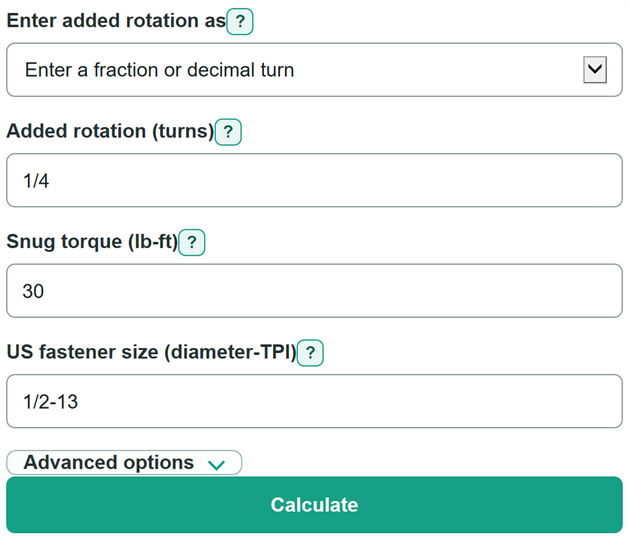
- Choose the wording used by the procedure under Enter added rotation as, then enter degrees or a fraction such as 1/4 in Added rotation.
- Enter the printed inch thread designation in US fastener size, such as 1/2-13.
- Select Calculate, then use the turns or degrees result that matches your angle tool or marking plan.
- Sanity-check that 1/4 turn equals 90 deg and that a higher threads-per-inch value gives a smaller Ideal thread advance for the same rotation.
Definitions
Snug torque: The specified first tightening stage before the added rotation.
Added rotation: The turn applied after the snug stage. One full turn equals 360 deg.
US fastener size: An inch-thread designation such as 1/2-13. The first part is nominal diameter in inches; the second part is threads per inch.
Threads per inch (TPI): The number of thread peaks in one inch. For a single-start thread, it determines the distance moved by one full turn.
Ideal thread advance: Calculated axial movement along the thread from the entered rotation and TPI. It is not bolt elongation, joint compression, or clamp load.
Significant digits: The number of meaningful digits shown in a displayed result. This setting changes rounding on screen, not the calculation.
Common mistakes and quick fixes
Mistake: Entering the final desired torque in Snug torque.
Fix: Enter only the documented first-stage torque before the added rotation.
Mistake: Typing 1/4 while Enter added rotation as is set to degrees.
Fix: Choose the turn entry method for fractions, or enter 90 for the same rotation in degrees.
Mistake: Using total bolt length as US fastener size.
Fix: Enter the nominal diameter-TPI marking, such as 3/8-16 or 1/2-13.
Mistake: Writing the thread size as 1/2 x 13 in US fastener size.
Fix: Use one hyphen between diameter and TPI: 1/2-13.
Mistake: Treating Ideal thread advance as measured bolt stretch or clamp load.
Fix: Use it only as ideal movement along a single-start thread; verify any required elongation or preload by the governing procedure.
Mistake: Filling in Custom threads per inch when the standard designation is already correct.
Fix: Leave it blank unless a drawing, thread gauge, or manufacturer data gives a different TPI.
Limitations & Key Assumptions / Boundary Conditions
- Use this calculator only to restate a documented tightening instruction or plan markings. It does not create a torque-angle or turn-of-nut specification.
- Ideal thread advance assumes a single-start inch thread with lead equal to 1 divided by TPI. Multi-start threads need their actual lead.
- Thread advance is not verified bolt stretch, joint compression, clamp load, or preload. Seating, joint deformation, coatings, lubrication, and fastener condition can change those physical results.
- The calculator repeats the entered snug torque and does not estimate a final torque after rotation. Do not substitute an estimated torque for a manufacturer or project procedure.
- For structural bolting, thread size alone does not determine the required turn. Follow the applicable project specification and structural bolting procedure, including its bolt-length and connected-part conditions.
- A zero added rotation is accepted as a conversion case, but it does not mean a zero-rotation tightening instruction is appropriate for an actual joint.
Methodology
Calculation method
The calculator first converts the documented post-snug rotation to turns, then converts turns to degrees. It keeps the entered snug-torque stage separate and does not combine it with the rotation step.
rotation in turns = entered degrees / 360
rotation in degrees = rotation in turns x 360
For a turn entry, a complete decimal such as 0.25 or one simple fraction such as 1/4 is converted directly to turns. The fastener designation must have a positive inch diameter and positive TPI separated by one hyphen. A nonblank Custom threads per inch value replaces the TPI in that designation.
ideal thread advance (in) = rotation in turns / applied TPI
Worked example
For 1/4 turn on a 1/2-13 fastener, the rotation is 0.25 turn and 90 deg. The ideal thread advance is 0.25 / 13 = 0.01923 in. If the specified snug torque is 30 lb-ft, the initial snug-torque target remains 30 lb-ft.
Calculation scope
The calculation uses only angle conversion and single-start thread lead arithmetic. It validates the nominal diameter in the designation for clarity, but diameter is not used to estimate fastener strength, stress, clamp load, bolt stretch, or equivalent final torque.