
Enter cable data and reel measurements to check fit, remaining capacity, cable weight, and loaded-reel gross weight.
Advanced options
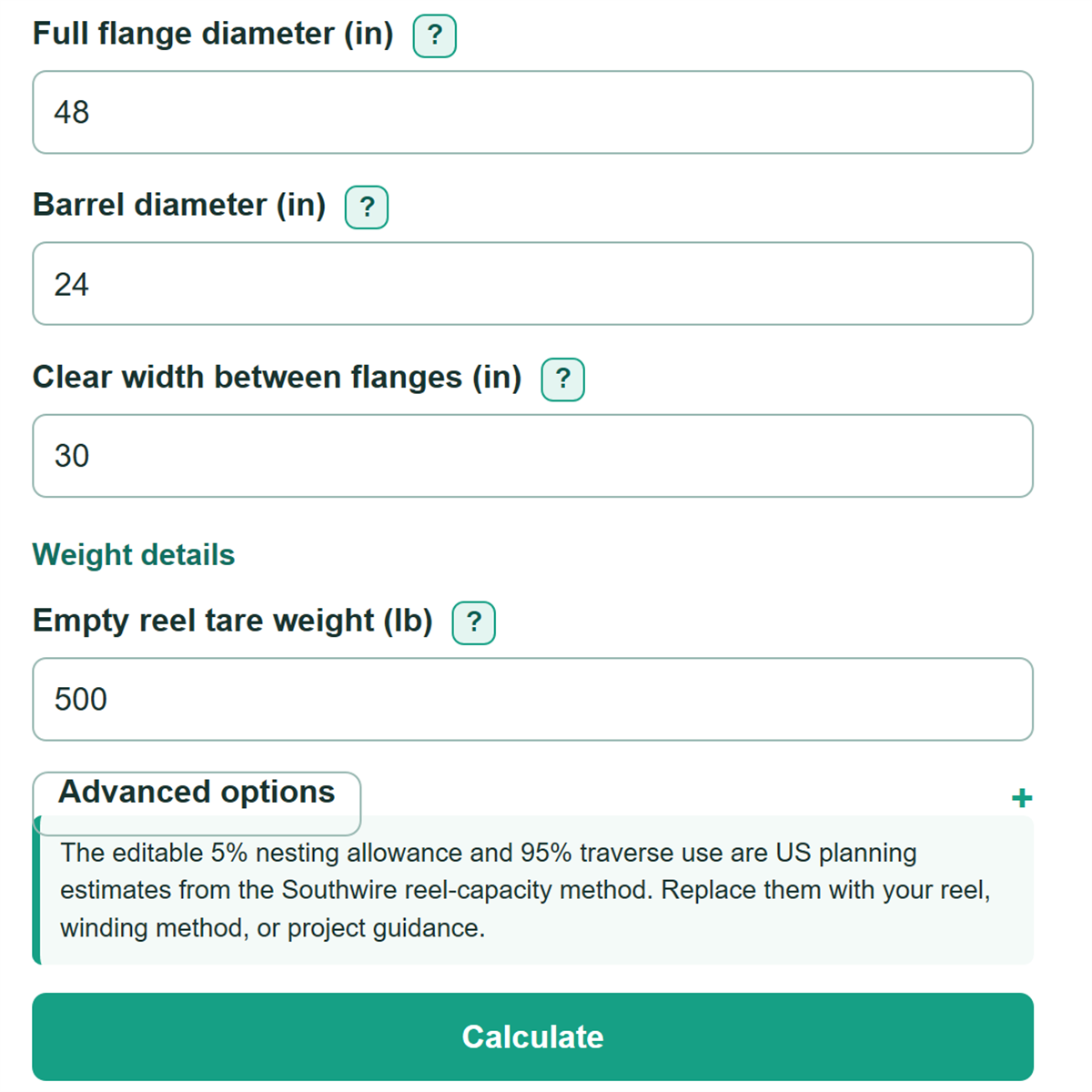
The editable 5% nesting allowance and 95% traverse use are US planning estimates from the Southwire reel-capacity method. Replace them with your reel, winding method, or project guidance.
Table of contents
How to use our Multi-Conductor Cable Weight, Length and Drum Capacity Calculator
- Choose Measurement system to match the cable data sheet and reel drawing.
- Enter the finished cable OD, Cable weight, and Required cable length from the cable schedule or manufacturer data.
- Enter the full flange diameter, barrel diameter, clear width between flanges, and empty reel tare weight.
- Open Advanced options only if you need extra ordering length, edge clearance, retained barrel wraps, or different packing assumptions.
- Click Calculate, then check Cable length remaining or over capacity: a positive number fits with space left, while a negative number is the length that will not fit.
Definitions
Finished cable outside diameter (OD): The outside diameter of the complete cable, including jacket, shield, armor, and all conductors. It controls winding space.
Barrel diameter: The diameter of the reel core where the first cable layer rests.
Clear width between flanges: The usable inside reel width between flange faces, not the outside reel width.
Tare weight: The weight of the empty reel. Gross weight is cable net weight plus tare weight. [2]
Practical cable capacity: The geometric reel capacity adjusted for edge clearance, retained wraps, cable nesting, and usable traverse width.
Cable nesting allowance: A packing adjustment for round cables settling into spaces between neighboring turns.
Common mistakes and quick fixes
Mistake: Entering conductor size, such as 4/0, for Finished cable outside diameter.
Fix: Copy the completed cable assembly OD from the manufacturer data sheet.
Mistake: Entering cable weight per foot in Cable weight when the US label is lb/1000 ft.
Fix: Copy the listed lb/1000 ft value directly, or use Metric units when the data sheet gives kg/km.
Mistake: Entering flange height instead of Full flange diameter.
Fix: Measure straight across the entire flange through its center.
Mistake: Using the reel's outside width for Clear width between flanges.
Fix: Enter only the usable inside distance between the flange faces.
Mistake: Treating Empty reel tare weight as part of Cable weight.
Fix: Enter tare separately; it is added once to Requested loaded-reel gross weight.
Mistake: Reading a negative Cable length remaining or over capacity as zero space left.
Fix: The negative value is the planned cable length that exceeds the practical reel capacity.
Limitations & Key Assumptions / Boundary Conditions
- Capacity is an estimate based on finished cable OD, reel dimensions, and round-cable winding geometry. Flat, oval, irregular, damaged, or loosely wound cable can occupy different space.
- The default 5 percent nesting allowance and 95 percent usable traverse width are editable planning assumptions. Replace them with a documented reel or winding requirement when available.
- Clearance and retained wraps are optional because their required values depend on the reel application, equipment, and project rules. Do not apply hoist or winch rules to a shipping reel without confirming they apply.
- Loaded-reel gross weight includes cable net weight and empty reel tare only. It excludes packaging, hardware, moisture, shipping restraints, deposits, and commercial reel charges.
- A fit result does not confirm that a truck, axle, hoist, forklift, floor, or cable-pulling system is rated for the calculated load.
- Use the finished cable OD and unit weight for the exact product. Conductor count and conductor size alone cannot reliably determine capacity or weight.
Methodology
Capacity calculation
The calculator converts all entered dimensions to inches, calculates the usable winding space, and then converts results back to the selected measurement system. The reel-capacity geometry uses full flange and barrel diameters. [1]
usable winding diameter = full flange diameter - 2 x cable clearance
effective barrel diameter = barrel diameter + 2 x finished cable OD x retained wraps
theoretical capacity (ft) = (π / 48) x (usable winding diameter^2 - effective barrel diameter^2) x clear width between flanges / finished cable OD^2
Practical capacity applies the editable nesting and traverse assumptions after the geometric result.
practical capacity = theoretical capacity x (1 + nesting allowance / 100) x (usable traverse width / 100)
Length and weight
Planned length is Required cable length plus Extra ordering length. Cable net weight uses the manufacturer unit weight, and empty reel tare is added once.
fit margin = practical capacity - planned cable length
requested cable net weight = planned cable length x cable weight per foot
requested loaded-reel gross weight = empty reel tare weight + requested cable net weight
For example, a 1,000 ft cable listed at 1,000 lb/1000 ft has a 1,000 lb cable net weight. On a 500 lb empty reel, the requested loaded-reel gross weight is 1,500 lb.
Calculation boundaries
Blank Extra ordering length, Cable clearance below flange edge, and Cable wraps kept on the barrel are treated as zero. Physical dimensions and cable weight must be positive; planned length and tare may be zero. The calculation stops if the flange is not larger than the barrel or if clearance and retained wraps leave no winding space. A negative fit margin is preserved because it states how much planned cable does not fit.