
Calculate basic bearing L10 operating life or the minimum dynamic load rating C needed for a target service life.
Advanced options
Table of contents
How to use our Bearing L10 Life and Load Rating Calculator
- Choose whether to find L10 life or find the required C rating, then select Ball bearing or Roller bearing.
- Choose the force unit used by your catalog or load calculation. Enter every rating and load in that same shared unit.
- Enter Basic dynamic load rating C for a life check, or Target L10 life for a required-C calculation. Enter Shaft speed in rpm.
- Choose how to enter the bearing load. Enter Equivalent dynamic load P, or enter Radial load Fr, Axial load Fa, and the catalog factors X and Y.
- Check that Equivalent dynamic load P used is positive and that C/P matches your entered values. Treat Basic L10 life in operating hours as a 90 percent reliability rating, not a replacement date.
Definitions
Basic dynamic load rating C: A catalog rating used in the basic rolling-bearing life equation. It is not the static rating C0.
Equivalent dynamic load P: The load used in the life equation. It can be entered directly or calculated as X times Fr plus Y times Fa.
Radial load Fr: Load acting toward or away from the shaft center.
Axial load Fa: Thrust load acting along the shaft.
Catalog factors X and Y: Bearing- and load-condition-specific factors that weight Fr and Fa when calculating P. Copy them from the exact bearing catalog.
L10 life: Basic bearing fatigue rating life at 90 percent reliability for a bearing population, not a guaranteed life for one bearing. [1]
C/P: The basic dynamic rating divided by equivalent dynamic load. The calculator raises this ratio to a bearing-type life exponent.
Common mistakes and quick fixes
Mistake: Entering static rating C0 as Basic dynamic load rating C.
Fix: Copy the catalog's basic dynamic rating C for the exact bearing; C0 is used for a different static-load check.
Mistake: Entering radial load as Equivalent dynamic load P while Axial load Fa is present.
Fix: Choose the radial-and-axial route and enter Radial load Fr, Axial load Fa, Catalog radial factor X, and Catalog axial factor Y from the bearing catalog.
Mistake: Mixing kN for Basic dynamic load rating C with lbf for Equivalent dynamic load P.
Fix: Set Force unit for all ratings and loads first, then enter or convert every force value in that one unit.
Mistake: Using calendar time for Target L10 life.
Fix: Enter operating hours only. Running time each operating day and Operating days each year only convert the result into calendar service years.
Mistake: Treating Basic L10 life in operating hours as the exact time one bearing will fail.
Fix: Use it as a basic 90 percent reliability fatigue-life rating and complete the manufacturer's selection checks before approving a bearing.
Limitations & Key Assumptions / Boundary Conditions
- This calculator uses the basic L10 rating-life equation only. It does not calculate modified or adjusted bearing life for lubrication, contamination, temperature, mounting, preload, misalignment, vibration, or material differences.
- Use Basic dynamic load rating C, not static rating C0, and use catalog data for the exact bearing part number.
- If calculating Equivalent dynamic load P from loads, X and Y must match the bearing type and applicable load condition in the manufacturer catalog.
- C and P must use the same force unit. Switching the shared unit preserves physical force values, but copied catalog values should still be checked for unit labels.
- Basic L10 life is a population fatigue-life rating at 90 percent reliability. It is not a guaranteed failure time, maintenance interval, or complete bearing-selection approval.
- Calendar service years are only Basic L10 life in operating hours divided by the entered operating schedule. A missing schedule does not change the operating-hours result.
Methodology
Basic life calculation
The calculator uses the basic rolling-bearing rating-life relationship. Ball bearings use a life exponent of 3, and roller bearings use 10/3. Basic L10 is the 90 percent reliability rating life. [1]
P = direct P, or X * Fr + Y * Fa
L10 (million revolutions) = (C / P)^p
Basic L10 life in operating hours = L10 * 1,000,000 / (60 * rpm)
In these formulas, p is the life exponent selected by Bearing type. C and P are valid only when they use the same force unit. The force-unit selector converts N, kN, and lbf entries together so the C/P ratio keeps the same physical meaning.
Required C calculation
For the reverse mode, the calculator first converts Target L10 life and Shaft speed into required million revolutions, then solves the same relationship for C.
Minimum basic dynamic load rating C = P * ((target hours * 60 * rpm) / 1,000,000)^(1 / p)
Worked example
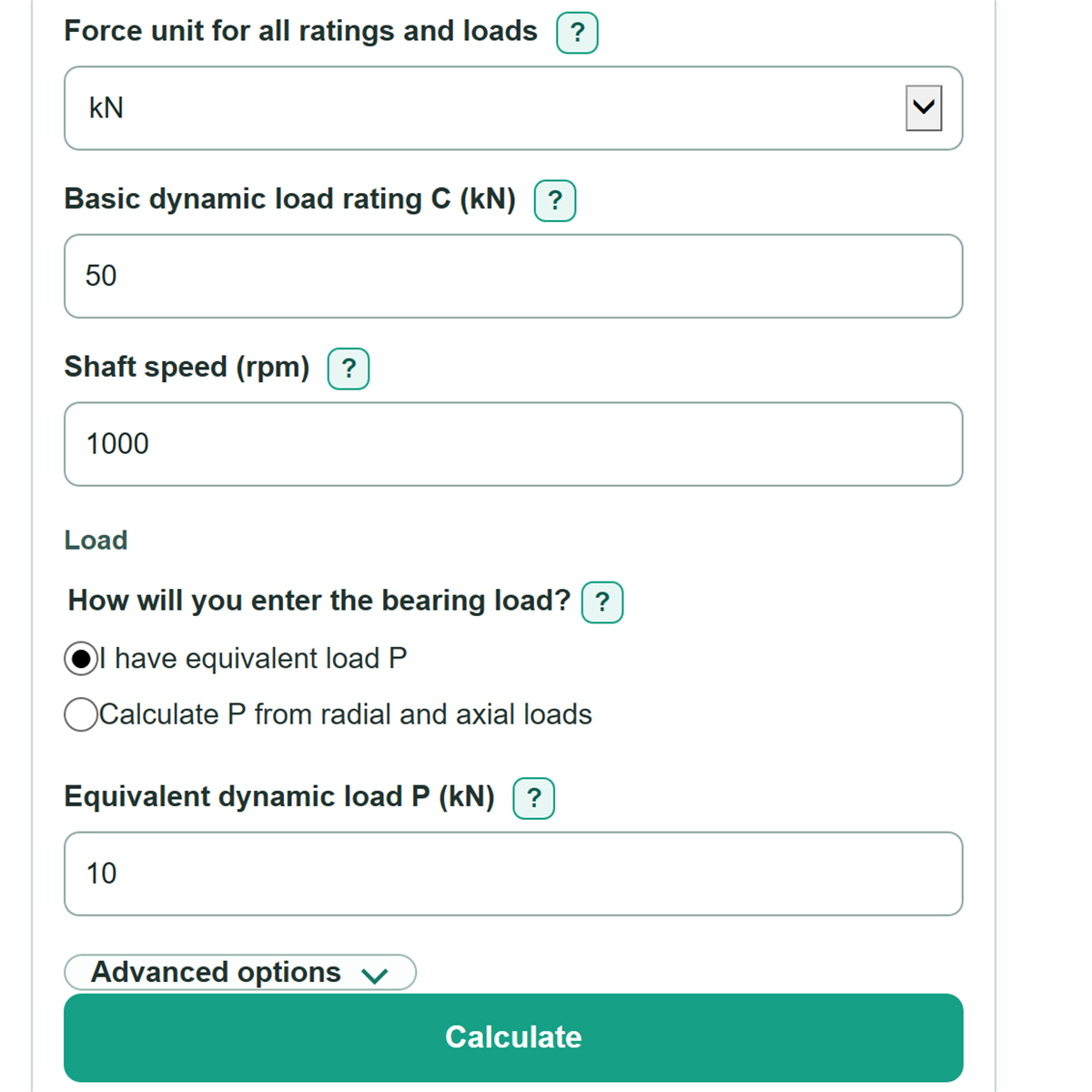
For a ball bearing with C = 50 kN, P = 10 kN, and speed = 1,000 rpm, C/P = 5. The basic life is 5^3 = 125 million revolutions, or 125,000,000 divided by 60,000 = 2,083.33 operating hours. If the schedule is 8 hours per day for 250 days per year, that equals about 1.04 calendar years.
Calendar service years = life hours / (hours per day * days per year)