
Compare the yearly value of exporting extra solar with storing it in a home battery for later use.
Advanced options
Table of contents
How to use our Solar Export vs Battery Storage Calculator
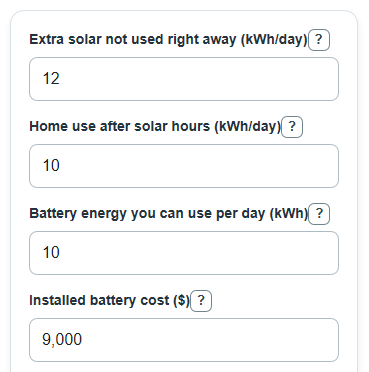
- Enter Extra solar not used right away from your solar app, bill, or a daily average you trust.
- Enter Home use after solar hours and Battery energy you can use per day so the calculator can cap storage at real demand and battery size.
- Enter Installed battery cost, Power price you avoid, and Export credit using the same billing period or rate plan.
- Open Advanced options if you want to change Battery round-trip efficiency or include Solar blocked by export limit.
- Check whether Home energy supplied by battery each day is realistic; if it is higher than your evening and night use, recheck your daily kWh inputs.
Definitions
kWh: A kilowatt-hour is a unit of energy. One kWh means using 1 kilowatt of power for 1 hour.
Extra solar not used right away: Solar energy left after your home uses what it can during solar hours.
Home use after solar hours: The later energy demand the battery could cover, such as evening, night, and cloudy-period use.
Battery energy you can use per day: The usable battery capacity available to power the home, not always the full nameplate size.
Battery round-trip efficiency: The percent of energy charged into the battery that comes back out for use.
Export credit: The money or bill credit your utility gives for each kWh sent to the grid.
Solar blocked by export limit: Extra solar that cannot be exported because of a utility, inverter, or interconnection cap.
Simple battery payback time: Installed battery cost divided by the yearly battery advantage, with no financing, wear, or future rate changes included.
Common mistakes and quick fixes
Mistake: Entering total solar production as Extra solar not used right away .
Fix: Use only the solar left after daytime home use, including energy exported or blocked.
Mistake: Using all-day home use for Home use after solar hours .
Fix: Count the part of home use that happens when solar is not covering the house, such as evening and night use.
Mistake: Typing the battery nameplate size into Battery energy you can use per day when the usable amount is smaller.
Fix: Use the usable kWh from the battery quote, spec sheet, or app setting.
Mistake: Putting the full system cost into Installed battery cost when you already own the solar panels.
Fix: Use the installed battery-only cost after any rebate or tax credit you want included.
Mistake: Mixing up Power price you avoid and Export credit .
Fix: Use your import price for avoided power and the lower sell-back or credit rate for exports, if your plan has one.
Mistake: Entering Solar blocked by export limit higher than Extra solar not used right away .
Fix: Blocked solar must be part of the extra solar total, not an additional amount.
Limitations & Key Assumptions / Boundary Conditions
- The calculator uses average daily kWh values and annualizes them with 365 days, so it does not model season-by-season solar changes.
- It uses one Power price you avoid and one Export credit. Time-of-use plans can change the real value if evening power and daytime exports have different prices.
- Battery round-trip efficiency is treated as one steady percent. Real efficiency can change with power level, temperature, and battery age.
- The comparison is energy value only. It does not subtract battery degradation, maintenance, replacement, outage backup value, financing, or demand charges.
- Solar blocked by export limit must be included inside Extra solar not used right away. If blocked solar is estimated poorly, the export-limit bonus will also be off.
- If the yearly battery advantage is zero or negative, Simple battery payback time is not available because the battery does not recover its cost from this energy-value comparison.
Methodology
Daily battery use
The calculator first estimates how much energy the battery can deliver each day. Home batteries store solar for later use, but some energy is lost during the charge and discharge cycle [1]. The efficiency percent is converted to a decimal by dividing by 100.
eta = Battery round-trip efficiency / 100
Home energy supplied by battery each day = min(Home use after solar hours, Battery energy you can use per day, Extra solar not used right away * eta)
Solar energy charged into battery each day = Home energy supplied by battery each day / eta
Export-limited solar is used first
If some extra solar would be blocked by an export limit, the calculator treats that blocked energy as the first solar charged into the battery. That is because blocked solar has no export credit in the export-only case.
blocked_charge_kwh = min(Solar blocked by export limit, Solar energy charged into battery each day)
exportable_charge_kwh = Solar energy charged into battery each day - blocked_charge_kwh
Yearly values
The export-only case values the exportable extra solar. The battery case adds avoided grid purchases from battery output, then adds export credit for any exportable solar left after charging.
Yearly value if extra solar is only exported = (Extra solar not used right away - Solar blocked by export limit) * Export credit * 365
remaining_export_kwh = Extra solar not used right away - Solar blocked by export limit - exportable_charge_kwh
Yearly energy value with battery = (Home energy supplied by battery each day * Power price you avoid + remaining_export_kwh * Export credit) * 365
Yearly battery advantage over exporting = Yearly energy value with battery - Yearly value if extra solar is only exported
Yearly extra value from export-limited solar = blocked_charge_kwh * Export credit * 365
Simple battery payback time = Installed battery cost / Yearly battery advantage over exporting
Mini-example
With 12 kWh/day of extra solar, 10 kWh/day of later home use, a 10 kWh usable battery, 90 percent efficiency, $0.30/kWh avoided power, $0.08/kWh export credit, and no blocked solar, the battery delivers 10 kWh/day and charges 11.11 kWh/day. Export-only value is $350.40/year. Battery energy value is $1,120.96/year. The yearly battery advantage is $770.56/year, so a $9,000 battery has a simple payback of about 11.68 years.
Calculation choices
Simple payback is shown only when the yearly battery advantage is positive. If the advantage is negative, the negative value is kept because it means exporting is worth more than storing before battery cost. If installed battery cost is $0 and the yearly advantage is positive, payback is 0 years.