
Enter your battery, panel, and local sun details to find the solar array watts needed for a one-day refill and your array's estimated charging time.
Battery
Solar panels and sunlight
Advanced options
If left blank, PV system loss uses the 14% NREL PVWatts planning value and battery charging efficiency uses an ideal 100%.
This is a simplified planning target. It does not check controller, wiring, or installation compatibility.
This rounds up to matching whole panels and does not check electrical string compatibility.
A value above 1 means the entered array needs more than one average solar day under these assumptions.
This is equivalent full-sun time, not elapsed clock time. Weather, shade, temperature, charge taper, and equipment limits can extend actual charging.
This is nominal battery energy across the entered charge range.
This is an average-condition planning estimate, not guaranteed daily production.
A blank Advanced field uses the disclosed 14% NREL PVWatts planning value.
A blank Advanced field uses an ideal 100% factor and may understate real charging time.
Table of contents
How to use our Solar Panel to Battery Calculator
- Find the battery capacity in Ah and nominal voltage on the battery label, manual, or battery-bank documentation.
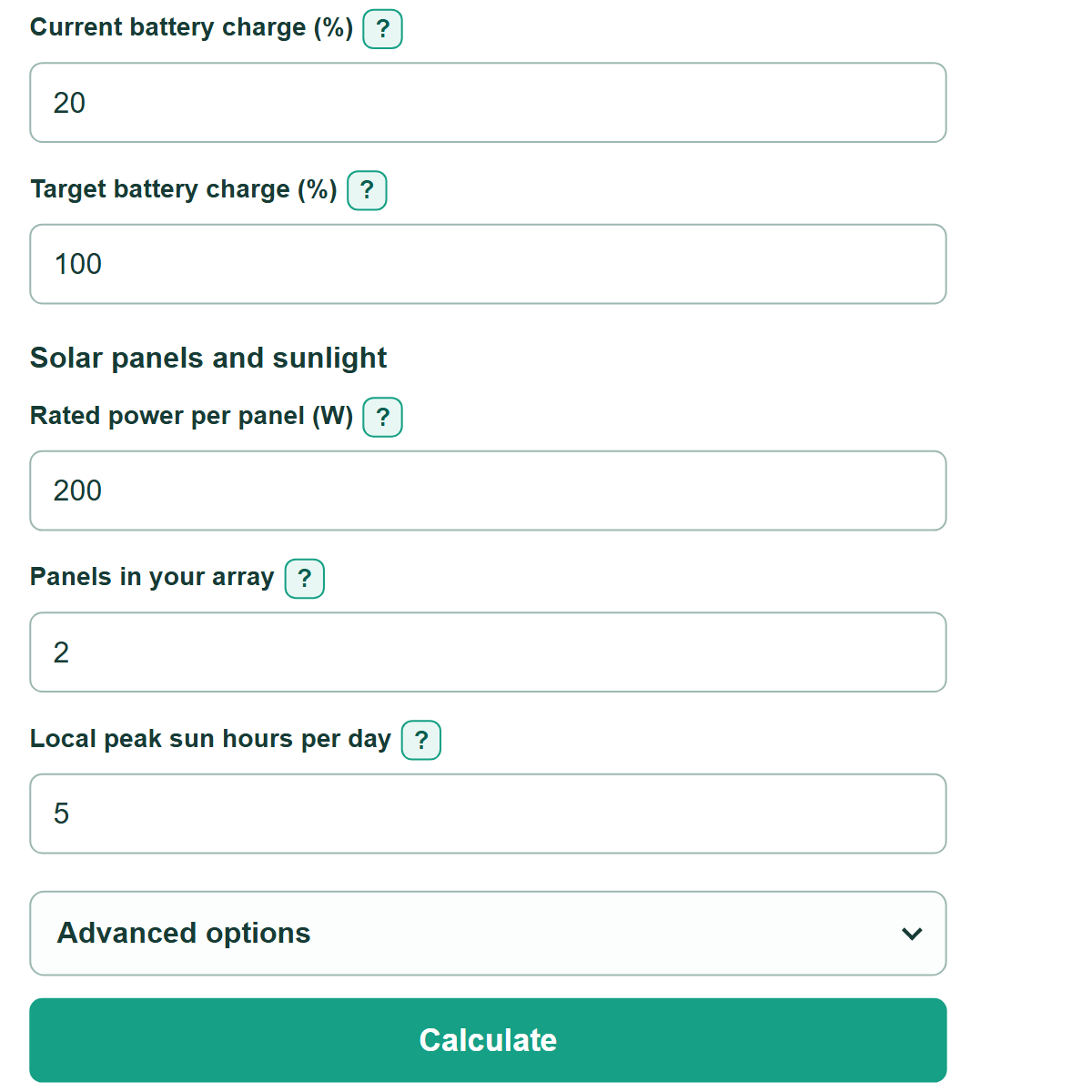
- Enter the current battery charge and the target battery charge you want to reach.
- Enter the rated watts for one panel and the whole number of matching panels you own or plan to use.
- Enter local peak sun hours per day from a solar-resource estimate. Use peak sun hours, not total daylight hours.
- Open "Advanced options" only if you have a site-specific PV loss or battery charging-efficiency value. A blank PV loss uses 14%, and blank charging efficiency uses an ideal 100%.
- Click "Calculate." The first result is the rated solar array watts needed for a one-day refill. Compare the following panel count and recharge-time results with your planned array.
Definitions
Amp-hour (Ah): A battery capacity rating. Combine it with nominal voltage to estimate energy in watt-hours.
Nominal voltage: The labeled voltage class of a battery or battery bank, such as 12 V or 24 V. It is not a live voltage reading.
State of charge: The percentage of battery energy currently stored or wanted at the end of charging.
Watt-hour (Wh): A unit of energy. This calculator uses Ah, volts, and the selected charge change to estimate the energy to refill.
Peak sun hours: Equivalent hours of full solar intensity used for energy planning. They are different from daylight hours.
PV system loss: A percentage reduction applied to panel nameplate energy for losses such as wiring, mismatch, soiling, and related effects.
Battery charging efficiency: The share of energy reaching the battery that is stored. Leaving this optional field blank uses an ideal 100% factor.
Common mistakes and quick fixes
Mistake: Entering daylight hours as peak sun hours.
Fix: Use a local solar-resource estimate of equivalent full-sun hours. Ten hours of daylight does not mean 10 peak sun hours.
Mistake: Using Ah without checking battery voltage.
Fix: Enter both values for the same battery or complete battery bank. Ah multiplied by nominal volts gives the nominal watt-hours used in this estimate.
Mistake: Setting the target charge below the current battery charge.
Fix: Set "Target battery charge (%)" equal to or higher than "Current battery charge (%)." Equal values correctly mean no refill is needed.
Mistake: Treating panel nameplate watts as guaranteed charging power.
Fix: Use realistic local peak sun hours and enter known PV system loss and battery charging efficiency in "Advanced options."
Limitations & Key Assumptions / Boundary Conditions
- This is a planning estimate based on nominal battery capacity and voltage. Actual usable battery energy can differ because of battery age, temperature, discharge rate, battery-management limits, and state-of-charge accuracy.
- Peak sun hours are an average solar-resource input. Clouds, season, shade, panel direction, dirt, and temperature can reduce actual energy and extend charging time.
- The estimate does not model charge taper near a full battery, so actual charging can take longer than the calculated peak-sun time.
- The result does not check charge-controller voltage or current limits, battery charging limits, panel string compatibility, wire size, inverter demand, mounting, or local electrical rules.
- A one-day refill means one average solar day under the entered assumptions. It does not guarantee charging in one calendar day.
Methodology
Battery energy to replace
The calculator finds the portion of nominal battery energy between the current and target charge levels.
battery_energy_wh = battery_capacity_ah * battery_voltage_v * (target_soc_pct - current_soc_pct) / 100
For example, a 100 Ah, 12 V battery charged from 20% to 100% needs 100 * 12 * 80 / 100 = 960 Wh of nominal energy.
Loss factors
PV system loss and battery charging efficiency are separate factors, so the calculator multiplies them. A blank PV loss uses the 14% PVWatts planning default. [1] A blank battery charging-efficiency field uses an ideal 100% factor, which can make estimated charging time shorter than real charging time.
effective_energy_factor = (1 - pv_loss_used_pct / 100) * (charging_efficiency_used_pct / 100)
Array size and recharge time
The one-day array requirement divides the energy to replace by local peak sun hours and the effective energy factor.
required_array_w = battery_energy_wh / (peak_sun_hours * effective_energy_factor)
The panel count rounds up because a fraction of a panel cannot be installed.
required_panel_count = ceil(required_array_w / panel_power_w)
The entered array's recharge time uses its total rated watts after the same factors.
recharge_peak_sun_hours = battery_energy_wh / (panel_power_w * panel_count * effective_energy_factor)
recharge_solar_days = recharge_peak_sun_hours / peak_sun_hours
With 5 peak sun hours and 14% PV loss, the 960 Wh example needs 223.26 W for a one-day refill. Two 200 W panels need about 2.79 peak-sun hours, or 0.56 average solar days, under the same assumptions.