
Calculate peak electric demand in kW from interval kWh, then estimate demand charges, load factor, and peak-cut savings.
Advanced options
Table of contents
How to use our Peak Demand Calculator
- Enter Energy used in the highest interval (kWh) from the highest meter block on your bill or data export.
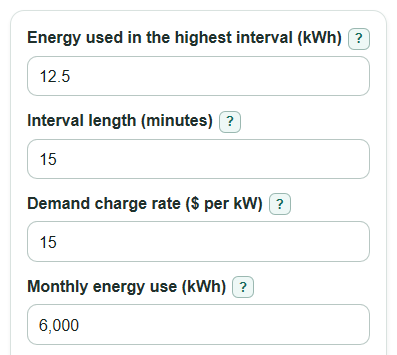
- Enter Interval length (minutes), Demand charge rate ($ per kW), Monthly energy use (kWh), and your Planned peak cut (kW).
- Open Advanced options only if you need to change Billing period length (days) or add a Minimum billed demand (kW).
- Click Calculate and read Peak demand first, then compare Estimated demand charge with Demand charge after planned cut.
- Sanity-check the result: if Load factor is over 100% or much higher than expected, make sure the kWh, days, and peak interval all come from the same billing period.
Definitions
kW: Kilowatts measure electric power, or how fast electricity is being used at one moment.
kWh: Kilowatt-hours measure electric energy used over time. A 10 kW load running for 1 hour uses 10 kWh.
Peak demand: The highest average kW during the interval you entered.
Demand charge: A bill charge based on maximum electric capacity usage under the rate schedule [2].
Billed demand: The kW used for the demand-charge calculation. It is the measured peak or the minimum billed demand, whichever is larger.
Load factor: Average demand divided by peak demand, shown as a percent. Lower values mean the usage is more spiky.
Minimum billed demand: A demand floor used by some rate plans, such as a contract demand or ratchet-like billing value.
Common mistakes and quick fixes
Mistake: Using total monthly kWh in Energy used in the highest interval (kWh) .
Fix: Use only the kWh from the single highest 15-minute, 30-minute, or 60-minute interval.
Mistake: Entering hours instead of minutes in Interval length (minutes) .
Fix: Enter 15, 30, or 60 minutes, not 0.25, 0.5, or 1 hour.
Mistake: Putting an energy price in Demand charge rate ($ per kW) .
Fix: Use the demand rate billed per kW, not the cents-per-kWh energy rate.
Mistake: Leaving an old value in Minimum billed demand (kW) when your rate has no demand floor.
Fix: Set Minimum billed demand (kW) to 0 unless your rate plan or bill lists a minimum, contract, or ratchet demand.
Mistake: Treating Planned peak cut (kW) as monthly kWh savings.
Fix: Enter the kW you can avoid during the peak interval, such as not running two large loads at the same time.
Mistake: Mixing a 31-day bill with the default Billing period length (days) of 30.
Fix: Enter the actual number of billing days so Average demand for the bill period and Load factor are closer.
Limitations & Key Assumptions / Boundary Conditions
- This estimates the demand-charge line item only. It does not include energy charges, taxes, riders, fixed fees, credits, or seasonal adjustments.
- The highest interval kWh, interval length, monthly energy use, and billing days should all come from the same bill period.
- Some utilities use time-of-use demand periods, ratchets, contract demand, or separate on-peak and off-peak demand rates. Use the rate and minimum billed demand that match the period you are checking.
- The peak-cut savings assumes the planned kW cut happens during the exact interval that sets the monthly peak.
- If the minimum billed demand is above the measured peak after the cut, savings can be $0 even when the actual peak demand goes down.
- The calculator treats the interval value as an average over the full interval. It does not model second-by-second spikes inside the interval.
- A load factor above 100% usually means one or more inputs do not match, such as monthly kWh from one period and peak kW from another period.
Methodology
How the calculator finds peak demand
The calculator first converts the meter interval from minutes to hours, then divides the kWh used during the highest interval by that interval length. Demand charges are commonly based on maximum demand in kW during a billing period [1].
interval_hours = interval_minutes / 60
peak_demand_kw = highest_interval_kwh / interval_hours
How cost and savings are estimated
If a minimum billed demand is entered, the billed kW is the larger of measured peak demand and that minimum. The demand charge is billed kW times the demand charge rate.
billed_demand_kw = max(peak_demand_kw, minimum_billed_demand_kw)
demand_charge = billed_demand_kw * demand_rate
For the peak-cut check, the requested cut is capped so it cannot reduce the measured peak below 0 kW. The calculator then recomputes billed demand and demand charge after the cut.
feasible_peak_cut_kw = min(max(planned_peak_cut_kw, 0), peak_demand_kw)
after_cut_peak_kw = peak_demand_kw - feasible_peak_cut_kw
after_cut_billed_kw = max(after_cut_peak_kw, minimum_billed_demand_kw)
after_cut_charge = after_cut_billed_kw * demand_rate
possible_savings = demand_charge - after_cut_charge
How load factor is checked
Average demand is total billing-period kWh divided by billing-period hours. Load factor compares that average to the peak.
average_demand_kw = monthly_energy_kwh / (billing_days * 24)
load_factor_percent = (average_demand_kw / peak_demand_kw) * 100
Mini example
If the highest 15-minute interval used 12.5 kWh, the interval is 0.25 hours. Peak demand is 12.5 / 0.25 = 50 kW. At $15 per kW with no minimum billed demand, the estimated demand charge is 50 * $15 = $750. If the planned peak cut is 5 kW, the after-cut demand charge is 45 * $15 = $675, so possible savings are $75. With 6,000 kWh over 30 days, average demand is 6,000 / 720 = 8.33 kW and load factor is 8.33 / 50 * 100 = 16.67%.