
Use this calculator to compare PWM and MPPT solar output from your panel label, wiring, battery voltage, and sun hours.
Table of contents
How to use our PWM vs MPPT Solar Calculator
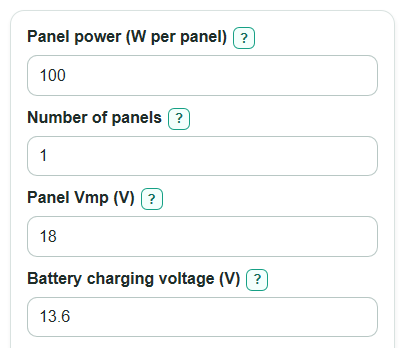
- Enter Panel power (W per panel), Number of panels, Panel Vmp (V), Battery charging voltage (V), and Good sun per day (hours) from your panel label and battery setup.
- Open Advanced options if your panels are wired in series, if you know Panel Isc (A, optional), or if you want to change MPPT efficiency (percent) or Controller sizing safety factor (percent).
- Click Calculate and read Best fit based on these numbers first, then compare Extra power from MPPT, Extra energy per good-sun day, and both minimum controller ratings.
- Sanity-check the result: Array Vmp from wiring should match how the panels are connected, and the controller rating should be at or above the calculated minimum before you shop.
Definitions
PWM: Pulse-width modulation is a simpler solar charge controller style that connects the panel array close to battery voltage, so extra panel voltage is often not turned into extra charge current.
MPPT: Maximum power point tracking is a controller style that tries to run the panels near their best power point and convert extra input voltage into more battery charge current [1].
Vmp: Voltage at maximum power. It is the panel voltage when the panel makes its rated watts under test conditions.
Isc: Short-circuit current. It is a panel label current used for safer controller and wire sizing.
Array Vmp: The panel Vmp multiplied by Panels in series per string. It helps show the voltage the controller sees from the panel wiring.
Peak sun hours: Full-strength sun hours added together for one day. Five peak sun hours means the same energy as 5 hours at rated sun strength.
Charge current: The estimated amps flowing into the battery from the controller.
Watt-hour: A unit of energy. One watt running for one hour equals one watt-hour.
Common mistakes and quick fixes
Mistake: Using the battery name, such as 12 V, for Battery charging voltage (V).
Fix: Enter the voltage while charging, such as about 13.6 V for many 12 V systems, unless your battery manual says otherwise.
Mistake: Entering total array watts in Panel power (W per panel).
Fix: Enter the watt rating for one panel, then put the total panel count in Number of panels.
Mistake: Leaving Panels in series per string at 1 when the panels are actually wired positive-to-negative in a series string.
Fix: Set Panels in series per string to the number of panels in each series string so Array Vmp from wiring is correct.
Mistake: Confusing Panel Vmp (V) with open-circuit voltage from the panel label.
Fix: Use the label value called Vmp, Vmpp, or voltage at maximum power for Panel Vmp (V).
Mistake: Putting a guess in Panel Isc (A, optional) to force a larger Minimum PWM controller rating.
Fix: Leave Panel Isc (A, optional) blank if you do not have the label value; the calculator will still estimate the PWM rating.
Mistake: Treating Extra energy per good-sun day as guaranteed daily production.
Fix: Use Good sun per day (hours) as peak sun hours, then remember that shade, heat, battery charge stage, and weather can lower real energy.
Limitations & Key Assumptions / Boundary Conditions
- The calculator uses panel label watts and Vmp. Real panels can make less power because of heat, shade, dirt, panel angle, wiring loss, and age.
- The PWM estimate assumes current is close to the panel operating current derived from Panel power (W per panel) divided by Panel Vmp (V). It does not use a full solar panel current-voltage curve.
- The MPPT estimate uses the entered MPPT efficiency (percent). It does not model controller clipping, startup voltage, battery charge-stage limits, or exact manufacturer behavior.
- Panel count must divide evenly by Panels in series per string because the calculator models equal strings only.
- Minimum MPPT controller rating and Minimum PWM controller rating are output current estimates. You must also check controller PV voltage limits, battery type settings, wire size, fuses, and local electrical rules.
- If Panel Isc (A, optional) is blank, the PWM controller rating is only an estimate. Use the panel label Isc for final sizing when possible.
- Extra energy per good-sun day is a peak-sun-hour estimate, not a weather forecast or a guaranteed daily battery charge amount.
Methodology
Power from the panel label
The calculator starts with the rated watts per panel, total panel count, and Panel Vmp (V). Vmp is used to estimate the panel operating current at rated power.
panel_imp = panel_power_w / panel_vmp
array_power_w = panel_power_w * panel_count
Wiring
Series wiring raises voltage. Parallel strings raise current. The calculator requires equal strings, so Number of panels must divide evenly by Panels in series per string.
strings_parallel = panel_count / series_per_string
array_vmp = panel_vmp * series_per_string
MPPT estimate
An MPPT controller is estimated as total panel rated power multiplied by the entered controller efficiency. MPPT controllers are designed to run the array near its maximum power point and convert extra input voltage into battery charging current [1].
mppt_power_w = array_power_w * (mppt_efficiency_percent / 100)
PWM estimate
A PWM controller is estimated from battery charging voltage, panel operating current, and the number of parallel strings. The result is capped at total array rated watts so the rated-condition estimate cannot exceed the panel nameplate power.
pwm_power_raw_w = battery_charge_voltage * panel_imp * strings_parallel * 1.00
pwm_power_w = min(array_power_w, pwm_power_raw_w)
Extra power and daily energy
The calculator subtracts PWM charge power from MPPT charge power. Positive Extra power from MPPT means MPPT sends more watts to the battery. Negative Extra power from MPPT can happen if you enter a very low MPPT efficiency.
extra_watts_mppt = mppt_power_w - pwm_power_w
mppt_gain_percent = ((mppt_power_w / pwm_power_w) - 1) * 100
extra_daily_wh = extra_watts_mppt * sun_hours
Charge current and controller size
Battery charge current is charge power divided by Battery charging voltage (V). Controller ratings are then multiplied by the Controller sizing safety factor (percent). If Panel Isc (A, optional) is entered, the PWM controller rating uses Isc times parallel strings instead of the operating-current estimate.
mppt_charge_current_a = mppt_power_w / battery_charge_voltage
pwm_charge_current_a = pwm_power_w / battery_charge_voltage
min_mppt_controller_a = mppt_charge_current_a * (safety_factor_percent / 100)
min_pwm_controller_a = panel_isc * strings_parallel * (safety_factor_percent / 100)
If Panel Isc (A, optional) is blank, the PWM rating uses this fallback instead:
min_pwm_controller_a = pwm_charge_current_a * (safety_factor_percent / 100)
Best-fit rule
The recommendation is an interpretation rule. It points to MPPT when the extra MPPT power is at least 25 W, the MPPT gain is at least 15 percent, or Array Vmp from wiring is at least 1.5 times Battery charging voltage (V). Otherwise, it says PWM is close for the entered setup while still showing the calculated gain.
Mini-example
For one 100 W panel with Panel Vmp (V) of 18 V, Battery charging voltage (V) of 13.6 V, Good sun per day (hours) of 5, MPPT efficiency (percent) of 95, and one panel per string, panel operating current is 100 / 18 = 5.56 A. MPPT charge power is 100 * 0.95 = 95 W. PWM charge power is 13.6 * 5.56 * 1 = 75.56 W. Extra power from MPPT is 19.44 W, and Extra energy per good-sun day is 19.44 * 5 = 97.22 Wh/day.