
Enter a battery's Wh, kWh, or mWh rating and nominal voltage to find its matching amp-hour capacity.
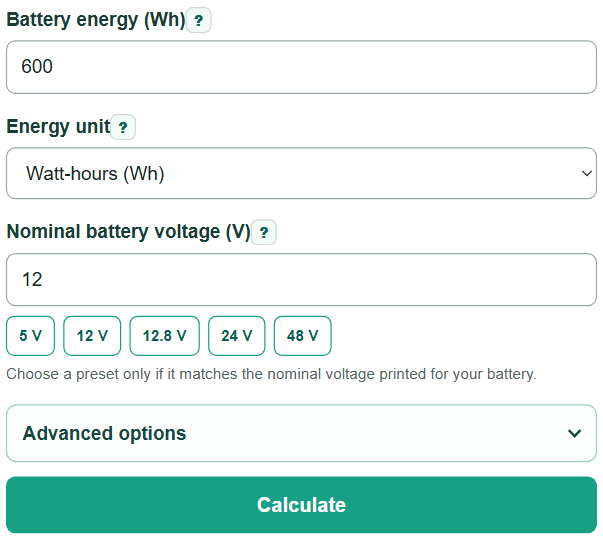
Choose a preset only if it matches the nominal voltage printed for your battery.
Advanced options
This changes only the displayed digits. The calculation keeps its unrounded values.
Table of contents
How to use our Watt Hours to Amp Hours Calculator
- Find the battery energy number on its label, product page, or specification sheet, then enter it in "Battery energy."
- Choose the unit printed beside that number: Wh, kWh, or mWh.
- Enter the pack's stated nominal voltage in "Nominal battery voltage (V)." Do not use wall-outlet, USB-output, or charger voltage unless it is also the battery's stated nominal voltage.
- Select "Calculate." Open "Advanced options" only if you need a different number of displayed decimal places.
- Check "Entered energy converted to watt-hours" before using the answer. For example, 1.2 kWh should show as 1,200 Wh, while 100,000 mWh should show as 100 Wh.
Definitions
Watt-hour (Wh): A unit of electrical energy. A battery label may use Wh to state its energy rating.
Amp-hour (Ah): A unit of electric charge commonly used for battery capacity. For the same energy rating, the Ah value changes with voltage.
Milliamp-hour (mAh): One thousandth of an amp-hour. 1 Ah equals 1,000 mAh.
Nominal battery voltage: The voltage printed by the manufacturer as the battery pack's normal reference voltage. This is the voltage used in the conversion.
kWh and mWh: A kilowatt-hour is 1,000 Wh, and a milliwatt-hour is 0.001 Wh. [1]
Common mistakes and quick fixes
Mistake: Using 120 V from a wall outlet, 5 V from a USB port, or a charger's voltage.
Fix: Enter the battery pack's nominal voltage from its label or specification.
Mistake: Entering 1.2 while "Energy unit" is set to Wh when the label says 1.2 kWh.
Fix: Choose "Kilowatt-hours (kWh)." The calculator then converts 1.2 kWh to 1,200 Wh.
Mistake: Treating mWh as Wh.
Fix: Choose "Milliwatt-hours (mWh)." For example, 100,000 mWh equals 100 Wh, not 100,000 Wh.
Mistake: Typing a malformed number such as 1,01.
Fix: Use commas only for thousands, such as 1,000. Use a decimal point for decimals, such as 1.01.
Mistake: Reading amp-hours as guaranteed runtime.
Fix: Treat the answer as a rated capacity conversion. Actual runtime also depends on load, losses, temperature, and battery limits.
Limitations & Key Assumptions / Boundary Conditions
- The result is a rated unit conversion using the entered nominal voltage, not a measured battery-capacity test.
- Actual usable energy and runtime can differ because of load, depth-of-discharge limits, temperature, battery age, wiring loss, inverter loss, and battery-management limits.
- Use the battery pack's stated nominal voltage. Outlet, USB-output, charger, and solar-panel voltages may describe different parts of the system.
- Zero energy is valid and gives zero Ah when voltage is positive. Negative energy and zero or negative voltage cannot be used in this conversion.
- The calculator does not adjust a label's energy rating for the test conditions under which the manufacturer measured it.
Methodology
Conversion method
The calculator first changes the entered energy to watt-hours, then divides by nominal battery voltage to find amp-hours.
Ah = Wh / V
mAh = Ah x 1,000
Wh means watt-hours, V means nominal battery voltage in volts, Ah means amp-hours, and mAh means milliamp-hours. The unit conversions are 1 kWh = 1,000 Wh, 1 mWh = 0.001 Wh, and 1 Ah = 1,000 mAh. [1]
Worked example
A battery rated at 600 Wh with a nominal voltage of 12 V converts to 50 Ah. Multiply that result by 1,000 to get 50,000 mAh.
Ah = 600 Wh / 12 V = 50 Ah
Calculation details
Energy must be zero or greater, and nominal voltage must be greater than zero. A zero Wh entry gives a valid result of zero Ah. Dividing by zero volts is undefined. The calculator uses unrounded values for the calculation; the decimal-place setting changes only what is displayed.