
Enter amps, voltage, and circuit type to calculate estimated real power in kilowatts for DC, single-phase AC, or three-phase AC.
Table of contents
How to use our Amps to Kilowatts Calculator
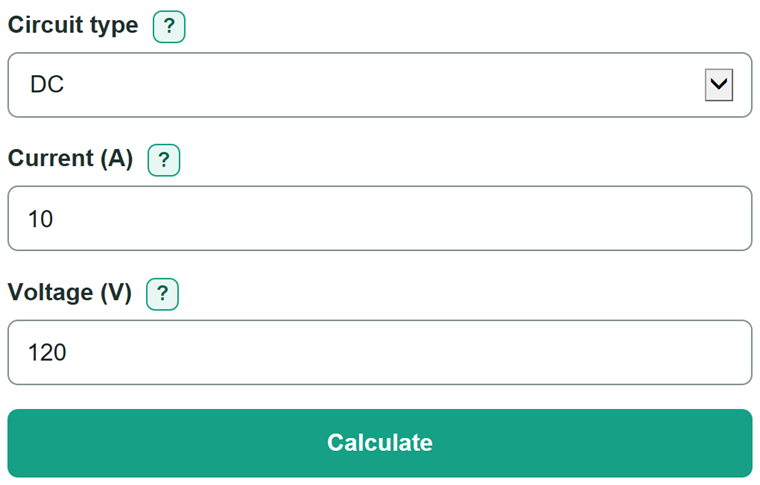
- Choose the circuit type: DC, single-phase AC, or three-phase AC.
- Enter the current and voltage from a meter, equipment nameplate, panel label, or system document.
- For AC, enter the power factor from the equipment specification or a measurement. For three-phase AC, choose whether the voltage is line-to-line or line-to-neutral.
- Click Calculate to see estimated real power in kW, the matching value in watts, and the formula multiplier used.
- Sanity-check the result before using it: higher current or voltage should increase kW, and the three-phase voltage basis must match the voltage you entered.
Definitions
Amp (A): A unit of electric current, or the amount of electric charge moving through a circuit.
Volt (V): A unit of electrical potential that drives current through a circuit.
Watt (W): A unit of power.
Kilowatt (kW): A unit of power equal to 1,000 watts.
Real power: Power a load uses to produce heat, light, motion, or other work.
Power factor: For an AC load, the ratio of real power to apparent power. It is from 0 to 1.
RMS: The effective AC voltage or current value used in ordinary AC power calculations.
Line-to-line voltage: Three-phase voltage measured between two phase conductors.
Line-to-neutral voltage: Three-phase voltage measured from one phase conductor to neutral.
Common mistakes and quick fixes
Mistake: Entering amps without using the actual circuit voltage.
Fix: Check Circuit type and then recalculate. Enter the measured or labeled voltage. The same current can produce very different power at different voltages.
Mistake: Using a peak AC reading instead of an RMS reading.
Fix: Check Circuit type and then recalculate. Enter RMS current and RMS voltage for AC calculations.
Mistake: Assuming every AC load has a power factor of 1.
Fix: Check Circuit type and then recalculate. Use the power factor on the equipment specification or from a measurement. A power factor below 1 lowers real power.
Mistake: Selecting line-to-neutral after entering line-to-line voltage, or the reverse.
Fix: Check Circuit type and then recalculate. Match the three-phase voltage basis to the nameplate, wiring diagram, or meter connection used for the voltage reading.
Mistake: Treating kW as energy used over time.
Fix: Check Circuit type and then recalculate. kW is power at a moment. Multiply power by operating time to find energy in kWh.
Mistake: Using the result to select a breaker or wire size.
Fix: Check Circuit type and then recalculate. Use the result only as a power estimate. Electrical sizing also depends on conductor conditions, equipment rules, and electrical code requirements.
Limitations & Key Assumptions / Boundary Conditions
- The result is an estimate from the values entered. Nameplate ratings, meter readings, and actual operating load can differ.
- AC calculations require RMS voltage and RMS current. Peak readings do not fit these formulas.
- Three-phase calculations assume a balanced load with equal phase currents. Unbalanced loads need phase-by-phase measurements and calculation.
- The selected three-phase voltage basis must match the entered voltage. Choosing the wrong basis gives a physically incorrect power result.
- The result is power in kW, not energy in kWh. Energy use also requires operating time.
- This calculator does not determine breaker size, wire size, generator capacity, utility charges, or electrical code compliance.
Methodology
Calculation method
The calculator converts the entered values to real power. DC uses current and voltage. AC also uses power factor, and the single-phase equation uses RMS voltage and current. [1]
P (kW) = I (A) × V (V) / 1000 for DC
P (kW) = I (A) × V (V) × PF / 1000 for single-phase AC
For balanced three-phase AC, the voltage measurement determines the multiplier.
P (kW) = √3 × I (A) × V line-to-line (V) × PF / 1000
P (kW) = 3 × I (A) × V line-to-neutral (V) × PF / 1000
P (W) = P (kW) × 1000
Worked example
A balanced three-phase load has 10 A, 208 V line-to-line, and a power factor of 0.8. The calculation is √3 × 10 × 208 × 0.8 / 1000 = 2.882 kW. That is about 2.88 kW, or about 2,882 W. The watts value is calculated from the unrounded kW result.