
Use this watts to volts calculator to find voltage from power and either current or resistance for DC and AC circuits.
Advanced options
Table of contents
How to use our Watts to Volts Calculator
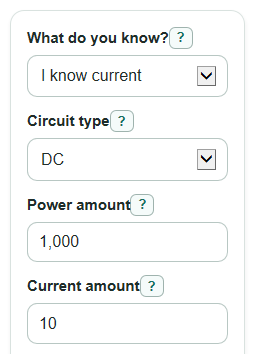
- Choose What do you know?: pick current if you have amps, or resistance if you have ohms.
- Enter Power amount (see power unit), then use Power unit in Advanced options if the value is in kilowatts.
- If using current, choose Circuit type, enter Current amount (see current unit), and enter Power factor (0 to 1) only for AC.
- If using three-phase AC, set Three-phase voltage to find so the answer is line-to-line or line-to-neutral as needed.
- Click Calculate, then check Formula used and What this voltage means; if the voltage is far from a normal equipment rating, recheck units, power factor, and AC phase choice.
Definitions
Watts (W): A unit of real power. It tells how fast electrical energy is being used.
Volts (V): A unit of electrical push. In basic circuit power math, 1 volt equals 1 watt per amp when current is known.
Amps (A): A unit of electrical current, or how much electric charge flows each second.
Ohms: A unit of resistance. Higher resistance means less current flows at the same voltage.
Power factor (0 to 1): The AC adjustment that compares useful real power in watts with apparent power in volt-amps. A value of 1 fits a purely resistive AC load.
Line-to-line volts: In three-phase AC, voltage measured between two phase wires.
Line-to-neutral volts: In three-phase AC, voltage measured from one phase wire to neutral.
AC apparent power: The volt-amp value found from real power divided by power factor.
Common mistakes and quick fixes
Mistake: Entering 10 in Power amount (see power unit) while Power unit is still Watts (W), when you meant 10 kW.
Fix: Change Power unit to Kilowatts (kW), or enter 10000 watts.
Mistake: Using Power factor (0 to 1) for DC and expecting it to change the Voltage result.
Fix: For DC, use Circuit type = DC; power factor is hidden and ignored.
Mistake: Picking Three-phase voltage to find = Line-to-neutral volts when you need the voltage measured between two hot wires.
Fix: Choose Line-to-line volts if your Voltage should match a line-to-line equipment rating.
Mistake: Choosing What do you know? = I know resistance for a motor or other reactive AC load.
Fix: Use I know current when you have amps; reserve Resistance (ohms) for DC or simple resistive loads.
Mistake: Entering milliamps in Current amount (see current unit) while Current unit is still Amps (A).
Fix: Change Current unit to Milliamps (mA), or convert mA to amps before calculating.
Limitations & Key Assumptions / Boundary Conditions
- The current method assumes the power amount is real power in watts or kilowatts, and the current amount is RMS current for AC.
- The single-phase and three-phase AC formulas use power factor. If the power factor is guessed, the voltage result is also a guess.
- The three-phase formulas assume a balanced three-phase load with the same current in each line.
- The resistance method uses V = sqrt(P * R). It fits DC and simple resistive loads such as heaters, not a general AC motor or reactive load.
- The calculator gives ideal circuit math. Real wire voltage drop, startup current, temperature changes, and equipment tolerances are not included.
- Hidden inputs are ignored. For example, when resistance is selected, Circuit type, Current amount, Power factor, and Three-phase voltage to find do not affect the answer.
Methodology
Unit setup
The calculator first converts the entered power to watts and the entered current to amps when those fields are used.
P_w = power_amount * power_multiplier
I_a = current_amount * current_multiplier
It uses a power multiplier of 1 for watts and 1000 for kilowatts. It uses a current multiplier of 1 for amps and 0.001 for milliamps.
Current method
For DC with known current, the calculator rearranges the electric power relationship P = V * I to solve for voltage [1].
V = P / I
For single-phase AC, power factor is included because watts are less than or equal to volt-amps for many AC loads.
V = P / (I * PF)
For three-phase AC, the selected voltage basis controls the formula. Line-to-line voltage uses the square root of 3 factor.
V_LL = P / (sqrt(3) * I * PF)
Line-to-neutral voltage divides the total real power across the three phase-to-neutral paths.
V_LN = P / (3 * I * PF)
When AC current math uses power factor, the calculator also shows apparent power.
S = P / PF
Resistance method
When resistance is known, the calculator uses the power and resistance form of the same basic circuit power relationship, then takes the square root to solve for voltage [1].
V = sqrt(P * R)
After voltage is found, the supporting current result is calculated from voltage divided by resistance.
I = V / R
Mini-example
For 60 W and 0.5 A in DC mode, the voltage is 60 / 0.5 = 120 V. For 1500 W, 12 A, and power factor 0.80 in single-phase AC, the voltage is 1500 / (12 * 0.80) = 156.25 V, and apparent power is 1500 / 0.80 = 1875 VA.
Input checks
Power must be greater than 0. Current must be greater than 0 when the current method is selected. Resistance must be greater than 0 ohms when the resistance method is selected. For AC current calculations, power factor must be greater than 0 and no more than 1.