
Enter a device's watts and supply voltage to calculate its expected operating current in amps.
Advanced options
Table of contents
How to use our Watts to Amps Calculator
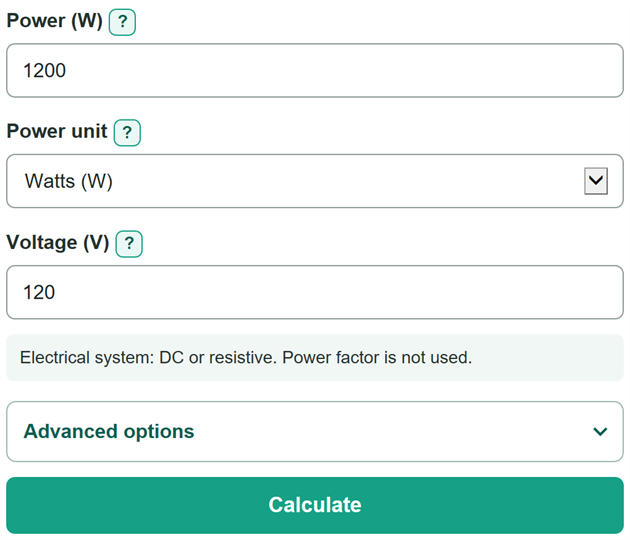
- Copy the device's power number into Power, then choose the unit printed beside it: mW, W, or kW.
- Enter the supply value in Voltage. Watts alone cannot determine amps.
- Open Advanced options and choose the electrical system from the equipment documentation. For an AC choice, enter the listed power factor as a decimal from greater than 0 through 1.
- Select Calculate. Check that Power used in calculation matches the rating after conversion and that Voltage and AC factor used matches the system you selected.
Definitions
Watt (W): A unit of real electrical power. This calculator uses watts as the power input after converting mW or kW.
Ampere (A): A unit of electric current. The calculated value is expected operating current from the entered values.
Voltage (V): The electrical potential supplied to a load. For the same power, higher voltage gives lower current.
Power factor: For an AC load, the relationship of real power to apparent power. It is a decimal greater than 0 through 1; a lower value increases calculated current for the same watts and voltage. [1]
Line-to-line voltage: Voltage measured between two phase conductors in a three-phase system.
Line-to-neutral voltage: Voltage measured from one phase conductor to neutral in a three-phase system.
Effective divisor volts: The voltage after the applicable three-phase multiplier and AC power factor are included in the current calculation.
Common mistakes and quick fixes
Mistake: Entering 1.5 for a 1.5 kW device while Power unit is set to Watts (W).
Fix: Choose Kilowatts (kW), so the calculator treats 1.5 as 1,500 W.
Mistake: Guessing voltage from the watt rating.
Fix: Check Power and then recalculate. Copy the supply voltage from the nameplate, manual, outlet information, or circuit documentation.
Mistake: Using DC or resistive for AC equipment such as a motor.
Fix: Check Power and then recalculate. Choose the AC system stated in the equipment documentation and enter its power factor.
Mistake: Mixing up line-to-line and line-to-neutral voltage for three-phase equipment.
Fix: Check Power and then recalculate. Match the electrical-system choice to how the voltage is written in the equipment or installation documentation.
Mistake: Using calculated current to choose a breaker or wire size.
Fix: Check Power and then recalculate. Treat it as operating current only. Starting current, load type, wiring conditions, and applicable electrical rules can change the design decision.
Limitations & Key Assumptions / Boundary Conditions
- The calculator uses real power in watts. Do not enter volt-amperes (VA) as watts unless the load power factor is 1.
- Three-phase calculations assume a balanced load. The selected line-to-line or line-to-neutral reference must match the entered voltage.
- The result estimates steady operating current. It does not estimate motor starting current, inrush current, surge current, harmonics, or a changing load.
- The result is not a breaker-size, conductor-size, service-load, or electrical-code compliance recommendation.
- Power and voltage must describe the same equipment and operating condition. A nameplate power rating can differ from power measured during actual use.
Methodology
Calculation method
The calculator converts the entered power to watts first. One milliwatt is 0.001 W, and one kilowatt is 1,000 W. It then divides real power by a divisor based on voltage, electrical system, and, for AC, power factor.
DC or resistive current (A) = power (W) / voltage (V)
Single-phase AC current (A) = power (W) / [voltage (V) x power factor]
Three-phase line-to-line current (A) = power (W) / [√3 x voltage (V) x power factor]
Three-phase line-to-neutral current (A) = power (W) / [3 x voltage (V) x power factor]
For AC equipment, power factor accounts for the difference between real power and apparent power. [1][2]
Worked example
A 1,200 W single-phase AC load on 120 V with a power factor of 0.8 has an effective divisor of 120 x 0.8 = 96 V. Its calculated current is 1,200 / 96 = 12.5 A. In DC or resistive mode, the same 1,200 W and 120 V values produce 10 A because power factor is not applied.
Display rounding
The calculator keeps the unrounded current value and applies the selected Result decimal places only when it displays the result.