
Enter your canopy size and light details to see whether the estimated beam reaches every corner and how much ideal light reaches the plants.
Table of contents
How to use our Grow Light Coverage Calculator
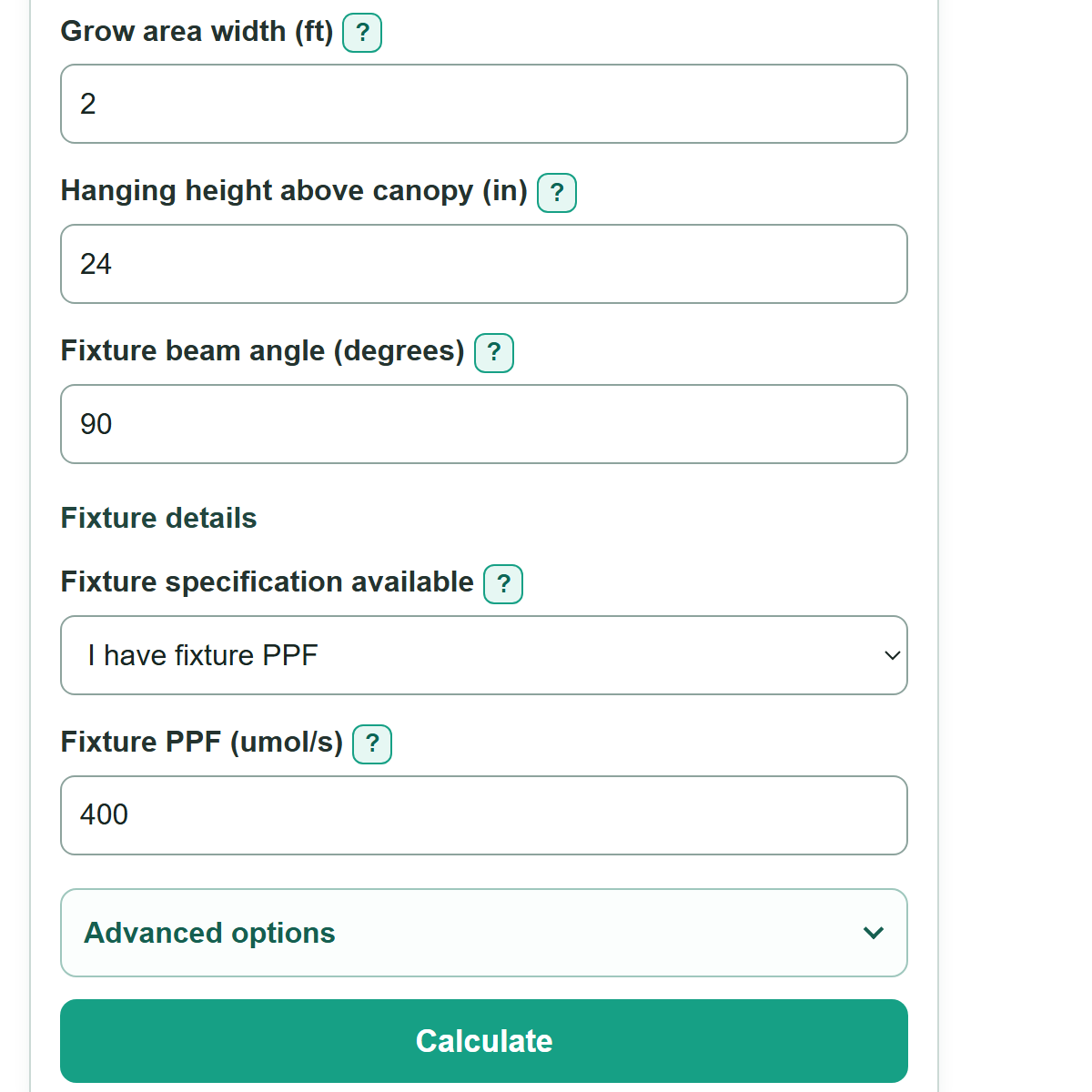
- Measure the planted canopy at leaf height. Enter those measurements in "Grow area length (ft)" and "Grow area width (ft)," not the full room or tent floor size.
- Measure straight down from the light-emitting face to the canopy top. Enter it in "Hanging height above canopy (in)."
- Copy the fixture's full beam angle from its manual or specification sheet into "Fixture beam angle (degrees)."
- Under "Fixture specification available," choose "I have fixture PPF" and enter the listed PPF, or choose "I have actual watts and efficacy" and enter both values. Use actual wall power, not equivalent watts.
- Select "Advanced options" if you want an estimated DLI. Enter the daily timer setting in "Light time (hours per day)." You can also change "Result decimal places."
- Select "Calculate." Read "Estimated grow-light coverage" first. Full coverage means the ideal centered beam reaches all four canopy corners.
- Treat PPFD and DLI as planning estimates. Check a manufacturer PPFD map or take readings across the canopy before relying on a new fixture height or plant layout.
Definitions
Beam angle: The full angle of the light cone. A wider angle creates a wider footprint at the same hanging height.
PPF: Photosynthetic photon flux. It is the total plant-useful photon output from a fixture each second, measured in umol/s.
PPFD: Photosynthetic photon flux density. It is plant-useful photons reaching one square meter each second, measured in umol/m2/s.
Fixture efficacy: Plant-useful photons produced per joule of electricity, measured in umol/J. Actual watts multiplied by efficacy gives PPF.
DLI: Daily light integral. It is the total plant-useful light over one day, measured in mol/m2/day.
Common mistakes and quick fixes
Mistake: Using the whole tent or room size when plants use only part of it.
Fix: Enter the planted canopy length and width at leaf height.
Mistake: Entering a marketing coverage size as the beam angle.
Fix: Copy the full beam angle in degrees from the fixture manual or specification sheet.
Mistake: Using equivalent watts or a model number for "Actual power draw (W)."
Fix: Use listed or measured wall power, then enter the fixture-specific efficacy in umol/J.
Mistake: Treating 100 percent beam area as proof that every corner receives light.
Fix: Use the "Estimated grow-light coverage" statement, which checks the canopy diagonal and corners.
Mistake: Treating ideal average PPFD as a meter reading.
Fix: Use a PPFD map or measure several canopy points to check center-to-edge variation.
Limitations & Key Assumptions / Boundary Conditions
- The footprint uses ideal cone geometry. Fixture optics, lenses, dimming, mounting position, and reflective walls can change the actual pattern.
- Full coverage means a centered ideal beam reaches the four canopy corners. It does not mean light is evenly spread across the canopy.
- Ideal average PPFD assumes all fixture PPF reaches the entered canopy and spreads evenly over it. Actual center and edge readings can differ.
- The beam-area comparison stops at 100 percent, so it does not show how much larger the beam is than the canopy.
- Use the fixture's full beam angle, actual wall power, PPF, and efficacy. Marketing coverage claims and equivalent-watt labels do not replace these values.
- DLI appears only after you enter daily light time and uses the same ideal PPFD assumptions. Verify a real setup with a PPFD map or meter readings at canopy height.
Methodology
Coverage check
The calculator treats the canopy as a rectangle and the light beam as a centered circle. The beam diameter must be at least as long as the canopy diagonal to reach all four corners.
canopy_area_ft2 = grow_length_ft * grow_width_ft
canopy_diagonal_ft = SQRT(grow_length_ft^2 + grow_width_ft^2)
hanging_height_ft = hanging_height_in / 12
beam_diameter_ft = 2 * hanging_height_ft * TAN(beam_angle_deg * pi / 360)
beam_area_ft2 = pi * (beam_diameter_ft / 2)^2
coverage_area_percent = MIN(100, 100 * beam_area_ft2 / canopy_area_ft2)
For example, a 2 ft by 2 ft canopy has a diagonal of about 2.8 ft. With a 24 in hanging height and a 90 degree beam angle, the ideal beam diameter is 4.0 ft, so the centered beam reaches the corners. The area comparison still stops at 100 percent even though the beam circle is larger than the canopy.
Photon calculations
Direct PPF is used as entered. For the watts-and-efficacy path, watts are joules per second, so watts multiplied by umol/J produces PPF in umol/s.
fixture_ppf = fixture_ppf_input
fixture_ppf = actual_watts * fixture_efficacy
ideal_average_ppfd = fixture_ppf / (canopy_area_ft2 * 0.09290304)
estimated_dli = ideal_average_ppfd * photoperiod_hours * 3600 / 1000000
For a 2 ft by 2 ft canopy with 400 umol/s PPF, the ideal average PPFD is about 1,076.4 umol/m2/s. At 12 hours per day, the ideal DLI is about 46.5 mol/m2/day. These are mathematical averages, not predicted meter readings.