
Convert cubic yards to cubic feet or cubic feet to cubic yards, and optionally estimate how much area that volume covers at a chosen depth.
Advanced options
Table of contents
How to use our Cubic Yards to Cubic Feet Converter
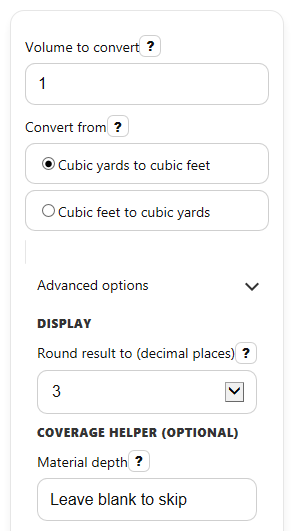
- Enter your number in Volume to convert, then choose the direction under Convert from.
- If you want a cleaner display, open Advanced options and choose Round result to (decimal places).
- If you are spreading material like mulch or soil, optionally enter Material depth and pick a Depth unit to see Area covered at this depth.
- Click Calculate to get Converted volume, the Conversion rule used, and any coverage estimate.
- Sanity-check the answer: 1 cubic yard should equal 27 cubic feet, and a deeper layer should give a smaller Area covered at this depth.
Definitions
Cubic yard (yd3): A unit of volume equal to a space 1 yard long, 1 yard wide, and 1 yard high.
Cubic foot (ft3): A unit of volume equal to a space 1 foot long, 1 foot wide, and 1 foot high.
Converted volume: The same amount of space written in the other unit.
Conversion rule used: The exact multiply-by-27 or divide-by-27 rule used for your result.
Material depth: How thick the material layer is after spreading it out.
Area covered at this depth: The estimated square footage your volume can cover at one even depth.
Decimal places: How many digits appear after the decimal point in the displayed answer.
Common mistakes and quick fixes
Mistake: Typing length or width into Volume to convert instead of a full volume.
Fix: Enter a volume only, in cubic yards or cubic feet based on Convert from .
Mistake: Choosing the wrong option in Convert from .
Fix: If your starting number is in cubic yards, use "Cubic yards to cubic feet"; if it starts in cubic feet, use "Cubic feet to cubic yards".
Mistake: Forgetting that cubic units are cubed, not just multiplied by 3 once.
Fix: Check the Conversion rule used : yards to feet means multiply by 27, and feet to yards means divide by 27.
Mistake: Entering 0 or a negative number for Material depth .
Fix: Leave Material depth blank to skip coverage, or enter a depth greater than 0.
Mistake: Entering inches in Material depth but leaving Depth unit on feet.
Fix: Match Depth unit to the number you typed so Area covered at this depth is estimated correctly.
Mistake: Treating a negative Converted volume like a normal real-world amount.
Fix: Negative math is allowed, but re-check Volume to convert because physical material volume is usually not negative.
Limitations & Key Assumptions / Boundary Conditions
- The coverage helper assumes the material is spread in one flat, even layer.
- The coverage estimate does not include settling, compaction, waste, spillage, or extra material left in a bag, truck, or wheelbarrow.
- If you enter Material depth, it must be greater than 0 or the estimate is not valid.
- Rounding changes only how the answer is shown, not the underlying conversion math.
- Negative values are allowed for math consistency, but they usually mean a data-entry mistake for real material volume.
- This tool converts volume only. It does not find volume from length, width, and height for you.
Methodology
How the converter works
The calculator uses the exact relationship that 1 yard equals 3 feet. Because volume is three-dimensional, the scale factor is cubed:
3 x 3 x 3 = 27.
ft3 = yd3 x 27
yd3 = ft3 / 27
That means converting from cubic yards to cubic feet uses multiplication by 27, and converting back uses division by 27.
Coverage helper
If you enter Material depth, the calculator first makes sure depth is in feet, then divides volume in cubic feet by depth in feet to estimate area in square feet.
depth_ft = depth_in / 12
area_ft2 = volume_ft3 / depth_ft
This output appears as Area covered at this depth. A bigger depth gives a smaller covered area because the same volume is spread thicker.
Mini example
Example 1: if Volume to convert is 2.5 and Convert from is cubic yards to cubic feet, the result is 67.5 cubic feet.
67.5 = 2.5 x 27
Example 2: if the volume is 1 cubic yard, that is 27 cubic feet. At a depth of 3 inches, convert depth to feet first: 3/12 = 0.25 feet. Then divide 27 by 0.25 to get 108 square feet of coverage.
27 ft3 = 1 yd3 x 27
0.25 ft = 3 / 12
108 ft2 = 27 / 0.25
Assumptions and limits
The calculator treats the conversion factor as exact and uses your selected rounding only for display. Coverage is only an estimate for a uniform layer, so real projects can need more material.