
Enter cubic feet to find the matching cubic yards and, if needed, round up to your supplier's order increment.
Advanced options
This is the direct conversion. It is not rounded to a supplier's order increment.
This is rounded up to the selected supplier increment. Confirm that increment with the supplier.
This added amount comes only from rounding up to the selected order increment.
Table of contents
How to use our Cubic Feet to Cubic Yards Converter
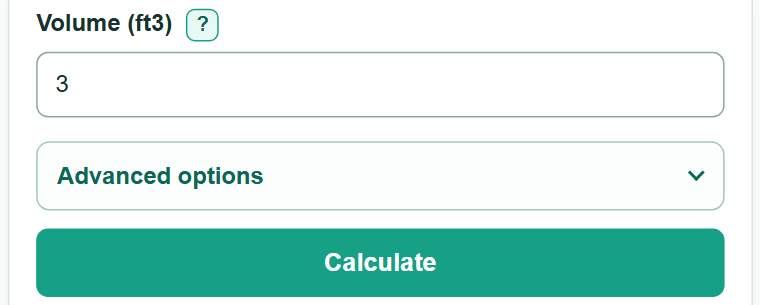
- Enter the known volume in "Volume (ft3)." You can use a plain number, a grouped number such as 27,000, or a matching suffix such as 54 cu ft.
- Click "Calculate" to see the converted volume in cubic yards.
- If you are ordering material, open "Advanced options" and select the smallest amount your supplier allows under "Round order up to."
- Use "Result decimal places" only to change displayed digits. It does not change the conversion or the rounded order amount.
- Sanity-check the answer with 27 ft3 = 1 yd3. A cubic-foot value should be divided by 27, not by 3.
Definitions
Cubic foot (ft3): A volume equal to a space 1 foot long, 1 foot wide, and 1 foot high.
Cubic yard (yd3): A volume equal to a space 1 yard long, 1 yard wide, and 1 yard high. One cubic yard equals 27 cubic feet. [1]
Supplier increment: The smallest cubic-yard amount a supplier will sell or deliver, such as 0.25 yd3, 0.5 yd3, or 1 yd3.
Round up: Increase a value to the next allowed supplier increment so the order amount is not below the needed volume.
Common mistakes and quick fixes
Mistake: Dividing by 3 because 1 yard is 3 feet long.
Fix: A cubic yard is 3 feet long, 3 feet wide, and 3 feet high, so divide cubic feet by 27.
Mistake: Entering length, width, and depth instead of a volume.
Fix: Multiply the dimensions first to find cubic feet, then enter that one value in "Volume (ft3)."
Mistake: Treating the displayed conversion as the amount a supplier will sell.
Fix: Ask the supplier for its smallest order increment, then choose it under "Round order up to."
Mistake: Rounding down before ordering material.
Fix: Use the rounded-up order amount so it is not less than the converted volume.
Mistake: Typing a malformed grouped number such as 1,01.
Fix: Use commas only as thousands separators, such as 1,000, or use a decimal point, such as 1.01.
Limitations & Key Assumptions / Boundary Conditions
- This converter needs an already known volume in cubic feet; it does not calculate volume from length, width, and depth.
- The conversion is exact: 1 yd3 equals 27 ft3. Displayed decimal places can round the visible value, but the calculation uses the unrounded value.
- The optional order amount only rounds up to the increment you choose. It does not add material for waste, settling, compaction, or a project buffer.
- Supplier minimums, increments, truck capacities, and delivery rules may differ by material and location. Confirm the final quantity with the supplier.
- Negative volumes are outside this converter's domain. Zero is valid and converts to zero cubic yards.
Methodology
Conversion method
One yard equals 3 feet. Because volume has length, width, and height, one cubic yard contains 3 x 3 x 3, or 27 cubic feet. [1]
cubic_yards = cubic_feet / 27
Order rounding
When you select a supplier increment, the calculator rounds the unrounded cubic-yard value upward to the next allowed increment. The direct conversion remains the first result.
order_cubic_yards = ceil(cubic_yards / order_increment) * order_increment
extra_cubic_yards = order_cubic_yards - cubic_yards
Worked example
For 804 ft3, divide 804 by 27 to get 29.7778 yd3. With a whole-yard supplier increment, the order amount rounds up to 30.00 yd3. The rounding adds 0.2222 yd3 above the exact converted volume.