
Convert cubic meters to cubic yards or cubic yards to cubic meters with the exact volume factor and simple rounding controls.
Advanced options
Table of contents
How to use our Cubic Meters to Cubic Yards Converter
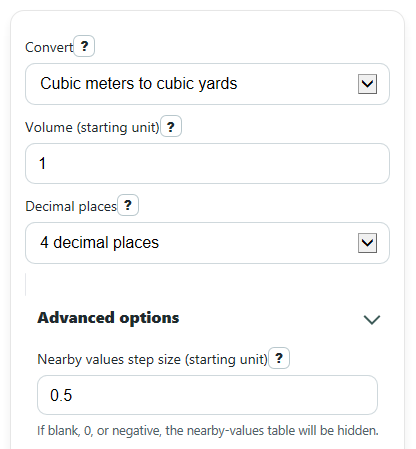
- Pick a direction in Convert so the tool knows which unit you are starting with.
- Enter your amount in Volume, then choose how many digits to show in Decimal places.
- If you want a quick reference list, enter Nearby values step size; leave it blank or use 0 to hide that table.
- Click Calculate to see Converted volume, Conversion factor used, and How the math works.
- Sanity-check the result by making sure the target unit matches your chosen direction and that the number changes by about 1.308 when converting 1 cubic meter to cubic yards, or about 0.7646 when converting 1 cubic yard to cubic meters.
Definitions
Convert: The direction of the unit change, either cubic meters to cubic yards or cubic yards to cubic meters.
Volume: How much 3D space something takes up. In this tool, it is the starting amount you enter.
Decimal places: How many digits appear after the decimal point in the displayed result.
Conversion factor used: The number multiplied or divided by your starting value to change it into the target unit.
Cubic meter (m3): A volume unit equal to a cube that is 1 meter long, 1 meter wide, and 1 meter tall.
Cubic yard (yd3): A volume unit equal to a cube that is 1 yard long, 1 yard wide, and 1 yard tall.
Nearby values step size: The gap between entries in the nearby reference table, using the same starting unit as Volume.
Common mistakes and quick fixes
Mistake: Typing a cubic-yard amount into Volume while Convert is still set to cubic meters to cubic yards.
Fix: Match Convert to your starting unit before you calculate.
Mistake: Using a length factor instead of a volume factor and expecting Converted volume to match.
Fix: Check How the math works ; cubic units use a cubed conversion factor, not a plain yard-to-meter length swap.
Mistake: Leaving Volume blank or entering text like "two".
Fix: Enter a real number in Volume , such as 1, 2.5, 0, or -3.
Mistake: Choosing too few digits in Decimal places and thinking the math is off.
Fix: Increase Decimal places to 4 or 6 when you need a closer match for hand checks or schoolwork.
Mistake: Entering 0 or a negative number in Nearby values step size and expecting the Nearby converted values table to appear.
Fix: Use a positive step size like 0.5 or 1 if you want the table shown.
Mistake: Thinking a negative Converted volume means the tool is broken.
Fix: A negative result only means the starting Volume was negative; for real physical material amounts, use a non-negative input.
Limitations & Key Assumptions / Boundary Conditions
- The calculator uses fixed conversion constants for cubic meters and cubic yards. It does not estimate loose-fill settling, compaction, moisture changes, or waste.
- Volume can be negative for math completeness, but real physical volume is usually 0 or more.
- If Nearby values step size is blank, 0, or negative, the main conversion still works but the Nearby converted values table is hidden.
- Results use exact internal factors and then round for display based on Decimal places, so hand calculations may look slightly different if rounded earlier.
- This tool converts units only. If you need material delivered in truckloads, bags, or tons, extra assumptions are required and are not included here.
Methodology
Calculation method
The converter uses exact internal volume factors. For cubic yards to cubic meters, it multiplies by 0.764554857984. For cubic meters to cubic yards, it divides by 0.764554857984, which is the same as multiplying by 1.30795061931439.
m3 = yd3 * 0.764554857984
yd3 = m3 / 0.764554857984
Why the factor is cubic
A yard-to-meter change starts with length, but volume is three-dimensional. That means the length factor must be cubed, not used once.
1 yd = 0.9144 m
1 yd3 = (0.9144 m)^3 = 0.764554857984 m3
This is why converting cubic units is different from converting plain length.
Worked example
If Convert is set to cubic meters to cubic yards and Volume is 2.5, the tool multiplies by 1.30795061931439.
yd3 = 2.5 * 1.30795061931439 = 3.269876548285975
With Decimal places set to 3, Converted volume displays as 3.270 cubic yards.
Nearby values table
If Nearby values step size is a positive number, the tool builds a short reference table around your entered value using that spacing. This helps when you want quick checks for slightly smaller or larger amounts.
Calculation choices
The tool accepts 0 as valid input. It also allows negative values for math completeness and shows a note because physical volume is usually non-negative. Rounding is applied only to the displayed outputs, not to the internal conversion step.