
Enter a rectangular space's length, width, and height or depth to find its volume in cubic feet.
Length
Width
Height or depth
Length
Width
Height or depth
Advanced options
This is the rectangular volume from the three converted measurements.
This is the same volume in cubic yards, not a material order amount.
Converted measurements used
Table of contents
How to use our Cubic Feet Calculator
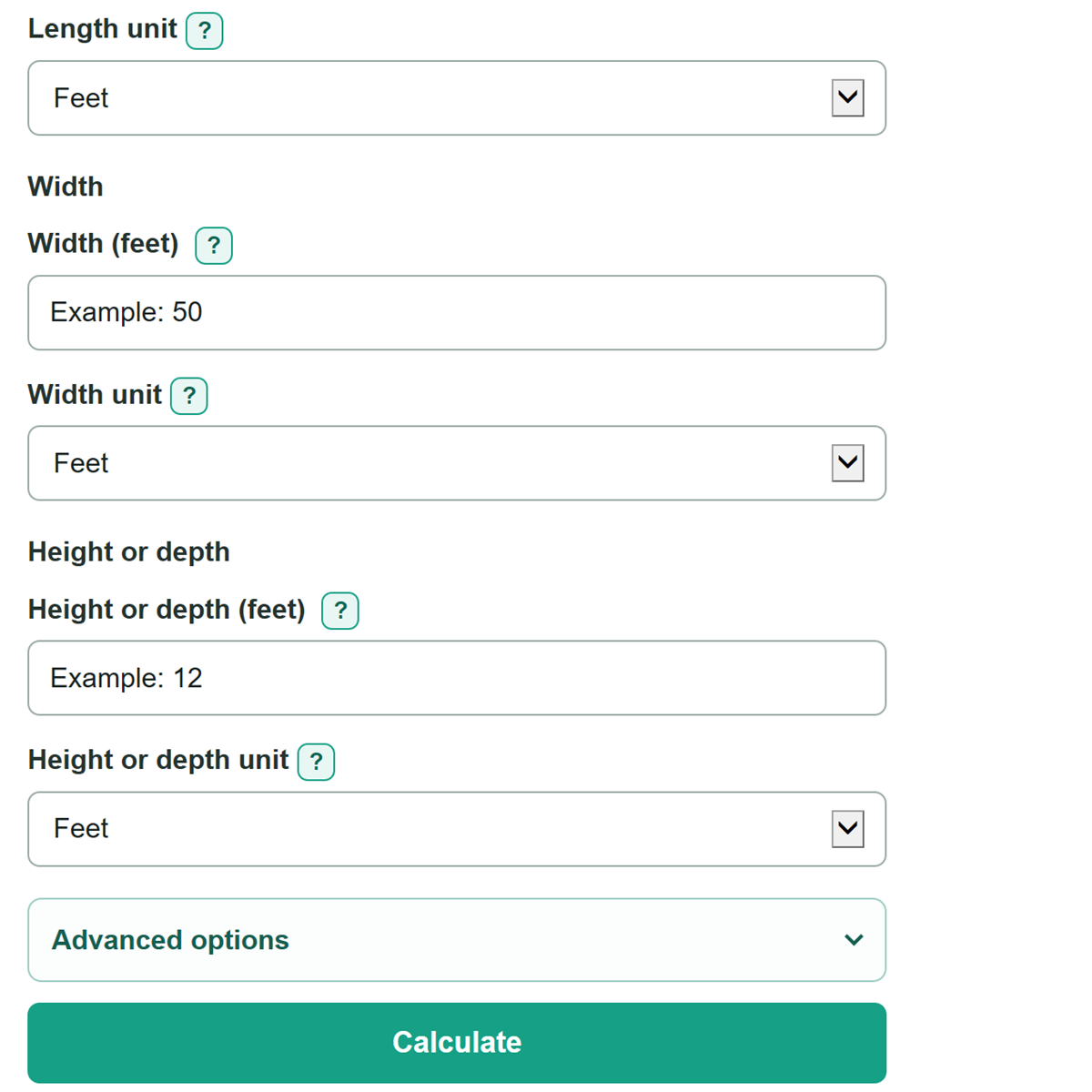
- Choose how the measurements are written. Select "Feet and inches" for tape-measure values, or select separate units when a plan or listing uses mixed units.
- Enter the length, width, and height or depth. In feet-and-inches mode, enter whole feet and the remaining inches in separate fields.
- Click Calculate to see the rectangular volume in cubic feet, followed by cubic yards, cubic inches, and cubic meters.
- Check the converted dimensions shown below the volume, especially when you entered inches, centimeters, meters, or yards. They should match the size you measured.
- For a container, appliance, or storage space, use inside measurements when you need usable capacity.
Definitions
Cubic foot (cu ft): A volume equal to a space 1 foot long, 1 foot wide, and 1 foot high.
Volume: The amount of three-dimensional space measured by length times width times height or depth.
Height or depth: The third dimension used with length and width. Use height for an upright space and depth for a pit, bed, or shallow container.
Extra inches: The inches left after the whole-foot part of a measurement. This value must be at least 0 and less than 12.
Cubic yard (cu yd): A volume equal to 27 cubic feet.
Cubic meter (m3): A metric volume unit. The calculator uses the exact relationship 1 foot = 0.3048 meter when converting to cubic meters.
Common mistakes and quick fixes
Mistake: Entering 12 or more as extra inches.
Fix: Check How are your measurements written? and then recalculate. Add the full foot to the feet field and keep extra inches from 0 to less than 12.
Mistake: Leaving both the feet and extra-inches fields blank for one dimension.
Fix: Check How are your measurements written? and then recalculate. Enter a positive length, width, and height or depth. One component may be blank only when the other is filled in.
Mistake: Treating cubic feet as square feet.
Fix: Check How are your measurements written? and then recalculate. Square feet measures a flat area. Cubic feet needs three measurements: length, width, and height or depth.
Mistake: Selecting a unit that does not match the source measurement in separate-units mode.
Fix: Check How are your measurements written? and then recalculate. Choose the unit printed on the plan, listing, or tape measure, then check the converted-dimension value.
Mistake: Using outside dimensions to estimate appliance or container capacity.
Fix: Check How are your measurements written? and then recalculate. Measure the usable inside length, width, and height or depth. Walls and internal parts take up space.
Mistake: Treating cubic yards as a material weight or bag count.
Fix: Check How are your measurements written? and then recalculate. Cubic yards measures volume only. Weight and product quantity need the material density or the supplier's stated yield.
Limitations & Key Assumptions / Boundary Conditions
- This calculation applies to rectangular spaces with straight sides and a consistent length, width, and height or depth.
- It does not calculate cylinders, round tanks, tapered containers, sloped ceilings, or other irregular shapes. Split an irregular space into suitable rectangular sections only when that matches its shape.
- The result is geometric volume, not guaranteed usable capacity. Walls, shelves, motors, rounded corners, and packing gaps can reduce usable space.
- Use inside dimensions for capacity questions. Outside dimensions answer a different question and can overstate the space available inside.
- Cubic feet alone cannot determine material weight, bag count, cost, or delivery quantity. Those require material-specific density, product yield, waste allowance, and supplier information.
- Displayed decimal places do not make a tape-measure reading more precise than the measurement entered.
Methodology
Calculation method
The calculator first converts each dimension to feet. In feet-and-inches mode, it combines the whole-foot value with the extra inches divided by 12. In separate-units mode, each dimension is converted from its selected unit before multiplication.
dimension in feet = whole feet + (extra inches / 12)
cubic feet = length in feet x width in feet x height or depth in feet
Worked example
A space measuring 10 feet long, 8 feet wide, and 2 feet 6 inches high has a height of 2.5 feet. The calculation is 10 x 8 x 2.5 = 200 cubic feet. This is about 7.4 cubic yards and 5.7 cubic meters when results are shown to one decimal place.
Unit conversions
The calculator converts the same unrounded volume to other units after finding cubic feet.
cubic yards = cubic feet / 27
cubic inches = cubic feet x 1,728
cubic meters = cubic feet x 0.028316846592
It uses 12 inches per foot and 3 feet per yard. The metric conversion uses the exact international-foot relationship of 1 foot = 0.3048 meter, making 1 cubic foot = 0.028316846592 cubic meter.