
Convert cubic feet to liters, liters to cubic feet, or box dimensions to liters with exact conversion math and simple rounding control.
Table of contents
How to use our Cubic Feet to Liters Converter
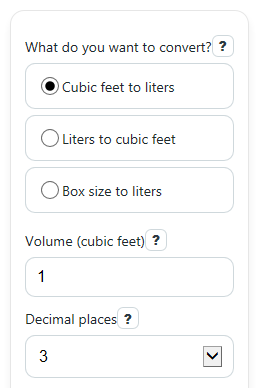
- Pick a mode in "What do you want to convert?" Choose "Cubic feet to liters," "Liters to cubic feet," or "Box size to liters."
- Enter the visible value fields only. For box mode, choose "Box measurement unit" first, then enter "Length," "Width," and "Height" in that same unit.
- Choose "Decimal places" to control rounding in the main answer, then click "Calculate."
- Read "Converted volume" first. In box mode, also check "Box volume in cubic feet" and "Box volume in cubic meters" so you can see the intermediate volume before the final liter result.
- Sanity-check the result: 1 cubic foot should be about 28.316846592 liters, and a larger box should always give a larger "Converted volume" than a smaller box entered in the same unit.
Definitions
Cubic foot (ft3): A unit of volume equal to a space that is 1 foot long, 1 foot wide, and 1 foot high.
Liter (L): A metric unit of volume. 1 liter equals 0.001 cubic meter.
Converted volume: The main answer in the target unit for the mode you picked.
Conversion factor used: The number multiplied or divided during conversion. For cubic feet to liters, the factor is 28.316846592 L per ft3.
Box volume in cubic feet: The intermediate box volume after "Length," "Width," and "Height" are converted into feet and multiplied together.
Box volume in cubic meters: The same box volume written in m3, useful as a metric cross-check.
Decimal places: How many digits appear after the decimal point in the main displayed result.
Common mistakes and quick fixes
Mistake: Typing a one-dimensional length into "Volume (cubic feet)" as if feet and cubic feet mean the same thing.
Fix: Use "Volume (cubic feet)" only for actual volume. If you only know side lengths, switch to "Box size to liters" and fill in "Length," "Width," and "Height."
Mistake: Entering inches in "Length," "Width," and "Height" while "Box measurement unit" is set to Feet.
Fix: Make sure "Box measurement unit" matches all three box measurements before you calculate.
Mistake: Filling in "Volume (liters)" while the mode is still "Cubic feet to liters."
Fix: Match the active mode to the field you want to use. In reverse mode, enter your value in "Volume (liters)."
Mistake: Using a negative number in "Volume (cubic feet)," "Volume (liters)," or any box dimension.
Fix: Enter 0 or a positive number. Physical volume cannot be negative in this tool.
Mistake: Thinking the exact factor and the rounded answer should look identical.
Fix: "Converted volume" follows your "Decimal places" choice, while "Conversion factor used" shows the factor for checking the math.
Limitations & Key Assumptions / Boundary Conditions
- The calculator uses the exact factor 28.316846592 liters per cubic foot. Your displayed answer may look slightly different from other sites if they round the factor to 28.32.
- Only the visible inputs for the active mode are used. Values in hidden fields are ignored on purpose.
- Negative values are rejected because this tool is for physical volume and box size, not signed engineering deltas.
- In box mode, all three dimensions must use the same "Box measurement unit" selected in the form.
- If any box dimension is 0, the box volume is 0. That is mathematically valid, but it means one side has no size.
- Rounding changes only the displayed result, not the internal conversion math used before formatting.
- This tool assumes a simple rectangular box in box mode. It does not handle cylinders, irregular containers, wall thickness, or usable fill limits.
Methodology
How the conversion is calculated
The calculator uses the exact relation between feet, meters, cubic meters, and liters. One foot is 0.3048 meters exactly, and one liter is 0.001 cubic meter. From that, 1 cubic foot equals 28.316846592 liters.
L = ft3 x 28.316846592
ft3 = L / 28.316846592
Box mode
For "Box size to liters," the calculator first converts each dimension to feet, then multiplies length x width x height to get cubic feet. After that, it converts cubic feet to liters. It also shows cubic meters as a metric check.
ft = in / 12
ft = cm / 30.48
ft = m / 0.3048
box ft3 = length_ft x width_ft x height_ft
m3 = L / 1000
L = m3 x 1000
Mini example
If a box measures 24 in x 18 in x 12 in, convert each side to feet:
24 in = 2 ft, 18 in = 1.5 ft, and 12 in = 1 ft. Then multiply 2 x 1.5 x 1 = 3 ft3. Finally, convert to liters:
3 x 28.316846592 = 84.950539776 L, which shows as 84.951 L when rounded to 3 decimal places.
Calculation choices
The calculator strips commas and spaces before reading numbers, rejects blank active inputs, rejects non-numeric text, allows zero, and rejects negative values. Only fields shown for the selected mode are used in the math.
Assumptions that affect results
Results assume a rectangular box in box mode and exact unit conversions. Real storage, shipping, or tank capacity can differ if inside dimensions, wall thickness, packaging clearance, or fill level are not the same as the outside measurements you entered.