
Convert cubic centimeters, cc, and liters both ways, with an mL check to help catch decimal-place mistakes.
Table of contents
How to use our Cubic Centimeters to Liters Converter
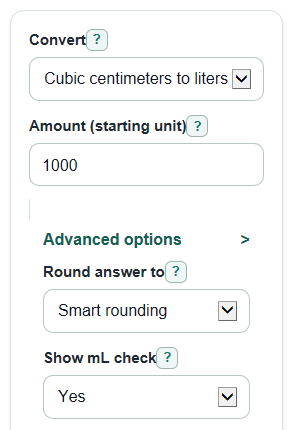
- Choose the starting direction in Convert: cubic centimeters to liters or liters to cubic centimeters.
- Type the value you have in Amount (starting unit); commas and spaces are okay.
- Open advanced options if you want to change Round answer to or turn Show mL check on or off.
- Click Calculate, then read Converted volume first and use mL check to confirm the cm^3 number matches the mL number.
- Sanity-check the size: converting cm^3 to L should make the number 1000 times smaller, while converting L to cm^3 should make it 1000 times larger.
Definitions
Cubic centimeter (cm^3): A metric volume equal to a cube that is 1 centimeter on each side.
cc: A common short way to say cubic centimeter. It is often seen with engine size or medical volumes, but cm^3 is the clearer unit symbol.
Liter (L): A metric volume unit. The capital L is used because a lowercase l can look like the number 1.
Milliliter (mL): One thousandth of a liter. One milliliter is the same volume as one cubic centimeter.
Smart rounding: A display choice that trims unneeded zeros while keeping small nonzero answers readable.
Common mistakes and quick fixes
Mistake: Choosing the wrong direction in Convert and getting an answer that is 1,000,000 times off.
Fix: If your starting number is in cm^3 or cc, choose cubic centimeters to liters; if it is in L, choose liters to cubic centimeters.
Mistake: Entering the target-unit number in Amount (starting unit) instead of the number you are starting with.
Fix: Put the original measured volume in Amount (starting unit) , then let Converted volume show the answer.
Mistake: Reading mL check as a second conversion to liters.
Fix: Use mL check only as a check: 1 cm^3 equals 1 mL, so the mL value should match the cm^3 value.
Mistake: Setting Round answer to to 0 decimal places for a small cm^3 value and hiding a tiny liter result.
Fix: Use smart rounding or more decimal places when the Converted volume is less than 1 L.
Mistake: Ignoring Conversion rule used when the answer looks surprising.
Fix: Check Conversion rule used : cm^3 to L divides by 1000, and L to cm^3 multiplies by 1000.
Limitations & Key Assumptions / Boundary Conditions
- This converter uses exact metric volume relationships: 1000 cm^3 = 1 L and 1 cm^3 = 1 mL.
- Negative volumes are blocked because a physical volume in cm^3, L, or mL cannot be negative in this use case.
- Rounding changes only the displayed Converted volume, not the underlying conversion rule.
- Very large or very small inputs may be rounded for display, so use more decimal places when a school or lab answer needs a fixed format.
- The tool converts volume only. It does not convert mass, weight, density, teaspoons, cups, gallons, or engine power.
Methodology
Conversion rule
The converter uses the metric relationship that 1 L equals 1000 cm^3, so 1 cm^3 equals 0.001 L. The same size volume is also 1 mL per 1 cm^3 [1].
liters = cubic_centimeters / 1000
cubic_centimeters = liters * 1000
milliliters = cubic_centimeters = liters * 1000
Rounding
If Round answer to is set to a fixed number, the main answer is rounded to that many decimal places. If smart rounding is selected, trailing zeros are removed and very small positive answers keep enough digits to avoid showing 0 unless the true converted value is 0.
Worked example
For 2500 cm^3, the calculator divides by 1000.
liters = 2500 / 1000 = 2.5 L
The mL check is 2500 mL because 2500 cm^3 has the same numeric value in mL. For the reverse direction, 3.785 L multiplied by 1000 gives 3785 cm^3 and 3785 mL.